SEDE VACANTE 1823
(August 20, 1823—September 28, 1823)
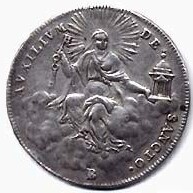 |
AG scudo AVXILIVM | DE | SANCTO Veiled female figure, seated on clouds, holding keys in r. hand, and a church in l. |
 |
SEDE VACANTE | MDCCCXXIII Arms of Bartolommeo Card. Pacca, Camerlengo of the Holy Roman Church (1814-1824), upon the cross of the Knights of St. John of Jerusalem, surmounted by the Ombrellone, crossed keys, and the Cardinal's Hat with six tassels on each side. The Holy Spirit above. Berman, p. 206 #1247. |
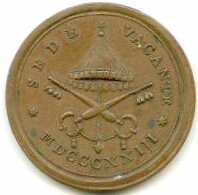 |
AE |
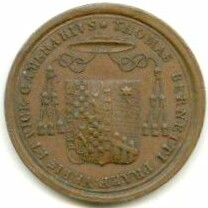 |
THOMAS BERNETTI PRAEF VRBIS ET VICE CAMERARIVS |
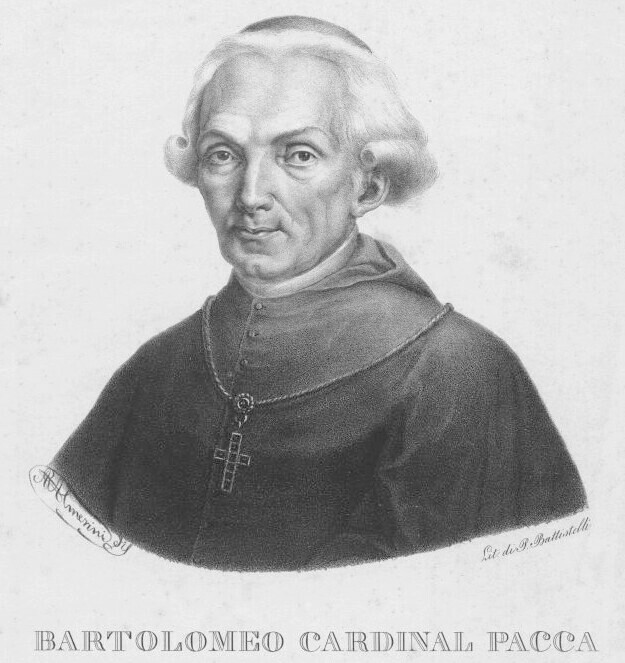
Born in 1756 at Benevento, Bartolommeo Pacca was the son of Orazio Pacca, Marchese of Matrice, and Crispina Malaspina. He was educated in Naples and at Rome, and attended the Academy for Noble Ecclesiastics. From an early age he was a member of the Knights of St. John of Jerusalem, as was his uncle, Pietro Paolo Pacca. He entered the papal diplomatic service and was appointed Nuncio to Cologne in 1785; to carry out that function he was named titular Archbishop of Damiata. At the time of his appointment Germany was in the throes of the Enlightenment, and Catholics in particular were in revolt against the autocratic, authoritarian and centralist policies of the Papacy. The three spiritual electors of the Holy Roman Empire (the Archbishops of Cologne, Trier and Mainz) were all touched by Febronianism and deeply hostile to the appearance in their territories of an outside authority. Pacca's difficult mission became an impossible one when the new French Republic invaded the Rheinland; he was consequently transferred to Lisbon (March 21, 1794—1801), but there too the government was not favorable to papal interests. Pacca was created Cardinal priest of San Silvestro on February 23, 1801. In 1808 French troops occupied Rome, and the Pope's secretary of state, Ercole Cardinal Consalvi, and his assistants were dismissed; Pacca was appointed pro-Secretary in their places. When Pius VII was arrested in July, 1809 and deported to France, Pacca attempted to accompany him, but he was sent to Fenestrelle where he was confined and closely guarded. When the Pope was forced into signing the Concordat of Fontainbleau (January 25, 1813), Pacca and other cardinals were allowed to join the Pope, but when they proved unaccommodating Napoleon rearrested the Pope and reimprisoned the cardinals. The Emperor himself declared, "Pacca is my enemy." With the fall of Napoleon, the Pope and his court returned to Rome, where Pacca was immediately named Camerlengo (1814-1824), and, in the absence of Cardinal Consalvi at the Congress of Vienna, he again served as pro-Secretary of State. He became Cardinal Bishop of Frascati in 1818, then Bishop of Porto and Santa Rufina in 1821, and finally Bishop of Ostia in 1830. He died in Rome on April 19, 1844. [His medal: Spink, 2093.]
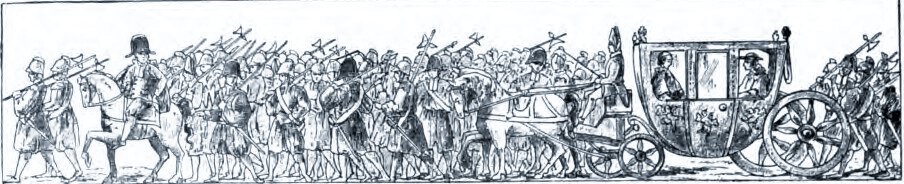
Cortege of the Camerlengo, Cardinal Pacca, in the streets of Rome. 1823.
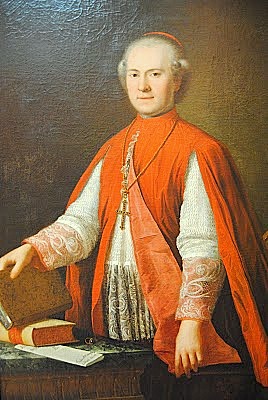
The Dean of the College of Cardinals was Giulio Maria Cardinal della Somaglia. (1744-1830) [portrait at right]. Son of Carlo, Baron della Somaglia of Piacenza and Milan. He was educated in Rome and took his degree at La Sapienza in utroque iure. Pope Clement XIV made him a Papal Chamberlain in 1769. He was created Cardinal Priest of Santa Sabina in 1795 (portrait at right). In 1798 he was arrested and deported by the French authorities. He participated in the Conclave at Venice in 1799-1800, and the new pope, Pius VII, named him Vicar of Rome in 1800. In March of 1808 he was again expelled from Rome by the French. He was summoned to Paris by Napoleon, only to be sent to live at Charleville under close confinement, and then to Mézières—as one of the Black Cardinals. When the Pope was induced to sign the Treaty of Fontainebleau in 1813, Somaglia was brought back to join the Pope, but soon sent into exile again when the Pope repudiated the Treaty. After the fall of Napoleon he returned with the Pope to Rome, where he was named the Grand Inquisitor, a post he occupied until his death. (Grandmaison, 228-229)
The Secretary of the Sacred College of Cardinals was Msgr. Rafael Mazio, canon of the Vatican Basilica, Secretary of Latin Letters, Corrector of the Apostolic Penitentiary. In 1822, as a longtime assistant of Cardinal Consalvi, he was a member of the legation of Cardinal Giuseppe Spina, Bishop of Palestrina, to the Congresses of Laibach and Verona. In 1824, he became Assessor of the Holy Inquisition and a Protonotary Apostolic. He was created Cardinal Priest of S. Maria in Trastevere by Pius VIII in March, 1830. He died on February 4, 1832.
The Treasurer General of the Holy Roman Church (Minister of Finance) was Msgr. Belisario Cristaldi, who was also a leading figure among the Zelanti. (Artaud de Montor, 25-26). He was the only son of the Roman Ascanio Cristaldi, Baron of Noba. Belisario was a lawyer by trade, and was involved in the government of Rome under the Neapolitan occupation. He was expelled from Rome during the French occupation in 1809. He worked with Cardinal Consalvi to restore papal government after the fall of Napoleon. In 1820 he became Treasurer General of the Apostolic Chamber. He was named Cardinal in pectore in 1826, and proclaimed publicly as Cardinal Deacon of Santa Maria in Portico in 1828. In 1829 he was finally ordained at the age of 65. He died in 1831.
Prince Agostino Chigi (d. 1855) was the Marshal of the Holy Roman Church during the Interregnum of 1823, as he was during those of 1830 and 1831. The Prince's diary for the years 1830-1855, Il tempo di Papa-Re, survives.
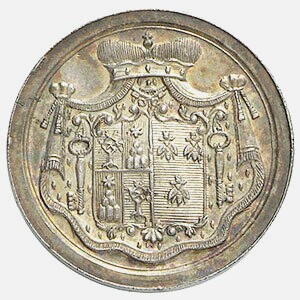 |
AE |
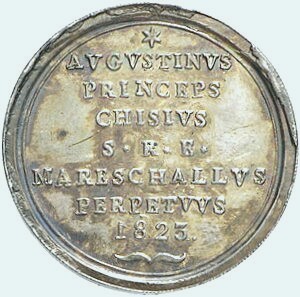 |
AVGVSTINVS | PRINCEPS | CHISIVS | S•R•E• | MARESCHALLVS | PERPETVVS | 1823
|
The Governor of the Conclave was Msgr. Tommaso Bernetti (1779-1852). He was born in Fermo, son of Count Salvatore Bernetti, and nephew of Cardinal Cesare Bracandoro. He prepared for the law, but the imprisonment of Pius VII in 1809 led to his deportation along with his uncle the Cardinal to France. He returned to Rome in 1814 along with his uncle, having been the principal manager of the process of the restoration of Pius VII to his domains. He was named a Domestic Prelate. From 1820 to 1826 he was Governor of Rome and Vice-Chamberlain of the Holy Roman Church. He was sent to represent the Pope at the coronation of the Russian Czar Nicholas I in 1826, but, though he was received twice by the Czar, he was not present for the grand event. On his way home from St. Petersburg, he visited Paris, where he was received by King Charles X and attempted to negotiate compensation for the seizure of Avignon. His efforts were unsuccessful. He was named a Cardinal Deacon in 1826 while still in Paris. He was named Papal Legate in Ferrara, though he remained in Rome to become (for a few months) Secretary of State. In the conclave of 1830-1831, Bernetti was the leading supporter of Cardinal Cappellari, who, as Gregory XVI, made him first pro-Secretary, and then, in a few months, Secretary of State a second time (1831 to 1836). It was Bernetti who received the Memorandum (May 21, 1831) drawn up by five European governments, England, France, Austria, Prussia and Russia (Johnston, Theocracy 341-343), demanding reforms in the Papal States:
...the States of the Church had need of ameliorations, to be founded on a more solid basis; that these ameliorations, which should become the foundation of a new era, ought, by an interior guarantee, to be protected from the changes inherent in the nature of all elective government. The principal guarantee was the general admissibility of the laity to the administrative and judicial functions, the judicial reform promised by Cardinal Consalvi in 1816; local administration, by the general organization of the municipalities elected by the population, and the foundation of municipal franchises; the organization of provincial councils destined to assist the governor of the province in the execution of his functions, and which should be consulted upon the interests of the province; these councils should finally conduce to the amelioration and simplification of the provincial administration, control the municipality, assess the taxes, and enlighten the government on the necessities of the province; a central establishment, charged, like a Supreme Court of account, with the control of the financial service of every branch of the administration, with large and independent powers, in order to answer the general expectation. This jury, or administrative-consultum, should have the stamp of stability, should be chosen by the municipal councils from among the notabilities of the country, and form a part of the council of State, nominated by the Sovereign.
To counter the reformers, Bernetti established a secret terrorist group called the Centurioni [ "Un citoyen romain", Les mystères du clergé romain (Lausanne 1852), pp. 20-23]. He was forced to resign (pressure being applied by Prince Metternich and the Austrian autocratic interest) during the political crisis in the middle of the reign of Gregory XVI. The offical reason for his resignation was 'reasons of health' (gout), as Gregory XVI noted in his letter accepting the resignation (Elogio funebre 23, 42-43). The Papal States were under occupation by Austrian troops. and he was replaced by his nemesis, the even more conservative Luigi Cardinal Lambruschini. Bernetti was finally ordained by his brother Alessandro in 1839. He participated in the Conclaves of 1829, 1830-1831, and 1846. In 1848 he fled from Rome with Pius IX and never returned, spending his retirement in his home town.
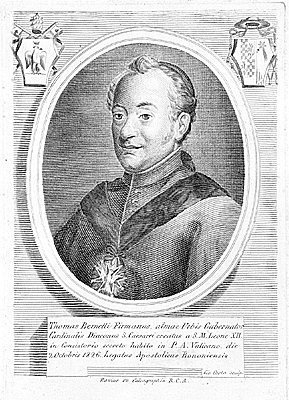
Cardinal Bernetti
The Ceremoniere who participated in the Conclave of 1823 were:
Dominicus Zucche, apostolicis caeremoniis praefectus.
Johannes Fornici, canon of S. Eustachio, Secretary of the SC Caeremonialis
Alexander Lazzarini, canon of S. Maria Transtiberim
Felix Maria Renazzi, canon of S. Eustachio
Matthias Pieri, Basilicae Lateranensis clericus beneficiatus
Joannes Baptista Adami, Basilicae Lateranensis clericus beneficiatus.
Death of the Pope
Pius VII died on August 20, 1823 at the Quirinal Palace.. He had suffered a serious fall on July 6 (Moroni, 53, 169-170), injuries from which eventually proved fatal. It was widely and quickly known that the pope was dying, and most of the cardinals and other officials were already in Rome by the time he expired. On the 20th of August, at a meeting of the General Congregation of Cardinals, it was decided to hold the conclave at the Quirinale Palace (Cancellieri, pp 70-71, who also gives the details of the distribution of quarters, pp. 95-102).
The Cardinals
On September 2, the Cardinals entered conclave; voting began on September 3, with forty-nine cardinals participating. All of the cardinals, with two exceptions (Somaglia and Ruffo) were creations of Pope Pius VII (1800-1823). A complete list is provided in Leo XII's motu proprio of November 17, 1823, granting privileges and favors to the dapiferi of the cardinals [R. Segreti (editor) Bullarii Romani continuatio Tomus decimus sextus (Romae 1854), pp. 4-6], and the motu proprio Nos Volentes of the same date, granting privileges and favors to the Conclavists of the Cardinals [pp. 9-11] . A second list, not nearly as authoritative, can be found in Berthelet (pp. 24-25).
- Giulio Maria della Somaglia (aged 79), Suburbicarian Bishop of Ostia – Velletri (died 1830) , Dean of the Sacred College of Cardinals (died April 2, 1830). Vice-Chancellor of the Holy Roman Church
- Bartolomeo Pacca, Suburbicarian Bishop of Porto e Santa Rufina (died April 19, 1844). Cardinal Camerlengo.
- Giuseppe Spina (aged 67), Suburbicarian Bishop of Palestrina (died November 13, 1828). .
- Pierfrancesco Galleffi (53), Suburbicarian Bishop of Albano (died June 18, 1837). Archpriest of the Vatican Basilica.
- Tommaso Arezzo (aged 66), Suburbicarian Bishop of Sabina (died February 3, 1833).
- Francesco Saverio Castiglioni (61), Bishop of Frascati [Tusculum].(died November 30, 1830)
- Giuseppe Firrao (aged 87), Cardinal Priest of S. Eusebio (died January 24, 1830) .
- Luigi Ruffo Scilla (aged 73), Cardinal Priest of S. Martino ai Monti (died November 17, 1832) Archbishop of Naples.
- Cesare Brancadoro (aged 68), Cardinal Priest of S. Girolamo dei Croati (died September 12, 1837). Archbishop of Fermo.
- Carlo Francesco Caselli (aged 72), Cardinal Priest of S. Marcello (died April 20, 1828). Archbishop-Bishop of Parma.
- Joseph Fesch (aged 60), Cardinal Priest of S. Lorenzo in Lucina and S. Maria della Vittoria (died May 13, 1839) Archbishop of Lyon.
- Carlo Oppizzoni (aged 54), Cardinal Priest of S. Bernardo alle Terme (died April 13, 1855). Archbishop of Bologna.
- Annibale della Genga Sermattei (aged 63), Cardinal Priest of S. Maria in Trastevere (died February 10, 1829). Vicar-General of Rome.
- Pietro Gravina (aged 73), Cardinal Priest of S. Lorenzo in Panisperna (died December 6, 1830). Archbishop of Palermo.
- Antonio Gabriele Severoli (aged 66), Cardinal Priest of S. Maria della Pace (died September 8, 1824). Archbishop-Bishop of VIterbo
- Giuseppe Morozzo (aged 65), Cardinal Priest of S. Maria degli Angeli (died March 22, 1842). Archbishop of Novara.
- Fabrizio Sceberras Testaferrata (aged 66), Cardinal Priest of S. Pudenziana (died August 3, 1843). Bishop of Senigaglia.
- Benedetto Naro (aged 79), Cardinal Priest of S. Clemente (died October 6, 1832)
- Francesco Cesarei Leoni (aged 66), Cardinal Priest of S. Maria del Popolo (died Jluy 25, 1830). Bishop of Jesi.
- Dionisio Bardaxí y Azara (aged 62), Cardinal Priest of S. Agnese fuori le mura (died December 3, 1826).
- Antonio Rusconi (aged 80), Cardinal Priest of Ss. Giovanni e Paolo (died August 1, 1825). Bishop of Imola.
- Emmanuele De Gregorio (aged 64), Cardinal Priest of Ss. Bonifacio ed Alessio (died November 7, 1839). Natural son of King Charles III of Naples (and VI of Spain).
- Giorgio Doria Pamphilj (aged 50), Cardinal Priest of S. Cecilia (died November 16, 1837).
- Luigi Ercolani (aged 64), Cardinal Priest of S. Marco (December 10, 1825).
- Paolo Giuseppe Solaro (80), Cardinal Priest of S. Pietro in Vincoli (died September 9, 1824). Bishop of Aosta.
- Casimir von Häffelin (aged 86), Cardinal Priest of S. Anastasia (died August 27, 1827)
- Anne-Antoine-Jules de Clermont-Tonnerre (aged 74), Cardinal Priest without titulus (died February 21, 1830). Archbishop of Toulouse
- Francesco Bertazzoli (aged 69), Cardinal Priest without titulus (died April 7, 1830).
- Gianfrancesco Falzacappa (56), Cardinal Priest of Ss. Nereo ed Achilleo (died November 18, 1840). Archbishop-Bishop of Ancona
- Antonio Pallotta (aged 53), Cardinal Priest of S. Silvestro in Capite (died July 19, 1834).
- Francesco Serlupi (aged 67), Cardinal Priest of S. Prassede (died February 6, 1828).
- Carlo Maria Pedicini (53), Cardinal Priest of S. Maria in Via (died November 19, 1843).
- Luigi Pandolfi (aged 72), Cardinal Priest of S. Sabina (died February 2, 1824).
- Fabrizio Turriozzi (67), Cardinal Priest of S. Maria in Ara Coeli (died November 9, 1826).
- Ercole Dandini (64), Cardinal Priest of S. Balbina (died July 22, 1840). Bishop of Osimo e Cingoli.
- Carlo Odescalchi (37), Cardinal Priest of Ss. XII Apostoli (died August 17, 1841). Archbishop of Ferrara.
- Placido Zurla (aged 54), Cardinal Priest without titulus (died October 29, 1834).
- Anne-Louis-Henri de La Fare (aged 71), Cardinal Priest without titulus (died December 10, 1829). Archbishop of Sens
- Fabrizio Dionigi Ruffo (aged 79), Cardiinal Deacon of S. Maria in Via Lata (died December 13, 1827). Cardinal Protodeacon..
- Ercole Consalvi (aged 66), Cardinal Deacon of S. Maria ad Martyres. Secretary of State. Librarian of the Vatican Library. He died on January 24, 1824, and was buried in S. Marcello [V. Forcella, Inscrizioni delle chiese di Roma II, p. 324, no. 1003]. His bust and memorial are in S. Maria Rotonda (Pantheon).
- Giuseppe Albani (aged 73), Cardinal Deacon of S. Maria in Via Lata (died December 3, 1834).
- Francesco Guidobono Cavalchini (aged 67), Cardinal Deacon of S. Maria in Aquiro (died December 5, 1828).
- Giovanni Caccia-Piatti (aged 72), Cardinal Deacon of SS. Cosma e Damiano (died September 15, 1833).
- Stanislao Sanseverino (aged 59), Cardinal-Deacon of S. Maria in Portico (died May 11, 1826),
- Pietro Vidoni (aged 64) Cardinal Deacon of S. Nicola in Carcere (died August 10, 1830),
- Agostino Rivarola (aged 64), Cardinal Deacon of S. Agata alla Suburra (died November 7, 1842).
- Cesare Guerrieri Gonzaga (aged 74), Cardinal Deacon of S. Adriano al Foro (died February 5, 1832).
- Antonio Maria Frosini (aged 72), Cardinal Deacon of S. Maria in Cosmedin (died July 8, 1834).
- Tommaso Riario Sforza (aged 41), Cardinal-Deacon of S. Giorgio in Velabro (died March 14, 1857).
- Domenico Spinucci, Archbishop of Benevento (aged 84), Cardinal Priest of S. Callisto (died December 21, 1823). Archbishop of Benevento.
- Louis-François de Bausset-Roquefort (aged 74), Cardinal Priest without titulus (died June 21, 1824)..
- Rudolf Johannes Joseph Rainier von Habsburg (aged 35), Cardinal Priest of S. Pietro in Montorio (died July 24, 1831). Archduke of Austria, Royal Prince of Hungary and Bohemia, Archbishop of Olmütz. Brother of the Emperor.
- Carlos da Cunha Meneses (aged 64), Cardinal Priest without titulus (died December 14, 1825). Patriarch of Lisbon
The Political Situation
The Conclave of 1823 was in effect an attempt on the part of the cardinals to come to grips with the implications of the French Revolution, the Napoleonic republics created in Italy, and Italian aspirations toward self-government and unity. Cardinal Consalvi had been working toward accommodations with the new European political situation through a series of treaties with various states, and toward a more humane and rational administrative system for the Papal States. But his policies of dealing with non-Catholic states and making concessions unfavorable to Catholic supremacy in religious matters offended many sincere Catholics; and his efforts toward introducing more non-clerics into the papal administration and allowing more local self-government in the Papal States were repugnant to the absolutists. Ultimately, the election became a referendum on the continuation or abandonment of Consalvi's policies.
Candidates
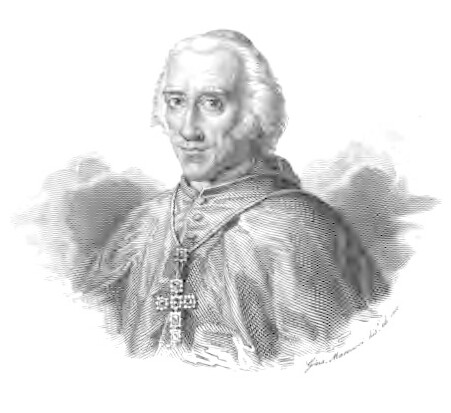 The candidate of the French and the Sardinians (Turin) was Francesco Cardinal Castiglioni, the Grand Penitentiary. Antonio Cardinal Severoli, Bishop of Viterbo, was the candidate of the Zelanti. King Ferdinand wrote to his agent in the conclave, Fabrizio Cardinal Ruffo, that, even though Naples did not enjoy the formal right of veto (exclusiva), the cardinal should attempt to form a group which could impose a veto tacita. To accomplish this, he was instructed to work closely with the Imperial Court in Vienna and its agent in the conclave (Bianchi, 379-381; Cipolletta, 135-140). The Count Luigi de Medici, Minister of Foreign Affairs at Naples, wrote to Ambassador Fuscaldo in Rome (August 18, 1823) that Naples favored the election of Consalvi, Arezzo, and Turiozzi, while disapproving of the election of De Gregorio (right), Oppizoni, Della Genga, Severoli and Rivarolo (Bianchi, 382). From the first days, Antonio Cardinal Severoli, the former papal Nuncio in Vienna, stood as opposition to Cardinal Consalvi, but he was in his turn opposed by the Austrians, even though he had once been Nuncio in Vienna and was well liked there, because of his distaste for Metternich's interventionist policies in Italian affairs.
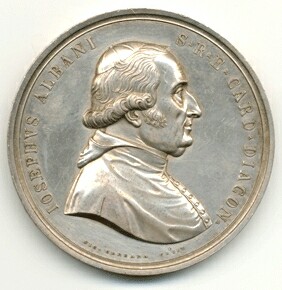 On September 14, the Duc de Laval-Montmorency, the French ambassador estraordinary, presented to the assembled cardinals his credentials and a letter from Louis XVIII, countersigned by Chateaubriand, expressing the French grief at the death of Pius VII (Montor, 29-30). On September 16, Count Apponyi, the Austrian Ambassador was admitted to present an address to the Cardinals. In it he declared that Giuseppe Cardinal Albani ( medallic portrait at left ) would represent the views of the Austrian Court inside the Conclave. In order to carry out this mission, Cardinal Albani, who up to the death of Pius VII had relied on a dispensation so as not to enter holy orders, was compelled to have himself ordained Sub-deacon, thus qualifying him to vote (Bianchi, 389; Cartwright, 125-126). In his Memoirs, Prince Metternich quotes a letter (April 6, 1829) which he himself wrote to Count Tatischeff, recalling that during this conclave Cardinal Consalvi had favored Francesco Cardinal Castiglioni:
"After the death of Pius VII., Consalvi wished to elevate [Castiglione] to the Pontificate, and he was not elected because he declared he would have no other Secretary of State than the same Cardinal. The Zelanti carried it against the moderate party."
On the first scrutiny, on September 3, Cardinal Severoli received 8 votes; Cardinal Castiglioni received 5; Cardjnal Pacca, the Camerlengo, received 2; and Cardinal Consalvi 1 (Nielsen, 3) Other votes were very widely scattered.
Marchese Fuscaldo, the Neapolitan Ambassador in Rome, reported the following details to the Minister of Foreign Affairs, Luigi de Medici (Bianchi, 382-383):
| Morning | Afternoon |
|---|---|
| Somaglia............15 Severoli.............. 18 Galeffi................. 4 De Gregorio....... 7 |
Somaglia........... 15 Severoli.............. 19 Castiglioni.......... 20 |
| Morning | Afternoon |
|---|---|
| Somaglia............16 Severoli.............. 16 Castiglioni........... 9 Della Genga ....... 7 |
Somaglia........... 16 Severoli.............. 18 Castiglioni.......... 10 Di Gregorio......... 4 |
| Morning | Afternoon |
|---|---|
| Somaglia............16 Severoli.............. 20 Castiglioni.......... 9 Della Genga....... 4 |
Somaglia........... 16 Severoli.............. 20 Castiglioni.......... 10 De Gregorio....... 2 |
Veto
On the 17th, Severoli had 20 votes; Cardinal Somaglia, Dean of the College of Cardinals, 16; Castiglioni, 9; and Annibale Cardinal Della Genga, the Vicar-General of Rome, 4. On September 21, Cardinal Severoli managed to obtain 26 votes in the morning scrutiny, only seven short of election. It was likely that the next ballot would be decisive. An emergency meeting was held by Cardinal Albani with representatives of France and Naples, Cardinals Ruffo, Solaro, and Haefflin, and the decision was taken to stop Severoli. At that point Giuseppe Cardinal Albani, on behalf of the Austrian Court, interposed the Veto (exclusiva) against Cardinal Severoli. In a letter to the Dean of the Sacred College, Cardinal Albani wrote (Bianchi, 388-389; Goddes de Liancourt and Manning, 96-97; Italian text in Berthelet, p. 21-22):
In my quality of Ambassador extraordinary of Austria at the Sacred College assembled in conclave, which quality has been notified to your Eminences and brought to your knowledge, as well by means of the letter addressed to you by His Majesty the Emperor and King, as by the declaration made to your Eminences by the Imperial and Royal Ambassador of Austria, and, further, in virtue of the instructions which I have received, I fulfill the unpleasing duty of declaring that the Imperial and Royal Court of Vienna will not accept for Sovereign Pontiff His Eminence the Cardinal Severoli and gives him a formal exclusion this 21st day of September, 1823.
Not only did this doom Severoli's chances, but it produced a backlash against Cardinal Castiglioni as well. (Nielsen, 4).
The next day the French ambassador, the Duc de Laval, conveyed in a letter to the French cardinals his master's desire for a moderate Italian, and intimated that Consalvi was not acceptable. He was likewise opposed to any of the candidates of the 'zelanti', Cardinals di Gregorio, Bertazzoli, and Cavalchini, and indicated that the French Court would not like the candidacy of della Genga. This was thoroughly confusing, as the custom allowed only one veto by a Power in a conclave. Severoli's group, for their part, asked their excluded candidate to recommend an alternate candidate for them, and he suggested della Genga. Consalvi's friends were prepared to stand by Cardinal Castiglioni (Lector, 485-491)
Election
But the "crowns" were ultimately unsuccessful. The extreme conservatives ('zelanti') finally won the day, on September 28, securing just enough votes (thirty-four) to elect Annibale Cardinal Sermattei della Genga (who, ironically, had been Cardinal Pacca's successor at Cologne). On October 5, the pope was crowned in the loggia of St. Peter's by Fabrice Cardinal Ruffo, the Cardinal Proto-deacon. As Pope Leo XII, della Genga immediately replaced Consalvi as Secretary of State. For his efforts in preventing the election of Severoli, Cardinal Albani was presented with the Grand Cross of the Order of St. Stephen by the Imperial government.
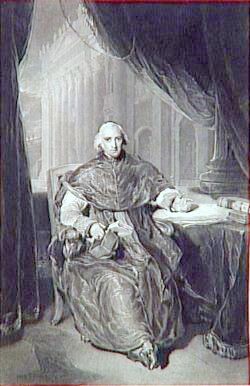
Ercole Cardinal Consalvi
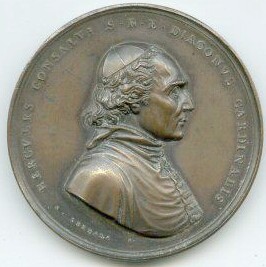 |
AE HERCULES CONSALVI S • R • E • DIACONVS CARDINALIS G • CERBARA Bust of Ercole Cardinal Consalvi, r., wearing zucchetto and mozzetta. |
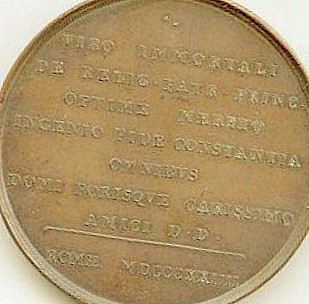 |
Inscription: VIRO IMMORTALI | DE RELIG(ione)•PATR• PRINC | OPTIME MERITO | INGENIO FIDE CONSTANTIA | DOMI FORISQVE CARISSIMO | AMICI D(ono)•D(ederunt)• | ROMÆ MDCCCXXIIII |
Bibliography
On the hostile reaction of the Roman people to Leo XII at his death, see: David Silvagni, La corte e la società di Roma nel secolo XVIII e XIX Volume III (Roma 1885), 122-125; 133-137.
A complete list of the cardinals and their conclavists is given in a schedule attached to the grant of privileges to the conclavists from Leo XII on November 23, 1823: Bullarii Romani continuatio. . . opera et studio Rainaldi Segreti, I. C. Tomus Decimus Sextus, continens Pontificatus Leonis XII (Romae 1851), 4-6; 9-11.
For the Conclave of 1823, see: Chevalier Alexis François Artaud de Montor, Histoire du Pape Léon XII (Paris 1843), I, pp. 26-84 (with a fold-out chart of the various votes during the Conclave). G. Moroni, Dizionario di erudizione storico-ecclesiastica Vol. 38 (Venezia 1846), 51-53. Count C. A. de Goddes de Liancourt and James A. Manning, Pius the Ninth (London 1847). Also, Francesco Cancellieri, Notizie historiche delle stagioni e de' siti in cui sono stati tenuti i conclavi nella città di Roma... (Roma 1823). Nicomede Bianchi, Storia documentata della diplomazia Europea in Italia Volume II (Torino 1865) 180-190; 379-389; 422-429. [G. M.], Giornale della sede vacante e ceremoniale dell' incornazione dell' eletto papa: con notizie del Pio VII (Roma 1823).
Geoffroy de Grandmaison, Napoléon et les Cardinaux noirs (1810-1814) (Paris 1895), especially 217-231. F. Petruccelli della Gattina, Rome and the Papacy (Philadelphia 1872) 53-57. Fredrik Nielsen, The History of the Papacy in the XIX Century (translated by A. Mason) Volume II (London 1906) 1-5. Eugenio Cipolletta, Memorie politiche sui conclavi da Pio VII a Pio IX, compilate su documenti diplomatici segreti (Milano: Legros e Marazzani 1863), 127-164 [based on Neapolitan documents]. Lucius Lector [pseudonym of Joseph Guthlin], Le conclave (Paris 1894), 483-491. Memoirs of Prince Metternich (1815-1829) (ed. Prince Richard Metternich) (tr. Mrs. Alexander Napier) Volume IV (New York 1881) pp . 61-66; 617. Charles van Duerm, Correspondence du Cardinal Hercule Consalvi avec le Prince Clément de Metternich, 1815-1823 (Louvain-Bruxelles 1899). Giovanni Berthelet, Conclavi, Pontefice e Cardinali nel Secolo XIX (Torino-Roma 1903). On the Veto of 1823, see Ludwig Wahrmund, Das Ausschliessungs-recht (jus exclusivae) der katholischen Staaten Österreich, Frankreich und Spanien bei den Papstwahlen (Wien: Holder 1888) 232-233.
For Cardinal Bernetti, see Elogio funebre del Cardinale Tommaso Bernetti recitato il giorno anniversario della sua morte nella Metropolitana di Fermo li 17 Marzo 1853 (Loreto 1853). On the replacement of Cardinal Consalvi, see: Ernest Daudet, Le Cardinal Consalvi (Paris 1866) 234-238. R. M. Johnston, The Roman Theocracy and the Republic (London 1901), Chapter 1.
For Cardinal Pacca, see the extensive entry in Charles Berton, Dictionnaire des cardinaux (1857) 1305-1342, based on the cardinal's extensive memoirs: Mémoires du Cardinal Pacca (tr. Abbé Jamet) 2 volumes (Caen 1832); Marchese di Villarosa, Notizie di alcuni cavaliere del sacro ordine Gerosolimitano illustri per lettere e per belle arti . (Napoli 1841) pp. 231-239. Francis A. Burkle-Young, Papal Elections in the Age of Transition, 1878-1922 (Lanham MD: Lexington Books 2000), 22-23.
For Cardinal Albani, William Cornwallis Cartwright, On the Constitution of Papal Conclaves (Edinburgh 1878) 123-126.
Cardinal De Gregorio: Giulio Barluzzi, Elogio storico del Cardinale Emmanuele de Gregorio (Roma: Salviucci 1840).
© 01/28/2006, 12/03/2006, 01/09/2007, 01/14/2007, 03/31/2007, 04/08/2007, 10/04/2008, 11/15/2008

