SEDE VACANTE 1829
(February 10, 1829—March 31, 1829)
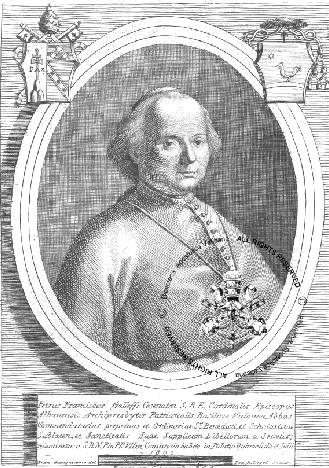
Pietro Cardinal Galeffi
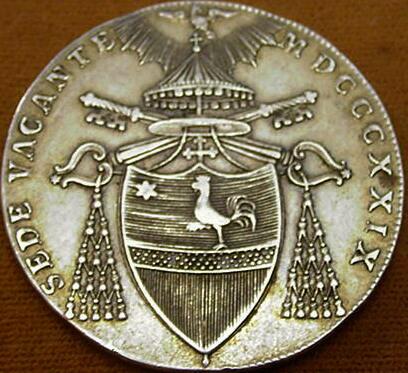 |
SEDE VACANTE MDCCCXXIX Arms of Pietro Francesco Card. Galeffi, Camerlengo of the Holy Roman Church, surmounted by the Ombrellone, crossed keys, and the Cardinal's Hat with fifteen tassels on each side. Above, the Holy Spirit and rays of light. Berman, p. 207 #3263. |
 |
AG
|
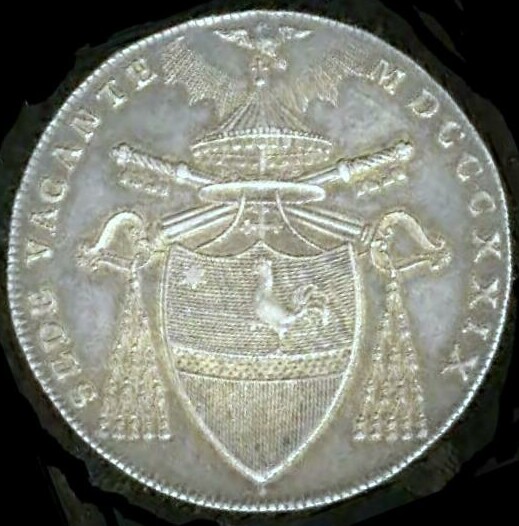 |
SEDE • VACAN TE • MDCCCXXIX Arms of Pietro Francesco Card. Galeffi, Camerlengo of the Holy Roman Church, surmounted by the Ombrellone, crossed keys, and the Cardinal's Hat with fifteen tassels on each side. The Holy Spirit above. Berman, p. 208 #3263. |
Camerlengo
Born in 1770 at Cesena, a relative of Pope Pius VI, Pietro Francesco Galeffi was created cardinal on July 11, 1803. He was deported to France in 1809 along with Pope Pius VII; in 1810 he was exiled to Sedan, and only able to return to Italy after Napoleon's exile. He became Archpriest of S. Pietro in Vaticano and Prefect of the Congregation of the Fabric of St. Peter's in 1820, as well as Bishop of Albano. In 1830 he exchanged Albano for Porto-Santa Rufina-Civitavecchia. On December 20, 1824, he became Camerlengo of the Holy Roman Church, a post which he held until his death on June 18, 1837.
Msgr. Mario Mattei (1792-1870) was Reverendae Camerae Apostolicae Thesaurius Generalis (Papal Treasurer) at the time of the conclaves of 1829 and 1830-31. He became a cardinal deacon on July 2, 1832 In 1843 he was named Archpriest and president of the Sacred Congregation of the Reverenda Fabbrica di S. Pietro. He became Cardinal Bishop of Frascati in 1844, was translated to Porto and Sta. Rufina in 1854, and became Bishop of Ostia in 1860. He was Dean of the Sacred College of Cardinals from 1860 until his death on October 7, 1870.
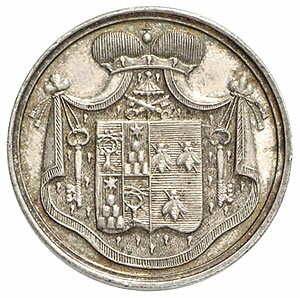 |
AE
|
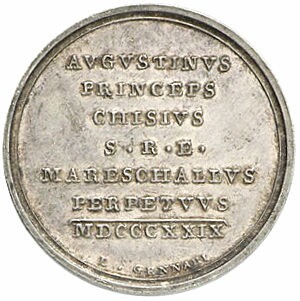 |
AVGVSTINVS | PRINCEPS | CHISIVS | S • R • E • | MARESCHALLVS | PERPETVVS | MDCCCXXIX |
Prince Agostino Chigi (d. 1855) was the Marshal of the Holy Roman Church during both interregna, as he had been in 1823. The Prince's diary for the years 1830-1855, Il tempo di Papa-Re, survives, providing some interesting background information on the agonized death of Pope Pius VIII, the Interregnum, and the Conclave of 1831. There were conspiracies and revolts against the papal government in a number of Italian cities, including Rome.
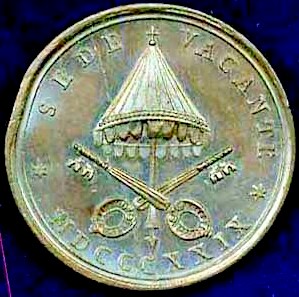 |
AE
Crossed keys, surmounted by Ombrellone. |
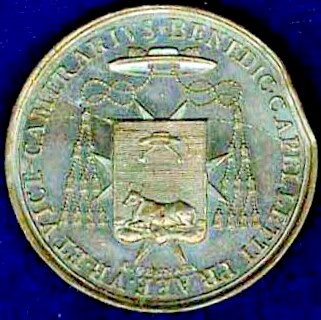 |
BENEDIC CAPELLETTI PRAEF• VR• ET VICE-CAMERARIVS |
The Governor of Rome (and therefore chief of police) during the two conclaves of 1829-1831 was Msgr. Benedetto Cappelletti (1764-1834). A Benedictine of Monte Cassino, he was essentially a civil and legal administrator, having begun his career in the Apostolic Signatura. He served as papal governor in Viterbo, Macerata (1822), Urbino (1823), and Pesaro. He became governor of the city of Rome in 1829, and held that post until he was named a Cardinal by Gregory XVI on July 2, 1832 as Cardinal Priest of San Clemente. He was named Bishop of Rieti in 1833, and died there the next year.
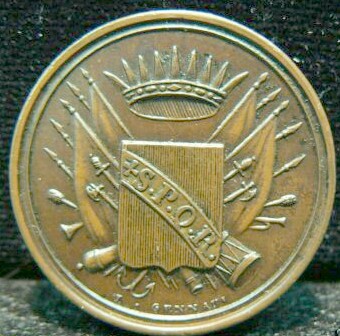 |
AE Arms of the Commune di Roma. surmounted by a crown, with flags and weapons behind. Inscription S.P.Q.R. on bend across the shield. |
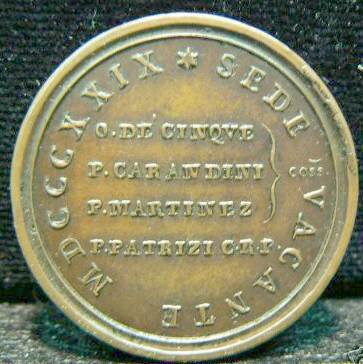 |
MDCCCXXIX • SEDE VACANTE O(doardus) DE' CINQUE P(aulus) CARANDINI } COSS P(aulus) MARTINEZ P(hilippus) PATRIZI.C(ivitatis) R(omae) P(atricius) The three governing Conservatori, Patricians of Rome Mazio, 909. Spink, #2141. |
cf. R. De Cesare, Il conclavo di Leone XIII , p 277. The Fasti Consulares Capitolini are printed by
Vincenzo Forcella, Inscrizioni delle Chiese e d' altri edificii di Roma Volume I (Roma 1869) 20.
The Secretary of the Conclave was Msgr. Paolo Polidori (1778-1847) He began his career as Vicar-General for the Diocese of Viterbo, and then served in the same capacity for the Suburbicarian Diocese of Ostia e Velletri, first for Cardinal Leonardo Antonelli, and then (after an exile from 1809-1814, during the imprisonment of Pope Pius VII) for Cardinal Alessandro Mattei. He was Secretary of Latin Briefs and Secretary of the SC of Tridentine Council. As Secretary of the Consistorial Congregation, he was Secretary of the Conclave of 1829 and the one of 1830-1831. He became a Cardinal on June 23, 1834, and was assigned the titulus of San Eusebio.
The Apostolicis Caeremoniis Praefectus was Dominicus Zucche. The Magistri Caeremonii were: Alexander Lazzarini, basilicae S. Mariae Transtyberim Canonicus; Felix Maria Renazzi, collegii S. Eustachii Canonicus; Matthias Pieri, basilicae Lateranensis clericus beneficiatus; Johannes Baptista Adami, basilicae Lateranensis beneficiatus; and Josephus de Ligne, collegii S. Eustachii Canonicus [Bullarii Romani continuatio 18 , no. XXII., p. 27].
Death of the Pope
On February 5, 1829, Pope Leo XII, who was suffering some pains, visited his Secretary of State, Cardinal Bernetti, who was also ill. That evening the Pope suffered some spasms, and his doctors decided to operate on his "vie orinarie". The operation did not go well, and in fact it aggravated the condition. (Silvagni, 619-620). Pope Leo died on February 10, 1829, possibly of a bladder infection, causing an interruption in the celebration of the Roman Carnival. He had been pope for five years, four months, and three days. At the enbalming, the autopsy showed that many of his internal organs, heart, liver, bladder and spleen, were diseased (Buckingham, 76). That evening, Cardinal della Somaglia, the Dean of the College of Cardinals, summoned a meeting of the cardinals who were heads of each order: Joseph Cardinal Fesch (Cardinal priest), Cardinal Cacciapiatti (Cardinal Deacon), Pietro Cardinal Galeffi (the Camerlengo), and the Secretary of the College of Cardinals. The funeral and novendiales were arranged.
Early maneuvering
In a dispatch to the French Foreign Minister, Comte Portalis, on February 17, 1829, the French Ambassador Ordinary in Rome, the Vicomte de Chateaubriand, reported a conversation which he had had with the Papal Secretary of State, Cardinal Bernetti, on February 13 (Chateaubriand, 2-9). Four cardinals appeared to have the early favor of popular opinion: Capellari, Pacca, di Gregorio, and Giustiniani.
It is important to the Diplomatic Body, and especially to the French Ambassador, that the Secretary of State in Rome should be a man of ready intercourse and accustomed to the affairs of Europe. Cardinal Bernetti is the minister who suits us best in every respect; he has committed himself on our behalf with the Zelanti, and the members of the lay congregations; we are bound to wish that he should be re-employed by the next Pope. I asked him with which of the four cardinals he would have most chance of returning to power. He answered: 'With Capellari.'
...Cardinal Pacca is very much enfeebled by age, and his memory, like that of the Senior Cardinal, La Somaglia, is beginning to fail him entirely.
Cardinal di Gregorio would be a suitable Pope. Although he ranks among the Zelanti, he is not without moderation; he thrusts back the Jesuits, who have as many adversaries and enemies here as in France. Neapolitan subject though he be, Cardinal Di Gregorio is rejected by Naples, and still more by Cardinal Albani, the executor of the high decrees of Austria....
The cardinals favourable to the Jesuits are Giustiniani, Odescalchi, Pedicini and Bertalozzi. The cardinals opposed to the Jesuits, owing to different causes and different circumstances, are Zurla, Di Gregorio, Bernetti, Capellari and Micara.
On the same day, February 17, Chateaubriand wrote a highly colored personal letter to Mme. Récamier [Le Correspondant, p. 692 n.; cf. I.M Luyster (ed.), Memoirs and Correspondence of Mme. Recamier, I (Boston 1867), p. 314]:
... J'ai vu Léon XII exposé le visage découvert sur un chétif lit de parade au milieu des chefs-d'oeuvre de Michel-Ange: j'ai assisté à la première cérémonie funèbre dans l'église de Saint-Pierre. Quelques vieux cardinaux commissaires, ne pouvant plus voir, s' assuraient de leurs doigts tremblants que le cercueil du Pape était bien fermé, à la lueur des flambeaux melée à la clarté de la lune. Le cercueil fut enfin enlevé par une poulie et suspendu dans les ombres pour être exposé dans le sarcophage de Pie VII. On vient de m'apporter le petit chat du pauvre Pape: il est tout gris et fort doux, comme son ancien maître....
On February 28, the Consular Agent in Rome of the Duke of Modena, Count Ceccopieri, wrote to the Marquis Giuseppe Molza, the Foreign Minister of Archduke Franz, Duke of Modena [Bianchi, 429-430]:
Tre cardinali sono stati sopra gli altri distincti in questi giorni dai loro eminentissimi colleghi e col maggior numero de' loro voti pel papato nella ballotazione, questi sono Pacca, Gamberini, e De Gregorio. Dicesi però che De Gregorio abbia l' esclusiva della Francia, e contro Pacca dicesi essersi molto adoperato il cardinale Zurla, il quale ha posto in vista dei votanti che quel cardinale pottrebe forse non essere immeritevole di soglio, ma che le persone che lo circodano sono forse di peggiore, o per lo meno di eguale calibro a quelle che circondavano Leone XII.
The Cardinals
One Cardinal, Giovanni Francesco Marazzani Visconti (aged 73), died during the Sede Vacante, on February 18, 1829. A list of the living cardinals at the time of the election of Pius VIII is given by Berthelet (pp. 32-33). An official list of Cardinals and their Conclavists is given in the motu proprio Nos Volentes of Pius VIII, of June 26, 1829 [Andreas Barberi (ed.), Bullarii Romani continuatio 18 (Romae 1856), no. XXII., pp. 27-29; and see also pp. 35-37].
- Giulio della Somaglia (aged 84), Suburbicarian Bishop of Ostia e Velletri, Dean of the Sacred College of Cardinals (died April 2, 1830). Vice-Chancellor. Librarian of the Holy Roman Church. [last surviving cardinal of Pius VI]
- Bartolomeo Pacca (aged 72), Suburbicarian Bishop of Porto e Santa Rufina and Civitavecchia (died 1844). Pro-Datary.
- Pietro Francesco Galleffi (aged 58), Suburbicarian Bishop of Albano (died 1837) Archpriest of the Vatican Basilica
- Tommaso Arezzo (aged 72), Suburbicarian Bishop of Sabina (died 1833) Legate in Ferrara.
- Francesco Saverio Castiglione (aged 67), Suburbicarian Bishop of Frascati (died November 30, 1830) Major Penitentiary
- Francesco Bertazzoli (aged 74), Suburbicarian Bishop of Palestrina (died April 7, 1830).Prefect of the S.C. of Studies.
- Giuseppe Firrao (aged 92), Cardinal Priest of San Eusebio (died January 24, 1829).
- Luigi Ruffo-Scilla (aged 79), Cardinal Priest of San Martino ai Monti (died November 17, 1832) Archbishop of Naples.
- Joseph Fesch (aged 66), Cardinal Priest of Santa Maria della Vittoria (died 1839) Archbishop of Lyon
- Carlo Oppizzoni (aged 59), Cardinal Priest of San Lorenzo in Lucina (died 1855) Archbishop of Bologna.
- Pietro Gravina (aged 79), Cardinal Priest of San Lorenzo in Panisperna (died December 6, 1830) Archbishop of Palermo
- Giuseppe Morozzo della Rocca (aged 71), Cardinal Priest of Santa Maria degli Angeli (died 1842) Bishop of Novara.
- Benedetto Naro (aged 84), Cardinal Priest of San Clemente (died 1832). Prefect of the S.C. of the Discipline of Religious, Archpriest of the patriarchal Liberian basilica (S. Maria Maggiore).
- Emmanuele de Gregorio (aged 70), Cardinal Priest of SS. Bonifacio ed Alessio (died 1839). Prefect of the S.C. of the Tridentine Council. Promoted Bishop of Tusculum in 1830 in succession to Cardinal Bertazzoli.
- Giorgio Doria-Pamphilj (aged 56), Cardinal Priest of Santa Cecilia (died 1837). Prefect of the S.C. of Indulgences and Sacred Relics.
- Fabrizio Sceberras Testaferrata (aged 71), Cardinal Priest of S. Pudenziana (died 1843) Bishop of Senigaglia.
- Anne- Antoine-Jules de Clermont Tonnerre (aged 80), Cardinal Priest of Sma. Trinità al Monte (died February 21, 1830) Archbishop of Toulouse
- Gianfrancesco Falzacappa (aged 61), Cardinal Priest of Santa Maria in Trastevere (died 1840). Prefect of the Tribunal of the Signature of Justice.
- Antonio Pallotta (aged 59), Cardinal Priest of San Silvestro in Capite (died 1834). Legate a latere of the Province of Maritima e Campania.
- Carlo Maria Pedicini (aged 59), Cardinal Priest of Santa Maria della Pace (died 1843). Pro-Secretary of Memorials.
- Ercole Dandini (aged 69), Cardinal Priest of Santa Balbina (died 1840).
- Carlo Odescalchi (aged 44), Cardinal Priest of SS XII Apostoli (died 1841). Prefect of the S.C. of Bishops and Religious. Leader of the Zelanti
- Giacinto Placido Zurla di Crema, OSB Cam.(aged 59), Cardinal Priest of Santa Croce in Gerusalemme (died 1834). Vicar-General of His Holiness for Rome.
- Anne-Louis-Henri de La Fare (aged 76), Cardinal Priest of Santa Maria in Transpontina (died December 10, 1829). Archbishop of Sens, France.
- Giovanni Battista Bussi (aged 74), Cardinal Priest of San Pancrazio (died 1844). Archbishop of Benevento.
- Bonaventura Gazzola, OFM Ref. (aged 84), Cardinal Priest of San Bartolommeo all' Isola (died 1832). Bishop of Montefiascone and Corneto.
- Karl Kajetan Gaisruck (aged 59), Cardinal Priest of San Marco (died November 19, 1846). Archbishop of Milan
- Ludovico (Luigi) Micara, OFM Cap. (aged 53), Cardinal Priest of Santi Quattro Coronati (died 1847).
- Gustave-Maximilien-Just de Croy (aged 55), Cardinal Priest of Santa Sabina (died 1844). Archbishop of Rouen, France.
- Mauro (Bartolommeo Alberto) Cappellari, OSB Cam. (aged 63), Cardinal Priest of San Callisto (died 1846). Prefect of the S.C. de Propaganda Fide.
- Jean-Baptiste-Marie-Anne-Antoine de Latil (aged 68), Cardinal Priest of San Sisto (died 1839). Archbishop of Reims, France.
- Pietro Caprano (aged 70), Cardinal Priest without title (died 1834). Secretary of the S.C. de Propaganda Fide
- Giacomo Giustiniani (aged 59), Cardinal Priest of SS. Marcellino e Pietro (died 1843). Archbishop-Bishop of Imola.
- Vicenzo Macchi (aged 58), Cardinal Priest of SS. Giovanni e Paolo (died 1860). Apostolic Legate in Ravenna. Doctor in utroque iure
- Giacomo Filippo Fransoni (aged 53), Cardinal Priest of Santa Maria in Aracoeli (died 1856)..Doctor in utroque iure Former Nuncio in Portugal (1823-1828)
- Benedetto Colonna Barberini di Sciarra (aged 40), Cardinal Priest without title (died 1863). Prefect of the Household of Pope Leo XII..
- Giovanni Antonio Benvenuti (aged 63), Cardinal Priest without title (died 1838). Bishop of Osimo and Cingoli.
- Ignazio Nasalli-Ratti (aged 78), Cardinal Priest of Sant' Agnese fuori le mure (died December, 1831).
- Joaquim-Jean-Xavier d'Isoard (aged 62), Cardinal Priest of San Pietro in vincoli (died 1839). Archbishop of Auch
- Antonio Domenico Gamberini (aged 58), Cardinal Priest without title (died 1841). Bishop of Orvieto.
- Giuseppe Albani (aged 78), Cardinal Deacon of Santa Maria in Via Lata (died 1834) Apostolic Legate in Bologna.
- Giovanni Caccia-Piatti (aged 78), Cardinal Deacon of SS. Cosma e Damiano (died 1833). Prefect of the Tribunal of the Signature of Grace.
- Pietro Vidoni (aged 59) [Cremona], Cardinal Deacon of San Nicola in Carcere Tulliano. He died August 10, 1830 at the age of 70. His funeral monument is in S. Andrea della Valle [V. Forcella, Inscrizioni delle chiese di Roma VIII, p. 277, no. 699].
- Agostino Rivarola (aged 71), Cardinal Deacon of Santa Maria ad Martyres (died 1842). Legate a latere extraordinary in Ravenna.
- Cesare Guerrieri-Gonzaga (aged 80), Cardinal Deacon of San Adriano al Foro (died 1832).
- Antonio Maria Frosini (aged 77), Cardinal Deacon of Santa Maria in Cosmedin (died 1834).
- Tommaso Riario-Sforza (aged 47), Cardinal Deacon of Santa Maria in Domnica (died 1857). Legate in the province of Forlì.
- Tommaso Bernetti (aged 49), Cardinal Deacon of San Cesareo in Palatio (died 1852). Secretary of State of Leo XII.
- Belisario Cristaldi (aged 64), Cardinal Deacon of Santa Maria in Portico (died February 25, 1831). former Treasurer of the Apostolic Chamber. Doctor in utroque iure
- Juan Francisco Marco y Catalán (aged 57)), Cardinal Deacon without title (died 1841) former Vice-Chamberlain of the Apostolic Chamber.
- Cesare Brancadoro (aged 73), Cardinal Priest of S. Agostino (died 1837) Archbishop of Fermo.
- Francesco Cesarei Leoni (aged 72), Cardinal Priest of Santa Maria del Popolo (died July 25, 1830). Bishop of Jesi.
- Rudolf Johannes Joseph Rainier von Habsburg-Lotharingen (aged 41), Cardinal Priest of San Pietro in Montorio (died July 24, 1831). Archduke of Austria, Archbishop of Olmütz
- Patricio da Silva, OESA (aged 72), Cardinal Priest without title (died 1840). Patriarch of Lisbon
- Carlo Vittorio Ferrero della Marmora (aged 71), Cardinal Priest without title (died December 30, 1831). former Bishop of Saluzzo
- Pedro de Inguanzo y Rivera (aged 64), Cardinal Priest of San Tommaso in Parione (died 1836). Archbishop of Toledo
- Francisco Javier de Cienfuegos y Jovellanos (aged 53), Cardinal Priest without titulus (died 1847). Archbishop of Seville
- Alexander (Sándor) von Rudnay und Divékújfalusi (aged 68), Cardinal Priest without titulus (died September 13, 1831). Archbishop of Esztergom
Ultimately fifty cardinals were present in the conclave. Thirty-four votes were needed for a canonical election. The Italian patriciate was well represented by the princely Albani, Barberini, Doria, and Giustiniani; the nobility was represented by Della Somaglia, Bernetti, Palotta, Ruffo-Scilla, Riario, Guerrieri Gonzaga, Franzoni, Morozzo, De Gregorio, Zurla and Firrao. (Silvagni, 625-626).
The Conclave Begins
On the morning of February 23, Cardinal Somaglia celebrated the Mass of the Holy Spirit in St. Peter's; that afternoon, thirty-two cardinals assembled at S. Silvestro, sang the Veni Creator, and marched in procession to the Quirinale Palace, where they were joined by five others. On February 27, three more cardinals entered conclave: Tommaso Arezzo (Bishop of Sabina), Giuseppe Morozzo (Bishop of Novara), and Vicenzo Macchi (the Apostolic Legate in Ravenna); that evening Cardinal Ruffo of Naples arrived; he entered the Conclave on March 2. On the 3rd, Carlo Cardinal Gaysruck arrived from Milan. Giuseppe Cardinal Albani arrived on the same day, with Austrian instructions, and subsequently Cardinal Giuseppe Firrao On the 12th of March de Latil (Rheims), and on the 13th de la Fare (grand-nephew of Cardinal Bernis), and d'Isoard (Auch) entered conclave after a thorough briefing from Chateaubriand (Chateaubriand, 22-23):
We have agreed that they should support the candidates of whom I have already spoken to you, namely, Cardinals Capellari, Oppizzoni, Benvenuti, Zurla, Castiglione, and lastly, Pacca and Di Gregorio; and that they should reject the Cardinals of the Sardinian faction: Pedicini, Giustiniani, Galleffi, and Cristaldi.
The French cardinals had, of course, also been instructed by the Comte Portalis, the French Foreign Minister, before they left Paris. He provided them with a memorandum which embodied the thinking of King Charles X, advising the cardinals to associate themselves with the Zelanti and resist the efforts of the Austrians (Bianchi, 422-430). King Charles maintained a high opinion of Cardinal Castiglione, Cardinal De Gregorio, Cardinal Brancadoro, and Cardinal Zurla. The leader of the Zelanti, Cardinal Carlo Odescalchi, Prefect of the Congregation of Bishops and Religious, however, was vigorous in resisting any cardinal proposed by the Crowns.
Balloting
In the first ballot Cardinal Castiglione received 11 votes, Cardinal Pacca 10, Cardinal de Gregorio 9, and Cardinal Cappellari 7.
March 4 was Ash Wednesday, and Cardinal Castiglione, the Major Penitentiary, distributed ashes to the cardinals. Msgr. Dardano reports the formation of a faction to get Cardinal de Gregorio elected; it included Zurla, Giustiniani, Benvenuti, Naro, Cappellari, Bertazzoli, Franzoni, Macchi, Bernetti, Guerrieri-Gonzaga, Riario-Sforza, Doria, Odescalchi, Morozzo, Falsacappa, and of course De Gregorio (Silvagni, 635). This faction was a group of moderates, and Riario and Falsacappa assumed the management of the strategy of the group. De Gregorio had good relations both with Naples and Spain. His father had been the favorite of Carlos III, and when Carlos moved to Madrid, the elder De Gregorio became his viceroy in Naples (Silvagni, 627). The leaders of the faction which favored Cardinal Castiglione were Frosini and Pedicini, along with Palotta, Rivarola and Arezzo.
In the scrutiny in the morning of March 5, De Gregorio received 19 votes. In the afternoon scrutiny, a problem arose over the number of ballots cast, 40 or 41; the Infirmarii had to collect votes from Cardinals Vidoni and Micari, who were ill, three separate times. De Gregorio had twenty votes.
On Friday the 6th, in the morning scrutiny, De Gregorio received 20 votes, and had 24 after the accessio—still four votes short of election. In the afternoon scrutiny, after the accessio, Cardinal Castiglione had 15 votes, according to Msgr. Dardano (Silvagni, 636). Cardinal Gaisruck arrived from Milan.
On March 7, Crosa, the Sardinian Ambassador in Rome, wrote to Turin (Bianchi, 430-431) that De Gregorio had obtained 24 votes on the 6th, only four short of election at the time (with 41 voters), and that he was being favored by the Ambassadors of France and Spain, probably to stop the Austrians. Cardinal Albani, who had entered the Conclave that day was a personal enemy of De Gregorio, which would affect the latter's chances (Buckingham, 98). Crosa wrote again on March 12 that the Minister of Naples had managed to have smuggled into the Conclave a memorial which denounced De Gregorio for personal laxity as well as political indulgence toward liberal ideas.
Also on March 7, a minor scandal erupted. At the morning scrutiny, Cardinal Somaglia, the Dean, made complaints against some of the conclavists were talking too much about information they received from their cardinals, and were putting about as certain fact things which were still very much uncertain. two conclavists were expelled from the Conclave and sent to the Castel S. Angelo for leaking the news that Cardinal De Gregorio was going to be elected within two days. The Consul of Modena reported in a letter of March 12 (Bianchi, 430):
Sono stati espulsi dal Conclave, e rinchiusi nelle prigioni un conclavista (e credo quello del cardinale Ruffo Scilla) ed un facchino. Costoro, ad onta dei giuramento di segretezza, e dal quale sono tutti legati nel porre il piede nel conclave, aveano fatto ben chiaramente conoscere che il cardinale De Gregorio sin da due giorni a questa parte sarebbe stato eletto papa. Tale elezione però è andata in fumo anch'essa per essere entrato il cardinale Albani.
In the afternoon scrutiny of the 7th of March, De Gregorio's numbers had fallen to 19 votes. Next morning his number had dropped to 13. Castiglione's numbers in the same scrutinies were 14 and then 15—according to Msgr. Dardano (Silvagni, 637). Cardinal Albani finally made his formal entrance into the Conclave:
La sua figura diceva entrato un volpone, traditore, uomo di Corte nel suo contegno, e capace di tutto.
But on Sunday, March 8, in the morning scrutiny De Gregorio again had 20 votes.
On the evening of March 9 [Allocuzioni, p. 3], the Imperial Ambassador Extraordinary, Count Lutzow, was formally received by the College of Cardinals, by torchlight. He urged the cardinals to elect "a wise and modest" pope, and the announced that, in accordance with a letter of February 26, Cardinal Albani was authorized to represent the Emperor inside the Conclave. Cardinal Castiglioni made the Reply. Cardinal Palotta was noticed visiting the cells of many of the cardinals that evening. The Consul of Modena remarked, in a letter of the 12th, that Albani's arrival sent Cardinal De Gregorio's chances of becoming pope up in smoke.
On March 10, Vicomte Chateaubriand presented his credentials and two letters from King Charles X, which were read aloud by the Secretary of the Conclave, and made his formal address [Allocuzioni, p. 7]. Cardinal Castiglione made the reply on behalf of the College of Cardinals.
On March 11, the Comte de Celles, the Ambassador of the Low Countries, presented his credentials [Allocuzioni, p. 13]. Cardinal Bertazzoli made the formal reply on behalf of the Sacred College.
Thursday March 12 saw the entry into Conclave of Cardinals Isoard and Latil, as well as the Neapolitan Cardinal Firrao, claimed to be 93 years of age. De Gregorio continued to receive 14 and 15 votes, while votes also went to Castiglione, Cappellari, Giustiniani, Macchi, and Benvenuti. News of a scandal circulated through Rome. A conclavist (said to be Cardinal Ruffo Scilla's) was expelled from the Conclave and sent to prison, along with a porter (facchino).
On March 13, Cardinals La Fare (Archbishop of Sens) and Croy (Archbishop of Rouen) arrived, raising the total number of cardinals present to 48, and the number needed to elect a pope to 32. De Gregorio received 17 votes.
On March 14, Cardinal Castiglione had 20 votes in the morning and 23 in the afternoon—according to Msgr. Dardano (Silvagni, 640). Perhaps (he theorizes) this was a demonstration that the votes existed to exclude De Gregorio. On the 15th and 16th, Castiglione moved up to 24 votes, then 19, 20 and 18, while De Gregorio fluctuated at 15 to 17. The other votes went to Cappellari, Pacca, and Clermont Tonnerre (one vote).
On March 18, Cardinal Firrao had an apparent heart attack while visiting Cardinal Pacca. The pains were renewed after lunch. Msgr. Dardano speculated that Firrao had just eaten too much. Speculation that evening was that Cardinal Castiglione was doing so well that he might be elected on the next day's balloting. The voting on the 19th, however, indicated that there was a deadlock between the two factions. On the 20th, in the morning De Gregorio still had his 15 solid votes, Castiglione had 22, and Pacca 11. In the afternoon, after some politicking by Albani, Testaferrata, Dandini, and Frosone, Pacca's tally on the accessio reached 19. But, as someone remarked, Pacca was "pieno di virtù polverosa". De Gregorio had 18, Castiglione 22. On the 21st, however, Pacca still maintained nineteen votes, while Castiglione had twenty-two, and De Gregorio 18.
On the morning of Monday, the 23rd, Castiglione had 24 votes, including those from the accessio. In the afternoon, there were 26 votes for Castiglione, and 19 for Cappellari, who had replaced Pacca as an alternative candidate to one of the factions in the balloting. Those working for Cappellari included Guerrieri and Morozzo.
On the 24th there was a strange quiet among the leaders of the factions. Msgr.Dardano took it as a good sign that cardinals were discussing what the objectives of the new pope ought to be. it was noticed that Oppizoni was working on Testaferrata to vote with him for Castiglione. In the evening after the scrutiny, the Ambassador of Spain, the Duke of Labrador, was received by the College of Cardinals; his letters were read out and appropriate replies offered.
The morning of the 25th saw a great deal of bustle in the Conclave. The rumor had been going around that this was the day a pope would be elected. Every movement was seen to have significance. Cardinal Firrao actually managed to make it to the Pauline Chapel. Pallota came out of the Chapel after the scrutiny with a look of triumph on his face. Bussi and Fesch looked happy. Everyone who came out seem satisfied. When the results became known, the votes had been cast as follows: 18 for Cappellari (plus 4 on the accessio), 14 for Castiglione (plus 9 on the accessio), 5 for Pacca (plus 6 on the accessio), and 2 for De Gregorio. Bertazzoli had one and so did Clermont-Tonnere. It might seem that De Gregorio was finished, but that was not the case. And it did not mean that the cardinals were near to making a pope. On the next day the vote was still the same as on the morning of the 25th, give or take a vote or two.
Cardinal Pietro Gravina, the Archbishop of Palermo, entered Conclave in the afternoon of the 26th, raising the number of electors to 49, and the number needed to elect a pope to 33. The second scrutiny of the day gave 22 votes to De Gregorio (plus 2 on the accessio), 14 or 15 to Castiglione
On March 28, in the morning scrutiny, Castiglione received 13 votes (plus 11 on the accessio); De Gregorio had one less than on the previous day, 23; both Cappellari and Somaglia received several votes.
The French Cardinal de Clermont-Tonnerre entered the conclave late in the afternoon on March 28. He had with him written instructions from Chateaubriand (32-33):
... Now it is impossible to allow the elevation to the Sovereign Pontificate of a cardinal openly belonging to a crown, whether it be the crown of France or any other. Consequently, Monseigneur, I charge you, by virtue of my full powers as His Most Christian Majesty's Ambassador, and taking all the responsibility upon myself alone, to give the exclusion to M. the Cardinal Albani, if, one the one hand, by a fortuitous juncture, or, on the other, by a secret combination, he should come to obtain the majority of the suffrages.
It is apparent that Chateaubriand was completely out of touch with the events going on inside of the Conclave, and was issuing instructions based on his own antipathies rather than on real circumstances.
On Monday the 30th, De Gregorio had 23 votes in the morning scrutiny, and Castiglione 25 (plus a few more on the accessio). In the afternoon scrutiny, Castiglione received 21 (plus 7 on the accessio), and De Gregorio 19 (plus a few on the accessio)
ELECTION
At the scrutiny on the morning of March 31, Castiglione had 28 votes, de Gregorio 15, Cappellari 4. and Somaglia, Giustiniani and Fransoni one each; the the accessio, brought Castiglione 8 more votes, de Gregorio and Somaglia five each, and Giustiniani one. Though Castiglione barely had his two-thirds, another vote was ordered due to a slight irregularity, and he thereupon received 47 votes. Cartwright (p. 157) explains that the irregularity was in the mottoes that each cardinal added to his own ballot as a means of identification; at the accessio, the same motto is supposed to be used as at the scrutiny. Two cardinals chose not to do so, thereby invalidating the accessio. Their actions were undoubtedly deliberate, intended to give the opponents of Castiglione time to continue their plotting against his election. Francesco Cardinal Castiglione was elected, with the support of Cardinal Albani and the Austrian interest. He took the name Pius VIII, and named Cardinal Albani as his Secretary of State.
Prince Clemens von Metternich supplied his information about the election to his friend Count Tatischeff on April 6, 1829:
"He was elected at first by a majority of thirty-six; a slight error having appeared in the ballot, Cardinal Castiglione insisted on a fresh one. In this he obtained forty-seven votes—that is to say, almost unanimity. We had placed him at the head of those who would be desirable as Pontiffs. The French Cardinals joined our Cardinals. M. de Chateaubriand, on the contrary, patronised Gregorio.
The new Pope has given Gregorio the post of Grand Pénetencier, which he had just left; and nominated Albani State Secretary. Chateaubriand, in consequence, will have absolution. "
The Sede Vacante had lasted 49 days; the Conclave, which began on February 23, took 36 days.
Chateaubriand immediately fired off a letter to Mme. Recamier [Souvenirs et Correspondence de Madame Récamier II, 352]:
Victoire enfin! J'ai, après bien des combats, un des papes que j'avais mis sur ma liste. C'est le cardinal Castiglioni, sous le nom de Pie VIII: le cardinal même que je portais à la papauté in 1823, lorsque j'étais ministre; celui qui m'a répondu dernièrement au conclave de 1820, en me donnant de si grandes louanges. Castiglioni est modéré, anti-jésuite, favorable aux ordonnances et tout dévoué à la France. Enfin, c'est un triomphe complet.
Nothing he wrote, of course, was true. The appointment of Cardinal Albani as Secretary of State pointed to an Austrian triumph, not a French one. And Castiglione's name had not been among those mentioned by Chateaubriand to the French Foreign Minister on February 17. As Metternich pointed out, Chateaubriand had been promoting De Gregorio. Chateaubriand was polishing an image in Paris, hoping to be the next Foreign Minister himself.
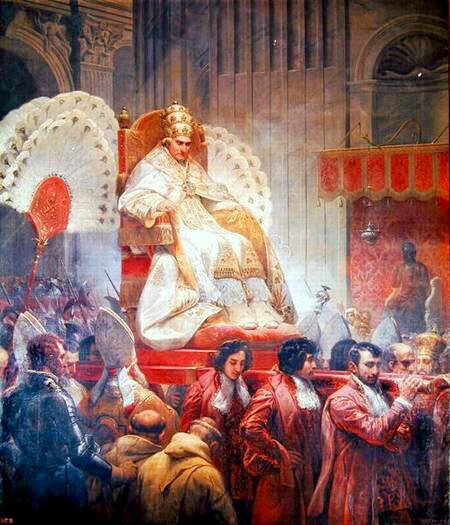
Next day, the new Pontiff was conveyed to St. Peter's from the Quirinale, in an immense procession of carriages. Richard, Duke of Buckingham, happened to be present and to witness the scene in the Piazza S. Pietro and in the Vatican Basilica [ The Private Diary of Richard, Duke of Buckingham and Chandos, K.G. Volume III (London 1862), 120-122]:
April 1st. Went this morning to St. Peter's. At ten o' clock the firing of cannon announced the Pope's arrival. the procession was a very long one, of all sorts of carriages, of all ages and all epochs, from the Pope's state carriage of the oldest pattern of the time of Louis XIV., down to the present day. He was received, as usual, by the Chapel singing, "Tu es Petrus," &c. The crowd in the Place of St. Peter's was immense, and cheered him loudly. He moved on giving his blessings; but when a great burst of "Viva nostro Santa Padre" came, the poor old man burst out crying. From his carriage he was put into the chair, and hoisted upon men's shoulders. He was dressed in the golden mitre, &c. In this way he was carried to the Baldaquino of St. Peter's. The effect of this vast edifice thus filled was very fine. The Cardinals, fifty in number, were seated down the nave. The Pope, first of all, knelt before the altar, prostrated himself, and prayed. He then rose up and was seated on the high altar—not in a chair, but on the altar itself—where each Cardinal went up to him, kissed his foot and his hand, and the Pope embraced him. It was curious and interesting to reflect and watch the countenances of the Cardinals when they performed that function—how few of them appeared to feel even charity towards the sovereign they embraced; how many felt disgust!
The Pope prostrated himself before the altar, thus acknowledging it to be a holy place. We know what veneration Catholics affix to the altar. Nothing but the figure of the crucified Saviour and the vessels consecrated to the Holy Elements, which, according to them, are the visible body and blood of Christ, are allowed to be upon this altar; and yet upon it, not on a throne by it, or before it, but on it, the new Pope sits, and is worshipped! I confess I never felt, before to-day, the strong impression that the religion is idolatrous. But I believe it now. It is impossible that any other interpretation can be put upon this adoration of a man seated on the altar of God! After this was gone through, the Pope retired into a covered place set apart for him to change his vestments in, and retired—all the bells of Rome chiming, and the cannon firing, as he entered....
Pius VIII was crowned in the Vatican Basilica on April 5, 1829. On Sunday, May 24, 1830, the Pope took possession of his cathedral church, S. Giovanni Laterano. Concerning the new pope, Chateaubriand noted (31):
Pius VIII is very learned, especially in matters of theology; he speaks French, but with less facility and grace than Leo XII. He is attacked on the right side with partial paralysis, and is subject to convulsive movements: the supreme power will cure him.
Chateaubriand was correct. The Supreme Power cured him of all his earthly ills on November 30, 1830.
Bibliography
An extensive, but excessively discreet account of the Conclave of 1829 is given by Chevalier Alexis François Artaud de Montor, who was a well-informed eyewitness, in his Histoire du Pape Pie VIII (Paris 1844), pages 34-61.
The French Ambassador to Rome, the Vicomte de Chateaubriand, wrote extensively in his celebrated Memoires d' outre-tombe about the conclave of 1829, as a person who knew intimately all the participants and witnessed the events personally: The Memoirs of François René Vicomte de Chateaubriand (translated by Alexander Teixeira de Mattos) Volume VI (London: Freemantle 1902) 1-49. Chateaubriand, however, nursed many grudges, not the least of which was against Comte Portalis, who paid little attention to him and did not make him Ambassador Extraordinary to the Conclave. Saint-Quirin, "Une correspondence inédite de Chateaubriand (1826-1836)," Le Correspondant Tome 204 (Paris 1901), 664-715. Souvenirs et Correspondence, tirés des papiers de Madame Récamier Tome seconde (Paris: Michel Lévy 1859).
Richard, Duke of Buckingham and Chandos, was in Rome during the conclave, and was in a position to hear a certain amount of information and gossip: The Private Diary of Richard, Duke of Buckingham and Chandos, K.G. Volume III (London 1862), 70-127.
Monsignor Pietro Dardano (1791-1870) was present at the conclave, as conclavist of Cardinal Giuseppe Morozzo di Bianzè, and left a diary: David Silvagni, "Diario dei conclavi del 1829 e del 1830-31 di Mons. Pietro Dardano," Rivista europea 13 (Firenze 1879), 605-648. David Silvagni, La corte e la societa romana nei secoli XVIII e XIX Volume Terzo (Roma 1885), 253-303.
Giovanni Berthelet, Conclavi, Pontefice e Cardinali nel Secolo XIX (Torino-Roma 1903). Giornale storico-politico ceremoniale della sede vacante e conclave per l' elezione di Pio VIII (Roma 1829) [Moroni, 53, 175]. Giornale della sede vacante: in cui si da distinta notizia di tutte le funzioni si sagre che civili... (Roma: Tipografia Arcivescovile [di Bologna] 1829) [the rituale].
The Speeches of the Ambassadors to the Cardinals are published in: Allocuzioni degli Eccmi Signori Ambasciatori straordinarj al Conclave, con le risposte degli E&mi e Rmi signori Cardinali Capi d'Ordine (Roma: Cracas 1829).
See also: G. Moroni, Dizionario di erudizione storico-ecclesiastica Vol 53 (Venezia 1846) p. 175-176 F. Petruccelli della Gattina, Histoire diplomatique des conclaves Volume 4 (Paris: 1866) 366-390 Memoirs of Prince Metternich (1815-1829) (edited by Prince Richard Metternich) (translated by Mrs. Alexander Napier) Volume IV (New York 1881) p. 617. See also: Lucius Lector [Joseph Guthlin], Le Conclave (Paris 1894), 491-494 (Cardinal Albani had authorization to use a veto against Cardinal di Gregorio, but he did not need to use it). Nicomede Bianchi, Storia documentata della diplomazia Europea in Italia Volume II (Torino 1865) 422-429.
Details about the offices and positions held by the cardinals can be found in Notizie per l' anno MDCCCXXVIII (Roma: Stamperia Cracas, 1828).

