SEDE VACANTE 1724
(March 7, 1724—May 29, 1724)
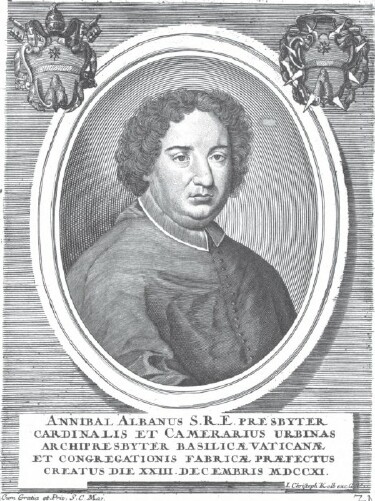
Cardinal. Albani
ANNIBALE CARDINAL ALBANI (1682-1751), was born at Urbino on August 15, 1682. His uncle became Pope Clement XI in 1700 (dying on March 19, 1721). He was created Cardinal Deacon on December 23, 1711, being appointed to the Deaconry of S. Eustachio on March 2, 1712. He became Archpriest of St. Peter's Basilica in 1712, where he had long been a Canon, and was promoted to be Cardinal Priest of S. Clemente in March, 1722, for which he was finally ordained a priest in October. He was appointed Camerlengo of the Holy Roman Church on March 29, 1719, a post he held until 1747. He became bishop of Sabina on July 24, 1730, and was translated to Porto and Sta. Rufina in 1743. From 1719 he was director of the English hospital of St. John in Jerusalem.
The Dean of the Sacred College of Cardinals was Sebastiano Tanara, Cardinal Bishop of Ostia and Velletri, but he left the conclave on April 15 and died during the Sede Vacante, on May 4.
The Treasurer General of the Holy Roman Church was Msgr.Carlo Collicola (Colligola) of Spoleti.
The Majordomo (Praefectus) of the Apostolic Palaces was Msgr. Niccolo del Giudice (1715-1725), nephew of Cardinal Francesco del Giudice, Cardinal Bishop of Frascati. His father was Domenico del Judice, Prince of Cellamare and Duke of Giovenazzi; his mother was Constanza Pappacoda. Doctor of Laws (Rome). He was appointed Protonotary Apostolic by Innocent XII in 1693, and made a Cleric of the Apostolic Chamber. At the beginning of the reign of Clement XI, he was promoted in the Apostolic Camera to the post of Praefectus viarum. In 1717 he became Prefect of the Apostolic Palaces (1717-1725). He was made a cardinal by Benedict XIII in 1725, with the title of S. Maria Rotonda. He died on January 30, 1743.
 |
AE
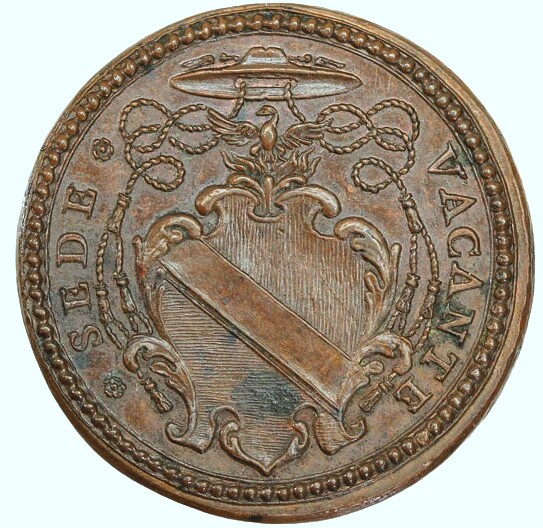
Stemma of Msgr. Niccolò del Iudice, surmounted by prelate's hat . |
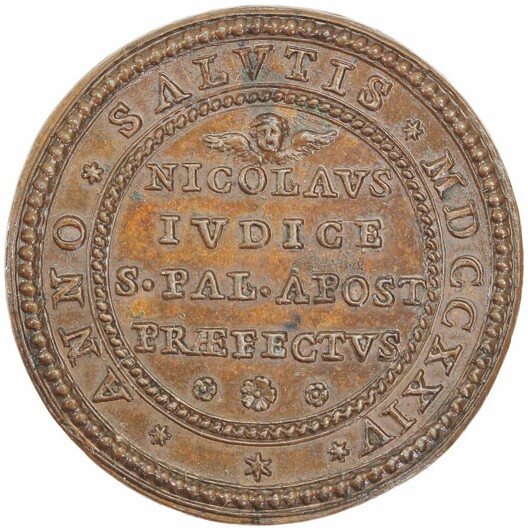 |
ANNO • SALVTIS • MDCCXXIV |
The Governor of the Conclave was Msgr. Maffeo Farsetti, Protonotary Apostolic de numero participantium, and Referendary of the two Signatures. He had previously been Governor of Rieti and Fano, and Vice-Legate of the Romagna.
The Governor of Rome was Msgr. Alessandro Falconieri [Romanus, of Florentine ancestry]. Doctorate (Rome). Auditor of the Rota and Vice-Chamberlain. He was created Cardinal by Benedict XIII on September 11, 1724. He died on January 26, 1734, at the age of 77, and was buried in S. Giovanni dei Fiorentini [Guarnacci 435-438].
The Conservatori di Roma were:
Marchese Clemente Spada Veralli
Conte Giacomo Bolognetti
Conte Fabil Carandini.
The Treasurer-General S. R. E. and Prefect of the Castel S. Angelo was Msgr. Carlo Collicola, Protonotary Apostolic. He was a Doctor of law (Rome, Sapienza). He was named a Cardinal by Benedict XIII in 1726.
The Marshal of the Holy Roman Church was Prince Augusto Chigi, appointed by Pope Clement XI to succeed Prince Giulio Savelli, the last male member of the Savelli family.
The Secretary of the Sacred College of Cardinals and Secretary of the Conclave was Msgr. Domenico Rivera, Protonotary Apostolic de numero participantium and Canon of the Vatican Basilica [Bullarium Romanum (Turin Edition) 22, p. 45].
The Masters of Ceremonies were:
Giovanni Battista Gambarucci [Romanus], Primo Maestro delle Cerimonie Pontificie
Ignazio Reali [Romanus], Beneficed Canon of the Vatican Basilica
Francesco Bolza [Novocomensis], Canon of S. Maria ad Martyres
[Venanzio] Filippo Piersanti [Camerino], Canon of S. Maria ad Martyres
Placido Eustachio Ghezzi [Romanus], Beneficed Cleric of the Vatican Basilica.
Death of Pope Innocent
Pope Innocent XIII (dei Conti), who suffered from hernia, also, beginning around three or four months after the start of his reign, suffered from acute attacks of kidney stones ('the gravel'). The pope ate a great deal and took no exercise. He also suffered from lethargy that caused him to sleep a great deal. In the middle of February, 1724, his long-standing complaints grew worse and worse, to the point where he could no longer get up. He suffered for some time from the accumulation of water in his lower limbs, an indication of severe kidney problems, and the doctors feared the development of congestive heart failure He had everyone except his brothers, nephews and doctors kept out of his room, where his health continued to decline. The sudden death of his Cup-Bearer, Msgr. Meniconi, in the antechamber of the Pope's palace on February 19, pressed upon the sick man even more morbid thoughts. On March 3, despite his condition, several officials from the Datary were able to get the Pope to sign some documents, and then he made some effort to show himself in his public rooms—though all who saw him saw a man upon whom death had settled. His exertions brought on a bad night for him, though he was better the next day, March 4. Cardinal Annibale Albani, the Camerlengo, recognizing the approach of death, put in motion the various operations that had to be attended to for a papal funeral and Conclave. He also began the pratticà. On the morning of March 5, one of the doctors fed the Pope a purgative, which, far from its intended result, aggravated the Pope's hernia. Attempted reduction was only partly successful (strangulated hernia), and the Pope spent the entire night between March 5 and March 6 in great pain. A serious inflammation quickly developed, accompanied by a high fever. [Relation de la mort du feu Pape Innocent, 2-7].
Realizing the state in which he found himself, Innocent began to prepare for death. He asked for the Viaticum, which he received in the evening of the 6th. His family gathered, and began to press him for this or that favor, seeing that their time to enrich themselves was nearly ended; this continued on the morning of the 7th. On the 6th the Cardinals in Rome began to gather at the Papal Palace. There attempts to get the Pope to name new cardinals at this last minute, for the benefit of the Conti faction. Abbe Tencin tried to get Innocent to sign a dispensation for the marriage of the Princess of Tourenne with the Prince d'Auvergne. Around 4 p.m on the 6th the Pope signed a codicil to his Testament, granting pensions to various members of the Papal Family (not the Conti family, but his chamberlains and other servants). That night he demanded and received Extreme Unction. The death agony began at 11:00 in the morning of the 7th. Innocent XIII died at sunset, around 23:00 hours (Rome time), on March 7, 1724, at the age of 68 years and nine months, in the presence of his nephew, Cardinal Conti, the Major Penitentiary; Msgr. Niccolò del Iudice the Prefect of the Apostolic Palace [He became a Cardinal on June 11, 1725]; the Preacher of the Sacred College, the Papal Confessor Father Flaminio Cesare, and the Generals of the religious Orders, including Fr. Lorenzo Cozza, OMin.Obs.[who became a Cardinal on December 9, 1726].
The next morning, Wednesday, March 8, the Recognition of the body was performed by the Camerlengo, Cardinal Albani. Msgr. Sinibaldo Doria, the Maestro di Camera and Archbishop of Patras, handed over the Fisherman's ring [Distinto Ragguaglio, 3; Diario ordinario 1130, 11 Marzo, p. 8]. A meeting of the cardinals who were heads of each order took place at Cardinal Tanara's palazzo; an edict for the purpose of ensuring public order was issued, with strict penalties attached for violation [Distinto Ragguaglio 3 and 7; Diario ordinario 17 marzo, p. 2-5]. On Wednesday, the body was opened and enbalmed; it was then placed on view in the Apostolic Palace of the Quirinale, for viewing by those who had the right to enter. On Thursday evening, shortly after sunset, the body was transferred from the Quirinale to the Vatican by the Penitenzieri of S. Peter's, under the direction of the Master of Ceremonies Msgr. Placido Eustachio Ghezzi and presided over by the Papal Maggiordomo, Msgr. del Iudice. The body was placed in the Sistine Chapel in the Vatican Palace. On Thursday evening, the Penitentiaries removed the body's domestic constume and placed the pontifical robes on the dead pope.
On the morning of Friday, March 10, the First Congregation of the Cardinals was held in the Sala Ducale of the Apostolic Palace, with the Dean of the College, Cardinal Tanara, presiding. Cardinal Marescotti, the prior presbyterum, did not attend. Twenty-eight cardinals took part. The Camerlengo broke the Fisherman's ring and the lead seal of the Apostolic Camera. The Apostolic Constitutions governing the procedure of conclaves were read to the assembled cardinals. Monsignor Alessandro Falconieri was confirmed as Governor of Rome [He became a Cardinal on September 11, 1724], and Msgr. Maffeo Farsetti, Protonotary Apostolic, was named Governor of the Conclave. Msgr. Giacomo Lanfredini Amadori was assigned to deliver the Funeral Oration [He was named a Cardinal on March 24, 1734], and Msgr. Francesco Bianchini the oration de pontifice eligendo. After the Congregation the Cardinals participated in the transfer of the body of Pope Innocent XIII to the Vatican Basilica. When the body was placed in the middle of the basilica, the Archbishop of Myra, in Lycian Turkey in the Ottoman Empire, Msgr. Giovanni Francesco Nicolai, who was Vicar of the Vatican Basilica, gave the Absolution [Distinto Ragguaglio, 7].
On Saturday morning, March 11, in his private chapel, Cardinal Paolucci, the Vicar-General of Rome, conferred the subdiaconate on Cardinal Alessandro Albani, in order to qualify him to participate and vote in the coming Conclave [Diario ordinario, 17 marzo, p. 5-6]
The body of Innocent XIII was buried on Saturday, March 11, in the afternoon. The first Requiem Mass of the Novendiales was celebrated by Cardinal Barberini. Twenty-four cardinals participated. The Interregnum lasted two months and twenty-seven days. Proceedings were overshadowed by the death of Cardinal Dubois, the French Foreign Minister, on August 10, 1723; by the death of the Grand Duke of Tuscany (November 1, 1723); by the death of the French Regent, Philippe d' Orleans, on December 2, 1723; and by the abdication of King Philip V of Spain (January 14, 1724). Spain, to name but one, was planning to have its Infante, Don Carlos, made Duke of Tuscany.
The Cardinals
Since the last Conclave in 1721, only a few participants had died: Conti (Innocent XIII), Cornaro, Mailly, and Paracciani (who died the day after Conti's election). Innocent XIII had named only three cardinals: Bernardo Conti, Guillaume du Bois (who had died),and Alessandro Albani. This was a net loss of two, leaving sixty-six living cardinals. An official list of the Cardinals and their Conclavists is attached to the Motu proprio Nos Volentes of Pope Benedict XIII, dated June 4, 1724 [Bullarium Romanum 22 (ed. Bilio) (Augusta Taurinorum 1871), pp. 45-48], including 6 Bishops, 37 Priests, and 11 Deacons. Another list of 55 Cardinals who were present and 13 who were absent, a total of 68, is given by Mario Guarnacci, Vitae et Res Gestae Pontificum Romanorum et Cardinalium Tomus secundus (Romae 1751) 388-390. Joannes Rudolphus Conlin, Roma Sancta, sive Benedicti XIII Pontificis Maximi et Eminentissimorum et Reverendissimorum S. R. E. Cardinalium viva virtutum Imago (Augustae Vindelicorum 1726).
A list of the functions of the cardinals in the Roman Curia can be found in the 1724 edition of 'Chracas', Notizie per l'anno 1724 (Roma: Galeazzo Chracas 1724), 154-186.
-
† Sebastiano Antonio Tanara (aged 73) [Bononiensis], Suburbicarian Bishop of Ostia e Velletri (since March 3) , Dean of the Sacred College of Cardinals. Former Nuncio in Portugal and in Austria. He was Abbot Commendatory of the Abbey of Nonantola (1695-1724). He died during the Conclave, on May 4, 1724, at the age of 74. His funeral inscription is in S. Maria della Vittoria [V. Forcella, Inscrizioni delle chiese di Roma XI, p. 70 no. 138; Diario ordinario 1058, in data delli 13 Maggio, 1724, pp. 2-4].
-
Vincenzo Maria Orsini de Gravina, OP (aged 75), 12th Duca di Gravina, 3rd Principe di Solofra, 3rd Principe di Galluccio, Conte di Muro Lucano e Signore di Vallata, Nobile Romano and Patrizio Napoletano (1658-1667; he renounced his titles to become a Dominican monk); eldest son of Ferdinando III Duke of Gravina, and Giovanna daughter of Carlo Frangipani della Tolfa, duca di Grumo. Suburbicarian Bishop of Porto e Santa Rufina (died February 21, 1730)
-
Francesco del Giudice (aged 76) [Neapolitanus, of Genoese origin], son of Nicolas, Prince of Cellamare and Duke of Giovennazo. Suburbicarian Bishop of Frascati (Tusculum). He had earlier been Cardinal Priest of S. Sabina (1700–1717), and of S. Maria del Popolo (1690–1700). He came to Rome in the reign of Clement IX, and was made Protonotary Apostolic participantium. Under Clement X, he was made pro-Legate of Bologna, then Governor of Fano. He then became Cleric of the Apostolic Camera, and was promoted under Innocent XI to the post of Praefectus Annonae in the Apostolic Camera. With the patronage of the Marquis of Cocogliudo (Duke of Medina Celi), he was created cardinal by Alexander VIII on February 13, 1690, with the title of S. Maria del Popolo. When Innocent XII became pope, del Giudice did not received expected favors, and so he left Rome for Spain, where he became first Minister of Philip V and Grand Inquisitor. From November 23, 1702 to April 4, 1706, he had been Viceroy Interino of Sicily and Captain General on behalf of the King of Spain [V. Di Blasi, Storia cronologica dei Vicere luogotenenti e presidente del Regno di Sicilia (Palermo 1842), 444-452]. He had been Archbishop of Monreale in Sicily since 1704 (to 1725). In 1714, he styles himself Protector of the Kingdom of Sicily and Inquisitor General of all the realms and seigneuries of His Majesty the King, and member of his Council of State (Spain). His influence lasted until the arrival of Philip's new Queen, Elizabeth Farnese, whose factotum Carlo Alberoni quickly undermined del Giudice's position. He returned to Rome, and with papal sanction (since the breaking of a solemn oath was involved), changed his allegiance to that of the Emperor. In December of 1718 the Cardinal published a 'letter' to a friend, explaining his motives in changing allegience [The History of Cardinal Alberoni, Chief Favourite of their Catholic Majesties and Universal Minister of the Spanish Monarchy (London 1719), 213-216]. He was named Imperial Orator to the Holy See. He was Secretary of the Holy Office. He died on October 10, 1725. His body was buried temporarily in the Minerva, but transferred eventually to the family chapel in the Church of the Carmelites in Naples.
-
Fabrizio Paolucci de Calboli (aged 73) [Forli], Suburbicarian Bishop of Albano. Appointed Bishop of Macerata by Innocent XII (1697-1698) [Ughelli-Colet, Italia sacra II (1717), 746]. Administrator of the Diocese of Fermo. Nuncio in Cologne. Apostolic Legate in Poland. Bishop of Ferrara (1697-1701) [Ughelli-Colet, Italia sacra II (1717), 563-564]. Doctor in utroque iure, Rome (La Sapienza). Secretary of State of His Holiness (1700-1721). Major Penitentiary (1709-1721). Vicar General of Rome at the time of the Conclave of 1724. He died on June 12, 1726, at the age of 76, and was buried in S. Marcello [V. Forcella, Inscrizioni delle chiese di Rome II, p. 320 no. 990 ; Oreste Raggi, Monumenti sepolcrali eretti in Roma agli uomini celebri II (Roma 1841) pp. 70-72].
- Francesco Pignatelli, Theat. (aged 72) [Neapolitanus], Suburbicarian Bishop of Sabina (1719-1724). Nuncio in Poland (1700-1703). Archbishop of Naples (1703-1734). (died December 5, 1734)
- Francesco Barberini (aged 61) [Romanus], Suburbicarian Bishop of Palestrina (died August 17, 1738)
- Giacomo Boncompagni (aged 71), Cardinal Priest of S. Maria in Via (died March 24, 1731). Archbishop of Bologna (1690-1731).
- Giuseppe Sacripante (aged 82) [Narni], Cardinal Priest of S. Prassede (died January 4, 1727). Protector of Scotland.
- Lorenzo Corsini (aged 71) [Florentinus], Cardinal Priest of S. Pietro in Vincoli.(died February 6, 1740) Doctor in utroque iure (Pisa). Prefect of the Supreme Tribune of the Apostolic Signatura (1720-1730). Bishop of Rome (1730-1740)
- Francesco Acquaviva d' Aragona (aged 58) [Neapolitanus], Cardinal Priest of S. Cecilia (died January 9, 1725) Doctor in utroque iure, Fermo. Protector of Spain.
- Tommaso Ruffo (aged 60) [Neapolitanus]. Cardinal Priest of S. Maria in Trastevere Doctor in utroque iure (Rome La Sapienza). Vice-Legate in Ravenna (1692). Inquisitor in Malta. Nuncio in Florence. Maestro di Camera of Innocent XII (1697) and Clement XI. Named Cardinal on May 17, 1706. Governor of Ferrara (1707). Bishop of Ferrara (March 10, 1717-May, 1738); first Archbishop of Ferrara (1738). Vice-Chancellor S. R. E. (1740). (died February 16, 1753, at the age of 89; buried in S. Lorenzo in Damaso [V. Forcella, Inscrizioni delle chiese di Roma V, p. 212, no. 605]). Bishop of Ferrara (1717-1735).
- Orazio Filippo Spada (aged 64) [Lucca], Cardinal Priest of S. Onofrio (died June 28, 1724). Doctor in utroque iure (Rome La Sapienza). Bishop of Osimo (1714-1724), previously Bishop of Lucca (1704-1714).
- Filippo Antonio Gualterio (aged 64) [Orvieto], Cardinal Priest of S. Crisogono (died April 21, 1728). Doctor in utroque iure, Fermo. Protector of England.
- Giuseppe Vallemani (aged 75) [Fabrianensis], son of Count Rinaldo Vallemani and Countess Maddalena della Genga. Cardinal Priest of S. Maria degli Angeli (1707-1725). Doctor in utroque iure, Macerata. Member of the suite of Cardinal Emilio Altieri. Privy Chamberlain of His Holiness. Prefect of the Archive of the Castel S. Angelo. Canon of the Vatican Basilica. Named Secretary of the SC of Rites by Innocent XI, then SC of the SC of Immunità (a congregation founded on June 22, 1622, by Urban VIII, taking over tasks previously dealt with by the SC on Bishops (founded by Sixtus V on January 22, 1588). Maggiordomo of His Holiness [Prefect of the Apostolic Palace] (June 7, 1706–August 1, 1707). Ordained priest in 1700. Titular Archbishop of Athens (1701-1707). Member of the Arcadian Academy under the name of Leodoco Sofidio. Protector of the Conventual Franciscans. Created cardinal by Clement XI in the Consistory of May 17, 1706, in petto, and made public on August 1, 1707. He died on December 15, 1725, and was buried in the Basilica XII Apostolorum [V. Forcella Inscrizioni delle chiese di Roma II, p. 276 no. 846].
- Carlo Fabroni (aged 72) [Pistoria], Cardinal Priest of S. Agostino, Prefect of the SC of the Index. Protector of the Canons Regular of the Lateran and of the Vallambrosian monks. (died September 19, 1727).
- Pietro Priuli (aged 55) [Venice], Cardinal Priest of S. Marco (died January 22, 1728). Bishop of Bergamo.
- Ulisse Giuseppe Gozzadini (aged 73) [Bononiensis], Cardinal Priest of S. Croce in Gerusalemme (died March 20, 1728). Doctorate in utroque iure, Bologna. Professor of Law at Bologna. Archbishop-Bishop of Imola (1710-1728).
- Annibale Albani (aged 41) [Urbino], Cardinal Priest of S. Clemente . Nephew of Clement XI. Cardinal Camerlengo. Archpriest of the Vatican Basilica. (died October 21, 1751)
- Luigi Pico della Mirandola (aged 55), Cardinal Priest of S. Silvestro in Capite (died August 10, 1743). Doctor in utroque iure. Prefect of the Apostolic Palaces. (Maggiordomo) under Clement XI. Named a cardinal in the Consistory of May 18, 1712. Archbishop-Bishop of Senigallia (1717-1724). Prefect of the SC of Indulgences.
- Gianantonio Davia (aged 63) [Bononiensis], Cardinal Priest of S. Callisto (died January 11, 1740). Doctor in utroque iure, Bologna. Archbishop-Bishop of Rimini (1698-1726).
- Agostino Cusani (aged 68) [Milan], Cardinal Priest of S. Maria del Popolo (died December 27, 1730). Doctor in utroque iure, Pavia. Nuncio in France (1706-1711). Archbishop-Bishop of Pavia (1711-1724).
- Giulio Piazza (aged 61) [Forli], Cardinal Priest of S. Lorenzo in Panisperna (died April 23, 1726). Nuncio in Switzerland (1698-1702), Cologne (1702-1706), Poland (1706-1709) and Vienna (1709-1712). Doctor in utroque iure. Archbishop-Bishop of Faenza (1710-1726).
- Antonio Zondadari (aged 58) [Siena], Cardinal Priest of S. Balbina (died November 23, 1737). Nuncio in Spain (1706-1712?). Doctor in utroque iure, Siena
- Giovanni Battista Bussi (aged 67) [Viterbo], Cardinal Priest of S. Maria in Ara Coeli Doctor in utroque iure, Rome La Sapienza. Titular Archbishop of Tarsus. Papal Nuncio in Cologne (1706-1712). Archbishop-Bishop of Ancona (1710-1726). (died December 23, 1726). he was buried in S. Maria in Trastevere.
- Pier Marcellino Corradini (aged 65) [Setinus], Cardinal Priest of S. Giovanni a Porta Latina (died February 8, 1743). Pro-Datary of His Holiness.
- Armand-Gaston de Rohan-Soubise (aged 49) [France], son of François, Prince de Soubise, and Anne de Rohan-Chabot, heiress of the Duchy of Rohan. Cardinal Priest without titulus (died July 16, 1749), on the nomination of King François I.. Granted the titulus of Sma. Trinità del Monte by Innocent XIII. Doctor of Theology (Paris Sorbonne). Bishop of Strasbourg (1704-1749).
- Giovanni Battista Tolomei, SJ (aged 70) [Pistoria], Cardinal Priest of S. Stefano al Monte Celio (died January 19, 1726)
- Benedetto Odescacalchi Erba (aged 44) [Milan], Cardinal Priest of SS. Nereo ed Achilleo (died December 13, 1740). Doctor in utroque iure, Pavia. Archbishop of Milan (1712-1736). Grand-nephew of Innocent XI.
- Henri Thiard de Bissy (aged 66) [French], Cardinal Priest of SS. Quirico e Giulitta (1721-1730). (died July 26, 1737). Doctor of Theology, Paris. Bishop of Meaux, France (1705-1737).
- Innico Caracciolo (aged 81) [Neapolitanus], Cardinal Priest of S. Tommaso in Parione 1716–1730). (died September 6, 1730). Doctor in utroque iure, Rome La Sapienza. Bishop of Aversa.
- Bernardino Scotti (aged 68) [Milan], Cardinal Priest of S. Pietro in Montorio (1716-1726), Prefect of the Signature of Justice (died November 16, 1726).
- Niccolò Caracciolo (aged 65), Cardinal Priest of S. Martino ai Monti (died February 7, 1728). Doctor in utroque iure, Naples. Archbishop of Capua.
- Giovanni Battista Patrizi (aged 65) [Romanus], Cardinal Priest of SS. Quattro Coronati (died July 31, 1727). Doctorates in Philosophy, Law, and Theology, Siena. Legate in Ferrara.
- Niccolò Spinola (aged 65) [Genoa], Cardinal Priest of S. Sisto (died April 12, 1735). Doctor in utroque iure, Rome La Sapienza. Former; Auditor General of the Apostolic Camera; Nuncio in Florence to Cosimo III; Protonotary Apostolic Participantium.
- Giberto Bartolomeo Borromeo (aged 52) [Milan], Cardinal Priest of Ss. Bonifacio ed Alessio (died January 22, 1740).
- Giorgio Spinola (aged 56), Cardinal Priest of S. Agnese fuori le mura (died January 17, 1739). Doctor in utroque iure, Rome La Sapienza.[Secretary of State May 10, 1721— March 7, 1724]
- Cornelio Bentivoglio d' Aragona (aged 56) [Ferrara], Cardinal Priest of S. Girolamo dei Croati (died December 30, 1732). Doctor in utroque iure, Ferrara. In 1700, he was in the embassy sent to Rome to congratulate Clement XI on his election. Two years later Pope Clement made him a Domestic Prelate, and in 1707 a Cleric of the Apostolic Camera. He filled the office of Comissary of the Army. He was named titular Archbishop of Carthage in 1712, and sent as Nuncio to Paris; when Louis XIV died, his difficulties with the Regent, Philippe d' Orleans, and the anti-Roman faction at Court, caused the Pope to authorize his recall. He retired to Ferrara. He was named cardinal on December 29, 1719. Legate in the Romagna. Minister of Spain before the Holy See.
- *Thomas Philip Wallrad d'Hénin-Liétard d'Alsace-Boussu de Chimay (aged 44), Cardinal Priest of S. Cesareo in Palatio (1721-1733). (died January 5, 1759). Doctor in Theology, Doctor in Philosophy, Rome Gregorian. Archbishop of Mechlin (1716-1759).
- Gianfrancesco Barbarigo (aged 65) [Venice], Cardinal Priest of Ss. Marcellino e Pietro (died January 26, 1730). Doctor in utroque iure, Pavia. Bishop of Brescia (1714-1723). Bishop of Padua (1723-1730).
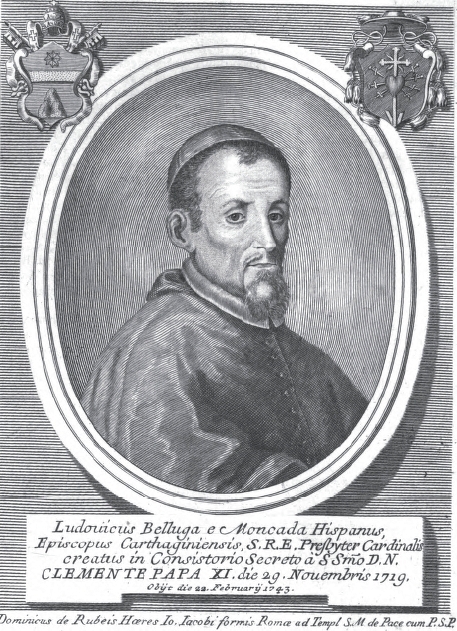 Luis Antonio Belluga y Moncada (aged 61) [Motril, Spain], Cardinal Priest of S. Maria in Traspontina (1721-1726). Studied in Granada and Seville. Doctor in Theology, Sevilla (1686). In 1687 he became a Canon at Zamora, and then Prebend in the Cathedral of Cordoba. In Cordoba he introduced the Congregation of the Oratorians of S. Philip Neri. He supported the party of Philip V de Bourbon in the War of the Spanish Succession. In gratitude, Philip named him Bishop of Cartagena. He was consecrated on April 19, 1705. In 1706 he was named Viceroy of Valencia and Captain General of Murcia. On November 29, 1719, Pope Clement XI named him cardinal. He had sworn a personal vow not to accept any office that was incompatable with residence in his diocese, but the Pope dispensed him. In 1724 he resigned his bishopric and travelled to Rome, in time for the Conclave of 1724 [Guarnacci II, 340, erroneously states that he was absent; his conclavists and his dapifer are granted conclave benefits]. He established his residence in Rome, and sought to live a life of prayer and meditation. He was a member of the SC of Bishops and Regulars, of the Council, of Rites, and of Ecclesiastical Immunity (a congregation founded on June 22, 1622, by Urban VIII, taking over tasks previously dealt with by the SC on Bishops (founded by Sixtus V on January 22, 1588). . He was offered the Archbishopric of Toledo, but he refused. Protector of Spain before the Holy See. He died in Rome on February 22, 1743, at the age of 80, and was buried in the Chiesa Nuova (S. Maria in Vallicella) [V. Forcella Inscrizione delle chiese di Roma IV, p. 179, no. 449]. [Biografia eclesiastica 14 (Madrid 1862), 239-240].
 - José Pereira de la Cerda (aged 61), Cardinal Priest of S. Susanna (died September 28, 1738). Doctor in utroque iure, Coimbra. Professor of Theology at Coimbra. Bishop of Faro [He is listed by some as 'absent', but his name and conclavists appear on the official list in the Bullarium Romanum, p. 47 col. 1 and p. 45 col. 1]
- Giovanni Battista Salerni, SJ (aged 52) [Cosenza], Cardinal Priest of S. Prisca (died January 30, 1729) Professor of Theology, Professor of Canon Law at the Collegio Germanico
- Carlos de Borja-Centelles y Ponce de León (aged 60), Cardinal Priest of S. Pudenziana (died August 8, 1733). Doctor in utroque iure, Alcala. Patriarch of the West Indies. [He is listed by some as 'absent', but his name and conclavists appear on the official list in the Bullarium Romanum, p. 47 col. 1 and p. 45 col. 1]
- Álvaro Cienfuegos Villazón, SJ (aged 67) [Spanish], Cardinal Priest of S. Bartolomeo all’Isola (died August 19, 1739). Professor of Theology, Salamanca. Bishop of Catania.
- Bernardo Maria Conti, OSB (aged 60) [Romanus], Cardinal-Priest of S. Bernardo alle Terme (died April 23, 1730). Major Penitentiary. Brother of Innocent XIII.
- Benedetto Pamphili, O.S.Io.Hieros.(aged 67) [Romanus], Cardinal Deacon of S. Maria in Via Lata (died March 22, 1730). Librarian of the Holy Roman Church. Prefect of the Signature of Grace.
- Pietro Ottoboni (aged 53) [Venice], Cardinal Deacon of S. Lorenzo in Damaso (died February 29, 1740). Vice-Chancellor. Archpriest of the Liberian Basilica (S. Maria Maggiore).
- Giuseppe Renato Imperiali (aged 69) [Genoa], Cardinal Deacon of S. Giorgio in Velabro (died January 15, 1737). Prefect of the SC of the Regular Clergy. Protector of Ireland. Leader of the Zelanti.
- Lorenzo Altieri (aged 49) [Romanus], Cardinal Deacon of S. Agata alla Suburra (died August 3, 1741).
- Carlo Colonna (aged 55) Romanus], Cardinal Deacon of S. Angelo in Pescheria (died July 8, 1739).
- Curzio d'Origo (aged 60) [Romanus], Cardinal Deacon of S. Eustachio, Prefect of the SC on the Council (died March 18, 1737).
- Melchior de Polignac (aged 59) [Chateau de la Ronte, near Puy en Vélay, Auvergne, France], son of Louis Armand, Vicomte de Polignac, and Jacqueline de Roure. Cardinal Deacon without deaconry He studied at the College de Harcourt in Paris, where an enthusiastic professor turned him into a Cartesian. His thesis at the Sorbonne was on pious kings of Judah who took away the high places. At the age of 28, he was a conclavist of Cardinal de Bouillon from August to October, 1689 [Crescimbeni Vite degli Arcadi V, 206], and served again in the same capacity in 1691. Member of the Académie Française (1704), taking the chair of Bossuet. Auditor of the Rota (1706-1709). Created Cardinal deacon in 1712, was not permitted by the French Regent, Philippe d'Orleans to attend the Conclave of 1721. In any event, he had not yet been ordained. He was ordained a deacon on September 8, 1722, at Anchin by Msgr. Pierre Sabatier, Bishop of Amiens; on the Saturday of Ember Week, September 19, he was ordained a priest. The Regent died on December 2, 1723. He did not receive a Roman Deaconry until after the Conclave of 1724, and then he held it only from September to November. He was promoted Cardinal Priest of S. Maria degli Angeli (1724–1741), having been named Chargé d'Affairs of King Louis XV before the Holy See (1724-1732), through the First Minister, Louis, Prince de Bourbon (1723-1726). He was a member of the Sacred Congregations of the Council, of Rites, of the Consistory, of Ecclesiastical Immunity (a congregation founded on June 22, 1622, by Urban VIII, taking over tasks previously dealt with by the SC on Bishops (founded by Sixtus V on January 22, 1588), and de Propaganda fide. Archbishop of Auch (1726–1741). In 1728 he was granted the Collar of the Order of the Holy Spirit. Member of the Arcadian Academy from 1724 [biography in Crescimbeni, Vite degli illustri Arcadi V, 203-224] He died in Paris on November 20, 1741, and was buried in Saint-Sulpice.
- Fab(riz)io Olivieri (aged 62) [Pisauro], Cardinal Deacon of Ss. Vito, Modesto e Crescenzia (died February 9, 1738).
- Carlo Maria Marini (aged 54) [Genoa], Cardinal Deacon of S. Maria in Aquiro (died January 16, 1747).
-
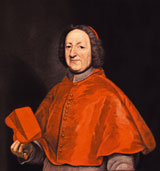 Giulio Alberoni (aged 56) [Piacenza], Cardinal Deacon without deaconry. He had received his red hat from Clement XI on July 12, 1717, at the specific request of King Philip V and Queen Elizabeth (of Parma) of Spain. It was in fact extortion. Alberoni began his career as a poor priest in the cathedral of Piacenza. He advanced when he found a place in the entourage of the Vice-Legate of Ravenna, Giorgio Barni, Bishop of Piacenza (1687-1731). Initially he was attached to the Duke de Vendôme, who was conducting the Italian theater of the War of the Spanish Succession (in concert with the Duke of Parma); thanks to the Duke's influence he was appointed Canon in the Cathedral of Parma. Alberoni subsequently served with him in the war in Flanders (from 1707), and then followed him to the Court of Spain; he lost his patron to death on June 11, 1712. Alberoni was nothing but an adventurer from Parma who had ridden to power in Madrid on the wedding veil of King Philip V's second Queen, to whom he had attached himself like a leech. He had then helped Elizabeth Farnese to rid Spain of her rival, Princess Orsini. He had engineered the fall of Cardinal del Giudice as Grand Inquisitor of Spain and principal minister of Philip V. He had himself named Bishop of Malaga, but the bulls were never provided; he received the income of the Bishopric of Malaga, nonetheless, during the vacancy of 1717-1725 [Gams, 49]. His fall from power in Spain was sudden and complete, his dismissal being handed to him on December 5, 1719, along with an order to leave Madrid within eight days and Spain within twenty-one. At Lerida, his belongings were searched, on the grounds that he had left Madrid with state papers in his possession. After leaving Barcelona, he was plundered by bandits. At Narbonne, too, his baggage was searched, this time by Customs officers under orders from the Chevalier de Marcieu, who had been ordered by the Regent of France to accompany Alberoni, and extract whatever information he could from the Cardinal. Sailing for Italy, he was met at Sestri Levante in Genoese territory by a papal official, who forbade his entry into the Papal States, on penalty of imprisonment [Professione, 264]. When Alberoni retreated to Genoa, France, the Emperor, and the Pope each tried to have him detained. On March 19, 1720, Clement XI appointed a Commission of Cardinals to try his case: Albani, Astalli, Barberini, Bentivoglio, Conti, Corradini, Corsini, Fabroni, Paracciani, Paolucci, Scotti, Tanara, Tolomei, Vallemani, and Zondadari; they were joined by three other prelates: Alamanni, Marefoschi and Riviera [Professione, 277]. The Genoese, however, allowed him to go on his way, and he reached Modena and Lucarno; he found refuge in a castle in the Alps (Castelnuovo Scrivia, in Austrian territory in Lombardy) until the death of Clement XI. He then emerged, to head by way of Bologna to Rome for the Conclave. The majority of the Cardinals voted to allow him to participate, but many of them refused to have anything to do with him personally.
The new Pope, Innocent XIII (Conti) turned him over to a commission of Cardinals, which convicted him and imposed a three-year sentence in a monastery. This was reduced by the Pope to a single year. When the Regent of France, Philippe d'Orleans, died in July of 1723, another of Alberoni's enemies was removed. But he did not receive a deaconry, S. Adriano al Foro, until 1724. He was not consecrated a bishop until 1725. (died June 26, 1752, at the age of 88) [Cardella, Memorie de' cardinali VIII, 169-176] - Alessandro Albani (aged 31) [Urbino], Cardinal Deacon of S. Maria in Cosmedin (died December 11, 1779) Brother of Annibale Albani. He succeeded Cardinal Tanara as Abbot Commendatory of the Abbey of Nonantola (1724-1779).
- Galeazzo Marescotti (aged 96), Cardinal Priest of S. Lorenzo in Lucina (died July 3, 1726) . Doctor in utroque iure.
- Louis-Antoine de Noailles (aged 72), Duke of S. Clodoald, Peer of France, Member of the Order of the Holy Spirit, Provisor of the Sorbonne. Son of Anne Duc de Noailles and Louise Boyer. Cardinal Priest of S. Maria sopra Minerva (died May 4, 1729). Doctor of Theology (Paris), 1676. Bishop of Cahors (1679-1680) [Gallia christiana I, 153]. Bishop of Chalôns-sur-Marne (1680-1695) [Gallia christiana 9, 901]; he participated in the Assembly of the Clergy in 1682, out of which came the Gallican Articles. Archbishop of Paris (1695-1729) [Gallia christiana 7 (1744), 188-191]
- Lorenzo Fieschi (aged 81), Cardinal Priest of S. Maria della Pace (died May 1, 1726). Archbishop of Genoa (1705-1726). Doctor in utroque iure, Rome La Sapienza.
- Christian August von Sachsen-Zeitz [Ágost Keresztély] (aged 57), Cardinal Priest without titulus (died August 23, 1725). Bishop of Györ. Supreme Chancellor of Hungary. Imperial Councillor.
- Imre Csácky (aged 51), Cardinal Priest of S. Eusebio (1721-1732). (died August 28, 1732). Archbishop of Kalocsa and Bács (1714-1732). [He is listed by some as 'present' (e.g. Guarnacci II, p. 312), but his name and conclavists do not appear on the official list in the Bullarium Romanum, pp. 45-50]
- Nuno da Cunha e Attaíde (aged 59), Cardinal Priest without titulus (died December 3, 1750). Privy Councillor of King John V of Portugal
- Wolfgang Hannibal von Schrattenbach (aged 63), Cardinal Priest of S. Marcello (died July 22, 1738). Doctor of Philosophy, Doctor of Theology (Rome La Sapienza). Bishop of Olomouc. Councillor of Emperor Charles VI. Regent of Naples.
- Damian Hugo Philipp von Schönborn Bushein (aged 47), Cardinal Priest of S. Pancrazio (died August 19, 1743). Bishop of Speyer (1719-1743).
-
Léon Potier de Gesvres (aged 67), son of Léon, Duc de Gesvres, Peer of France, Governor of Paris; and Marie-François-Angelique du Val, daughter of François, Marquis de Fontenay-Mareüil. Cardinal Priest without titulus, nominated in 1707 by King Stanislas of Poland and confirmed by King Augustus. Doctor of Law, Paris Sorbonne. Protonotary Apostolic de numero participantium. Archbishop of Bourges (1694-1729), consecrated by Cardinal César d'Estrées. (died November 12, 1744).
- Michael Althan (aged 41), Cardinal Priest of S. Sabina (died June 20, 1734). Doctor in Canon Law, Doctor in Theology, Prague. Bishop of Vác. Privy Councillor of the Emperor. Viceroy and Captain-General of the Kingdom of Naples.
Novendiales
The Second Congregation was held on the morning of Saturday, March 11, after Mass, in the Sacristy of the Vatican Basilica. All of the officials of the government, both in Rome and in the Papal States, were confirmed in office. Msgr. Maffeo Farfetti was elected Governor of the Borgo and of the Conclave. The Conservatori were received to present their condolences and to swear their oaths of loyalty [Diario Ordinario, 17 Marzo, p. 8]. Then the French Minister at the Papal Court, Msgr. Pierre Tencin, Abbot of Vezelay and Archdeacon of Sens, was received to present his condolences [Diario Ordinario, 17 Marzo, pp. 9-12].
On Sunday, March 12, the Second Requiem Mass was celebrated by Cardinal Francesco d'Aquaviva in the Chapel of the Choir in the Vatican Basilica, with twenty-three other cardinals in attendance. After the Mass, the Third Congregation took place in the Sacristy, and the confessors of the Conclave were appointed. Crowds continued to come to view the body of the late Pope, though the weather was extraordinarily cold and snow had fallen the previous Thursday night. The interment took place on Sunday night, presided over by Cardinals Giorgio Spinola, José Pereira de la Cerda, Bernardo Maria Conti (the dead Pope's brother), Fabio Olivieri, and Alessandro Albani.
On Monday, March 13, the Third Requiem Mass was celebrated by Cardinal Agostino Fabroni [Diario ordinario 1033, 18 Marzo, p. 2]; twenty-five other cardinals participated. Cardinal Alberoni was a new attendee. The Fourth Congregation elected the physicians to the Conclave. The condolences of the King of Portugal were presented by Don Andrea de Mello y Castro of the Conti de Galveas, Member of the Royal Council of Portugal, the Ambassador Ordinary. Cardinal Albani, the Protector of Poland, presented the condolences of the King of Poland. Cardinal Acquaviva did the same on behalf of the Court of Spain, Cardinal Gualtieri on behalf of England, and the Minister Plenipotentiary Cardinal Cienfuegos on behalf of the Emperor.
On Tuesday, March 14, the Fourth Requiem Mass was celebrated by the Camerlengo, Cardinal Annibale Albani [Diario ordinario 1033, 18 Marzo, p. 4]. Cardinal G.-B. Bussi, Archbishop of Ancona, was not yet present, having arrived in Rome only the previous evening. Neither was Cardinal Luigi Pico della Mirandola, who was also in Rome. At the Fourth Congregation, the junior Cardinal Deacon, Alessandro Albani, drew the lots for the assignment of cells in the Conclave. The Venetian Ambassador, Pietro Cappelli, presented the condolences of the Serenissima. Fra Giovanni Battista Spinola, Bailly and Grand Cross of the Order of the Military Order of Jerusalem, presented the condolences of his Order.
On Wednesday, March 15, Cardinal Patrizi, the Legate of Ferrara, arrived in Rome. Cardinal Bernardino Scotti sang the Fifth Requiem Mass, attended by twenty-five cardinals. At the Fifth Congregation, the surgeon and barbers of the Conclave were appointed.
On Thursday, March 16, the Sixth Requiem Mass was celebrated by Cardinal Antonio Zondadari; twenty-seven other cardinals were present. The Sixth Congregation authorized an extra conclavist for those cardinals who were ill.
On Friday, March 17, Cardinal Giovanni Battista Bussi sang the Seventh Requiem Mass. At the Seventh Congregation, Cardinals Corsini and Ottoboni were elected to examine the credentials of the Conclavists.
On Saturday, March 18, the Eighth Requiem Mass was sung by Cardinal Niccolò Spinola.
Sunday, March 19, was the last day of the Novendiales. Cardinal Giorgio Spinola sang the Requiem Mass in the presence of twenty-three cardinals. The Funeral Oration was pronounced by Msgr. Giacomo Amadori, già de Lanfredini, Domestic Prelate and Civil Auditor of the Cardinal Camerlengo. The "King and Queen of England" were present. [Diario Ordinario 1037, in data delli 25 Marzo, 1724, p. 2]. That same day Cardinal Orazio Filippo Spada, Bishop of Osima, arrived in Rome.
Factions and Candidates
The Conclave of 1724 began on Monday, March 20, with thirty-six cardinals in attendance. In the Vatican Basilica, in the Chapel of the Choir, the Mass of the Holy Spirit was sung by Cardinal Francesco del Giudice, in place of Cardinal Tanara, the Dean of the Sacred College (who was, nonetheless, present). At the conclusion of the Mass, the Oration de pontifice eligendo was pronounced by Msgr. Francesco Bianchini, Domestic Prelate, Canon of the Liberian Basilica [The Address is published in: Diario ordinario 1052, in data delli 29 Aprile, 1724, pp. 4-30]. The procession to the Conclave was led by Msgr. Francesco Bolza, Canon of S. Maria Rotonda and Master of Ceremonies, carrying the Cross. When the cardinals had reached the Capella Paolina, and after everyone else had been excluded, Cardinal Tanara presided over the recitation of the Apostolic Constitutions governing conclaves, and each Cardinal swore the solemn oath to observe them. In the evening Don Agostino Chigi, the Marshal of the Holy Roman Church, took up his position as Guardian of the Conclave. Around the sixth hour of the night the Conclave was enclosed [Diario ordinario 1037, 25 Marzo, 1724, p. 11].
In the evening of March 20, Cardinal Giuseppe Vallemani and Cardinal Luigi Pico della Mirandola, who were both somewhat indisposed earlier in the day, entered Conclave.
In the evening of Wednesday, March 22, three more cardinals entered Conclave: Ulisse Gozzadini, Giulio Piazza, and Pietro Corradini [Diario ordinario 1037, 25 Marzo, 1724, p. 15]. In the evening of Thursday, March 23, Cardinal Orazio Filippo Spada entered Conclave. There were now thirty-seven cardinals inside the Conclave. On the same evening, the 23rd, Cardinal Francesco Pignatelli, Archbishop of Naples, arrived in Rome and took up residence at the Palazzo di Propaganda Fide. On Saturday, the 25th, Cardinal Carlo Maria Marini entered Conclave, and Cardinals Tommaso Ruffo (Bishop of Ferrara and Legate in Bologna) and Cornelio Bentivoglio (Legate in the Romagna) arrived in Rome [Diario ordinario 1040, in data del 1 Aprile, 1724, p. 5-6]. On Sunday, March 26, Cardinals Pignatelli and Ruffo entered Conclave. On Tuesday, the 28th, Cardinals Orsini and Bentivoglio entered. On the 31st, the Venetian Ambassadors Extraordinary and Cardinal Barbarigo, Bishop of Padua, arrived; he entered Conclave on April 3. As of April 1, there were forty-three cardinals in Conclave. Cardinal Antonio De Via (Davia) arrived in Rome on Sunday, April 3 from Rimini. On the 4th, Cardinal Innico Caraccioli arrived. On Friday, April 7, Cardinal Boncompagni, Archbishop of Bologna, arrived in Rome, and Cardinal Caraccioli entered Conclave. On Saturday, April 8, the Venetian Ambassador Ordinary, Pietro Cappelli, was received by the Cardinals at the gate of the Conclave [Diario ordinario Num. 1046, in data delli 15 Aprile, 1724, p. 2]. The next day was Palm Sunday. On Tuesday, April 11, Cardinal Odescalchi arrived from Milan.
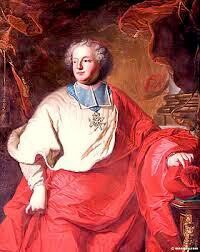 There were again, as in 1721, four groups, but the French and the Spanish were working in concert. The French had no authorized representative at the opening of the Conclave. Cardinal de Rohan [portrait at right] would not arrive for some weeks. In the meantime Abbe Pierre de Tencin acted as the French agent. He made the appropriate speech of condolence to the assembled cardinals, and he made the courtesy rounds of each cardinal. [Boutry, 102]
The Imperial party was led by Cardinals Alvaro Cienfuegos, SJ, Bishop of Catania, and Francesco del Giudici, Cardinal Bishop of Frascati. The Emperor was recommending several candidates: Corsini, Spada, Bussi, Piazzi, Barbadigo, and Gozzadini. On his own initiative Cardinal Cienfuegos was promoting Cardinal Imperiali. He sent Count Kaunitz again as Ambassador Extraordinary to represent his interests, and insisted that Cardinal Althan should leave Naples, where he was acting as Viceroy, and present himself at the Conclave. Unfortunately, the Imperial cardinals were not in evidence—Schoenbrunn (Speyer), Schrattembach (Olomouc), and Imre Czaki (Kalocsa and Bacs, Hungary); neither was the Cardinal of Malines. In the meantime Cienfuegos frantically tried to delay proceedings until the Cardinals of 'the Crowns' could arrive. In this he had the cooperation of Abbé de Tencin and Cardinal Acquaviva, who had been the representative of Philip V of Spain and Cardinal Protector of Spain (since 1713) in Rome. [Boutry, 102-103]
The Venetians wanted their three cardinals to hold back and await developments which might be favorable to Venice, but Cardinal Ottoboni was already committed to the French, Priuli (Bishop of Bergamo) was in league with Albani, and Barbarigo (Bishop of Padua) wanted nothing to do with the political schemes of the Venetian Republic.
The Zealots [Zelanti], the most numerous group, were led by Cardinal Giuseppe Imperiali, the papal Legate in Ferrara and Protector of Ireland, and by Cardinal Pietro Ottoboni. Parties formed in favor of Cardinal Giulio Piazza (Bishop of Faenza), comprised of Italian nationalists; and another in favor of Cardinal Ulisse Gozzadini, Bishop of Imola. Cardinal Alberoni was also active, and along with Cardinal Giorgio Spinola, Cardinal of S. Agnese, formed a bloc of eight votes. They were working with the English agent in Rome, John Walton (an informant of no high reliability), whose purpose was to see that neither Paolucci nor Albani, nor their partisans, would be elected [Petruccelli, 24].
The Arrival of Rohan
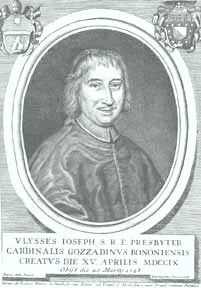 In March Prince Albani wrote to his two brothers in conclave, "If conscience orders you to elect this pope [Gozzadini: portrait at left], I have nothing to say. I just warn you that on the day Gozzadini is pope, I will leave Rome with my family and not return until after his death." Unfortunately Gozzadini came to know about this letter [dispatch of Giacobazzi, March 25; Petruccelli, 31] (Cardinal Ulisse Gozzadini's image at left).
On Monday, April 10, Cardinal de Rohan arrived in Rome, and entered Conclave on Wednesday the 12th [Diario ordinario Num. 1046, in data delli 15 Aprile, 1724, p. 7]. He was followed by Cardinal de Bissy on the 12th, and Cardinal Melchior de Polignac on Friday, the 21st [He entered Conclave on the evening of the 23rd: Diario ordinario 1052, in data delli 29 Aprile, 1724, p. 35; Boutry, 105]. Polignac had been the conclavist of Cardinal de Bouillon in 1689 and again in 1691; he was thoroughly familiar with the habits of conclaves. He was also thoroughly familiar with the transaction which had taken place in 1721 involving Cardinal Conti, Cardinal Rohan, Archbishop Dubois and Abbé Tencin that made Conti pope: "Quand il fut mort, on ne parle dans Rome que de cette affaire. Les zélants protestèrent de mourir plutôt que de souffrir une seconde fois de semblables pratiques et les moins zélés se demandaient comment on pourrait se fier à quelqu'un, après ce qui venait d' arriver." [Boutry, 34-35].
Cardinal Rohan believed that, thanks to his groundwork with Cienfuegos, Aquaviva and Albani, he would have an easy time achieving his goals. He was taken by surprise by the revelations of his own past deeds, but worse was about to befall him. He had been carrying an agreement, made in Paris, to join with Cardinal Albani's faction to make Cardinal Fabio Olivieri pope, in exchange for a number of concessions, including (according to Walton, in a dispatch of Tuesday, April 18) three red hats for the French. The agreement was made public by Cardinal Del Giudice, the Cardinal Bishop of Frascati, and it caused a sensation of indignation (a leak in Paris had become known to Cardinal Corsini, who passed on the information). The ambassador of Turin, De Gubernatis, wrote, in a dispatch of Saturday, April 22, of a universal outcry against Olivieri [Petruccelli, 34]. An investigation, pressed by the Zelanti, revealed that Olivieri had signed more than twenty letters involving negotiations with France, Spain and Vienna. Twenty-one cardinals, led by Giorgio Spinola and Francesco Del Giudice, signed a pledge to die in conclave before giving their assent to the election of Olivieri [Petruccelli, 35]. Corsini agreed to the pledge, but refused to sign the agreement. That number constituted an exclusiva tacita. Albani finally abandoned Olivieri. Without a candidate, Rohan immediately wrote to Paris for instructions; Cienfuegos wrote to Vienna; and Acquaviva wrote to Madrid. While waiting for responses, Cardinal Albani proposed one after another of his candidates, without hope or expectation of success. The Zealots continued to advance the cause of Paolucci. Rohan, ill, left the conclave for a few days on Sunday afternoon, April 23 [Diario ordinario 1052, in data delli 29 Aprile, 1724, pp. 33-34]. On his return, on Saturday, April 29, after lunch [Diario ordinario 1055, in data delli 6 Maggio, 1724, p. 2] , he is said to have remarked in very bad humor, "Ah! Vous ne voulez pas d' Olivieri; soit; mais vous n'aurez pas non plus Paolucci." [Petruccelli, 36]
The Arrival of Graf Kaunitz
 Cienfuegos wrote to Vienna that the election of Paolucci was almost inevitable. The Imperial Ambassador Extraordinary, Count Maximilian Ulrich Kaunitz, arrived in Rome on Sunday, April 23 [Diario ordinario 1052, in data delli 29 Aprile, 1724, pp. 35-36], and was received at the gate of the Conclave on Sunday afternoon, April 30, after the conclusion of the day's Scrutiny [His Address is published in: Diario ordinario 1058, in data delli 13 Maggio, 1724, pp. 6-8]. Subsequently, in a long conversation he made it clear to Cienfuegos that Paolucci was absolutely unacceptable to the Imperial advisors in Vienna. But he also stated that the Emperor himself had been persuaded by the Jesuits and by Prince Eugen that, if no candidate more sympathetic to Vienna could be found, Paolucci would be accepted.
On Wednesday, April 26, Cardinal Agostino Cusano, Bishop of Pavia, arrived in Rome [Diario ordinario 1052, in data delli 29 Aprile, 1724, p. 36]; he entered Conclave on the evening of April 30 [Diario ordinario 1055, in data delli 6 Maggio, 1724, p. 7]. By Saturday, April 29, 1724, there were fifty cardinals in conclave (dispatch of Giacobazzi, Petruccelli, 38). Thirty-four votes were needed for a canonical election. On Thursday, May 4, Cardinal Tanara, the Dean of the Sacred College, died [Diario ordinario 1055, in data delli 6 Maggio, 1724, p. 8].
In the midst of all the bad humor and recriminations, a committee of some Zelanti and the representatives of the Crowns attempted to agree upon the names of some acceptable candidates. They proposed Ruffo, Cusani, Corsini and Gozzadini. Immediately messengers were sent to consult with the various Courts. (various dispatches of 3, 6, and 8 May) The results of the consultations, however, seemed to point to Cardinal Giulio Piazza, Bishop of Faenza, and, at a meeting that took place in the cell vacated by the death of Cardinal Tanara, the French, Imperialists and Zelanti laid their plans. Unfortunately a space in the quarters was still occupied by a servant of the late Cardinal Dean, and he immediately informed the Albani of what was being discussed. The night was spent by the Albani faction trying to find the seventeen votes needed to block the election of Piazza. Cienfuegos had a particularly disagreeable conversation with Annibale Albani in his cell, and, though they were both supposed to be supporting Piazza, they parted in angry disagreement as to whose creature Piazza actually was.
Alessandro Albani put together an unsavory biography of Piazza, which he quickly circulated, and Cardinal Scotti went around accusing Piazza of being a supporter of Jansenist doctrines. Argument went on into the next day, but finally Albani had twenty-four votes, ten for Fabbroni (he announced) and fourteen for Orsini. Piazza could not advance to the Throne of Peter.
Instructions from Madrid
Cardinal Luis Belluga, Bishop of Cartagena, arrived in Rome on Saturday, May 13, and entered Conclave in the evening of Sunday, May 14 [Diario ordinario 1061, in data delli 20 Maggio, 1724, p. 2]. More significantly,Cardinal Carlos de Borja-Centelles (Patriarch of the West Indies) also arrived, at last, on May 14, and entered Conclave in the evening of Monday, May 15. He carried the latest instructions from Madrid [Petruccelli, 44]. They were said to be hostile to Piazza. Cienfuegos immediately wrote to Vienna in exaspiration, demanding either plenary powers or help. The return courier arrived on the evening of Sunday, May 28, with an order from the Emperor not to break with Albani but to come to an agreement with him on a choice [Petruccelli, 46]. At the same time a courier arrived from Paris with news for Cardinal Rohan of the death of his nephew. A chance word of Rohan to Del Giudice in compliment to Orsini caused Del Giudice, who was a secret partisan of Orsini, to invite Rohan to think seriously about Orsini, who had already received fourteen votes. Fabbroni, Vallemani, and Tolomei, inspired by Del Giudice, wondered why the cardinals should not take seriously the votes for Orsini which Albani had certainly authorized just to show his power.
When Cardinal Cienfuegos was approached, he could only say that he had no instructions on Orsini, and was waiting for a courier. To attempt to convince Cienfuegos, it was pointed out that Orsini was a Neapolitan, and thus an Imperial subject who had fiefs and supporters in the Kingdom of Naples. Cienfuegos replied that Orsini was a monk, was too zealous, and had stirred up his diocese of Benevento. The cardinals replied that he and his Emperor would be left behind on the morrow.
Election of Cardinal Orsini
 In the morning scrutiny of Monday, May 29, Orsini received thirty votes, six short of the two-thirds majority. Cienfuegos would only give way after consulting with the representatives of the other Crowns and with Albani. Then Cardinals Tolomei, Belluga and Albani had to convince Orsini to accept; this took three hours. Finally, at the afternoon scrutiny, which actually took place around the dinner hour, Vincenzo Maria Cardinal Orsini de Gravina, OP, Cardinal Bishop of Porto, was elected with 52 votes; his own went to Cardinal Paolucci [Diario ordinario 1065, in data delli 31 Maggio, 1724, pp. 17-18]. When he was approached by Cardinal del Giudice, the senior Cardinal Bishop, Cardinal Giacomo Boncompagni, the senior Cardinal Priest, and Cardinal Benedetto Pamphili, the Senior Cardinal Deacon, accompanied by the Camerlengo, who posed the traditional question, "Acceptasne electionem?", Cardinal Orsini hesitated for some time, in the midst of tears. Finally, at the urging of Cardinal Tolomei, he said the required words [Diario ordinario 1065, in data delli 31 Maggio, 1724, p. 4]. He took the name Benedict XIII. The Act of Acceptance was drawn up by Msgr. Gambarucci, the principal Master of Ceremonies, who was also a Protonotary Apostolic. After his change of costume, Pope Benedict was presented with the new Fisherman's Ring by the Camerlengo, Cardinal Albani.
Cardinal Pamphili, the senior Cardinal Deacon, was escorted by the crossbearer, Canon Francesco Bolza, to the loggia of the Portico of the Vatican Basilica, where the happy announcement was made to the people. Since it was already growing dark, the procession of the new pope to the Basilica was illuminated by torches. There, at the high altar, the third Adoration was performed. Thereafter, the Pope imparted his first solemn Apostolic Benediction.
The coronation took place on Sunday, June 4, 1724, the Feast of Pentecost, on the front steps of the Vatican Basilica. Early in the morning the Pope had distributed to each of the poor people found in the Belvedere courtyard a golden giulio. The Coronation was carried out by Cardinal Ottoboni, the prior Diaconum. An extensive description of the ceremonies is given in the Roman periodical, Diario ordinario [Num. 1070, in data delli 10 Giugno, 1724 (Roma: Chracas 1724), 2-31; Roma sacra (Roma: 1725), 701-712]. The Dominicans at the Minerva were so overjoyed at the election of one of their own that for three days there were Solemn Masses, Te Deums, and distributions of alms to the poor.
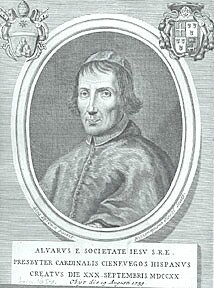
Benedict XIII reappointed Cardinal Paolucci as his Secretary of State, a post which he had held since 1700, and which he would continue to fill until his death on June 12, 1726 (portrait above, at right). He also reappointed Cardinal Pietro Corradini as pro-Datary, and Cardinal Olivieri as Secretary of Briefs. Msgr. Prospero Marefoschi was named his Auditor, Msgr. Nicolo Lercari was named his Maestro di Camera.
On September 24, 1724, the new pope took possession of the Lateran Basilica. His host was Cardinal Benedetto Pamphili, the Archpriest of the Lateran. Twenty-nine cardinals attended. Each cardinal was given a gold and a silver medal to commemorate the occasion. The Pope left at the high altar a purse containing 150 newly struck silver scudi. The details of the event are printed in Diario Ordinario Num. 1117, 30 Settembre 1724 (Roma: Chracas 1724).
Bibliography
Distinto Ragguaglio della malattia, e morte del sommo pontefice Innocenzo XIII.... (Firenze: Anton Maria Albizzini 1724).
Diario ordinario Num. 1030. In data delli 11 Marzo 1724.... Diario ordinario Num. 1146. In data delli 9. Decembre 1724. (In Roma: Stamperia del Chracas 1724).
[Abbé Anselme Tricaud], Relation de la mort du feu Pape, et du Conclave, assemblé pour l' Election de Benoît XIII son successeur (Nancy: Jean-Baptiste Cussom 1724).
Distinta Relazione di tutte le Cerimonie fatte nella solenne Coronazione di nostro Sig. Papa Benedetto XIII (Benedetto Soto Librario 1724) [almost entirely a generic rituale, not an historical account].
Roma sacra e moderna, Gia descritta dal Pancirolo ed accresciuta da Francesco Posterla... E di nuovo con somma diligenza, e studio riordinata da Gio: Franceco Cecconi... aggiuntovi anche in fine un Diario Istorico, che contiene tutto cio che e accaduto di piu memorabile in roma dalla clausura delle Porte Sante 1700. fino all' aperatura delle medesime nell' anno 1724... (Roma: Mainardi 1725). [pp. 680-720]
Joannes Rudolphus Conlin, Roma Sancta, sive Benedicti XIII. Pontificis Maximi et Eminentissimorum et Reverendissimorum S. R. E. Cardinalium viva virtutum imago ... qui ultimo conclavi anno 1724 interfuere.... (Augustae Vindelicorum 1726). Giuseppe de Novaes, Elementi della storia de' Sommi Pontefici third edition Volume 13 (Roma 1822), 7-16; 37; 44-46. G. Moroni, Dizionario di erudizione storico-ecclesiastica Vol. V (Venezia 1840) 9-11. Alexis François Artaud de Montor, Histoire des souverains Pontifes Romains, Volume VI (Paris 1851), pp. 332; 346-347. Ferdinando Petruccelli della Gattina Histoire diplomatique des conclaves Volume IV (Bruxelles 1864), 21-52 Max, Ritter von Mayer, Die Papstwahl Innocenz XIII. (Wien: Wilhelm Braumüller 1874). A. Casino, Papa Benedetto XIII (Molfetta 1980). Orietta Filippini, Benedetto XIII (1724-1730), un papa del settecento secondo il giudizio dei contemporanei (Stuttgart: Anton Hiersemann 2012)
Lorenzo Cardella, Memorie storiche de' cardinali della Santa Romana Ecclesia Tomo Ottavo (Roma: Pagliarini 1794).
Maurice Boutry, Une créature du Cardinal Dubois: Intrigues et missions du Cardinal de Tencin deuxième édition (Paris 1903).
Chrysostome Faucher, O.Min., Histoire du Cardinal de Polignac 2 vols. (Paris 1780) [fulsome and fawning]. P. Paul, Le Cardinal Melchior de Polignac (Paris, 1922).
On Cardinal Alberoni, see Charles Bertin, Dictionnaire des Cardinaux (1858) 205-208. G.P.R. James, Lives of the Most Eminent Foreign Statesmen, Vol. IV (London 1837), pp. 130-267 [derived from John Russell, Memoires of the Affairs of Europe from the Peace of Utrecht I (London 1824)]. Alfonso Professione, Il ministero in Spagna e il processo del Cardinale Giulio Alberoni (Torino 1897) 293-295. Camillo Pariset, Il Cardinale Giulio Alberoni (Bologna: Nicola Zanichelli 1905). S. Harcourt-Smith, Cardinal of Spain: The Life and Strange Career of Alberoni (1944).
'John Walton' was in fact a Prussian, Baron Philip de Stosch, who served as an espionage agent for the British Government (in particular Lord Carteret) in Rome: Martin Haile, James Francis Edward, the Old Chevalier (London: Dent 1907) 293-294.
Ludwig Wahrmund , Das Ausschliessungs-recht (jus exclusivae) der katholischen Staaten Österreich, Frankreich und Spanien bei den Papstwahlen (Wien: Holder 1888) 225.

