Sede Vacante 1187
December 17, 1187–December 19, 1187
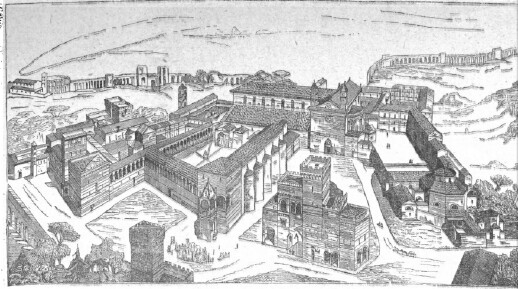
Clement III (Paolo Scolari) brought the Papacy back to the Lateran Palace
Background
Gregory VIII succeeded to the Papal Throne at a moment of extreme crisis. Urban III, in his high-minded and uncompromising way, had paid no attention to the realities of his situation. The popes had been expelled from Rome, and the city was in the hands of a Commune which was hostile to papal political pretensions. Pope Lucius had not even been able to maintain himself in the Roman Campagna. With Archbishop Christian of Mainz dead (1183), the Papacy had no German commander who could lead a papal army to assert its rights. The popes were now living in Lombardy, which was Imperial territory, and the Emperor, Frederick Barbarossa had been campaigning there vigorously for years, hoping to recoup all of his losses, real and psychological, from his defeat at the Battle of Legnano in 1176. His son, Henry (Heinrich VI) was only in his early twenties, and already an accomplished military commander. In 1187 he had campaigned in southern Tuscany and the Campagna with considerable success. When Urban III decided to exercise his spleen against his enemy the Emperor, he maneuvered himself into an impossible situation, politically, diplomatically, and personally. He and his court were trapped in Verona.
The Annales Romani [Watterich II, 691] report that, immediately on his election, Gregory VIII (Alberto di Morra) began to reverse the policy of the previous two reigns and attempt to restore the Roman Church. Indeed he had been elected specifically because he had been friendly toward and useful to the Emperor. Gervase of Canterbury writes that Cardinal Albert di Morra had a good deal of credit with the Emperor, and it was he who had been keeping the Emperor briefed on the confidential doings of the Roman Curia [ed. Stubbs II, p. 402; Watterich II, p. 684]:
Sciebant enim cardinales quod idem Albertus multam imperatoris haberet gratiam, eo quod ipsius semper fovens partem, eidem omnia Romanae curiae revelaret secreta.
He immediately promised King Henry that he would grant him the Imperial crown, which had been denied him by Urban III, stating that it was not the business of the Pope and Cardinals to take up arms and wage war, but to spend their time in charity and prayer. This concession, which cost him nothing but which was an object of great value to Frederick and Henry, brought about an immediate change in the political climate, however artificial and temporary. Robert of Auxerre reported in his Chronicle [Watterich II, 691]:
Audita eius promotione laetatus est admodum Fredericus Augustus, eo quod virum discretum et iustitiae zelatorem cognosceret sibique benevolum et omnibus, si viveret, profuturum.
The Emperor gave immediate orders to his various officials to show the new Pope every respect and to supply him from Imperial resources as he journeyed through his territories. The Pope, it seemed, might be going back to Rome. Henry did the same, granting the Pope and his Court free passage throughout the entire Roman Empire [Annales Romani: MGH SS 5, p. 479; Watterich II, 692]. The papal suite left Ferrara on November 16, and were in Bologna on the 18th. On the 22nd they were at Modena, and at Parma on the 26th.
On November 30, Gregory was at Foro Novo, whence he wrote to Volcmar (Folmar) of Trier, inhibiting him from launching any additional excommunications or depositions, for the sake of the Oriental Church, the good will of the Emperor, and many other reasons [Watterich II, 690; JL 16075].]
Death of Pope Gregory VIII
The Pope and his entire Curia, accompanied by Leo Monumenti, the Roman consul, and Anselm, a German Count, set out for the south. They stopped at Lucca on December 7, where the Pope had the un-Christian pleasure of turning the Anti-pope Victor IV (Octavianus), who had died in 1164, out of his tomb [Nicolaus, Canon of Amiens, Chronica, in continuation of Sigibert: MGH SS 6, p. 474; Watterich II, 692]. They managed to get as far as Pisa, on December 10, 1187. The Pope's intention was to settle a dispute which was being carried on between Pisa and Genoa [Annales Romani: MGH 5, p. 480; Watterich II, 692; Chronicon breve Pisanum sub anno 1186, in Ughelli Italia Sacra 10, Anecdota, 121]:
Gregorius Octavus Papa ingressus urbem Pisanam, receptus est ab eisdem Pisanis cum magno honore 4. Id. Decembr., et mortuus est Pisis 16 Kalen. Januar. [December 17, 1187]
The Annales Romani [Watterich II, p. 692] reports, however, that he was stricken by a sudden illness (repentino morbo) and died. He had reigned only fifty-seven days. He was buried in the Cathedral of Pisa [Nicolaus, Canon of Amiens, Chronica, MGH VI, 474]. His monument was unfortunately destroyed in the fire of 1600.
The Cardinals
No new cardinals had been created in the 57 day reign of Gregory VIII. The College of Cardinals, therefore, was basically the same as in the October Election, without Cardinal de Morra (Gregory VIII) and Cardinal Petrus de Bono (who died on November 20, 1187) [G. G. Trombelli, Memorie istoriche cocern. le due canoniche di S. Maria di Reno e di S. Salvatore (Bologna 1752), p. 227; J. Brixius, Mitglieder, p. 65]. Ciaconius-Olduin (columns 1133-1134) provides a list of the cardinales "qui interfuerunt comitiis in quibus electus est Clemens Papa Tertius"; the list contains twenty-two names; it still includes Petrus de Bono. A bull subscribed by nine cardinals on 11 December 1187, is a likely starting point [JL 16093]; it lists: Paulus, Theobaldus, Laborans, Melior Jac(inthus), Gratianus, Octavianus, and Petrus.
- ? Konrad von Wittelsbach, consanguineus Imperatoris [Frederici], de Bavaria oriundus. Count Palatine of the Rheinland. Bishop of Sabina, Archbishop of Mainz (November 1163-October 25, 1200) and Salzburg. Brought up in the Church of Salzburg (Christiani Chronicum Moguntinum, in P. Jaffé, Bibliotheca Germanica III, p. 693). In the early part of his career he was embroiled in the schism between Alexander III and "Victor IV" and his Imperial supporters in Germany, and was forced to flee to Rome. In 1177 it was agreed that he should have the Archbishopric of Salzburg, since he was exiled from Mainz (which was given to Archbishop Christian, who died in 1183, after which Conrad was able to regain his seat in Mainz). He subscribed documents for Urban III in the first three months of 1186 [PL 202, 1351 (January 11, 1186)]. He did not subscribe papal documents at all for Gregory VIII or Clement III, and only once for Celestine III (in February, 1197). He died at the end of 1200 [cf. Innocent III, Epistolae III. 4: Migne, PL 214, columns 873-876 (mid-October, 1200) (Potthast 1148); Potthast 1179 (November, 1200)]; and Theiner (editor), Vetera monumenta Slavorum I, no. 246 (Potthast 1225)]. In the Catalogus Moguntinus and in the Annales Moguntini (P. Jaffé, Bibliotheca Germanica III, p. 4 and p. 708), the date of his death is given as 1200. Cardinal Konrad was, of course, hostile to the Emperor, because of the dispute over the See of Mainz. He was no friend of Archbishop Christian or of Christian's patron, Pope Lucius III.
- Paolo Scolari, Bishop of Palestrina (first subscribed on January 13, 1181). Educated at S. Maria Maggiore, and made Canon of the Liberian Basilica [F. Contelori, La gerarchia cardinalizia di Carlo Bartolomeo Piazza (Roma 1703) 221; G. Cappelletti, Le chiese d' Italia 1 (Venezia 1844), 606]. He was Archpriest of the Liberian Basilica (S. Maria Maggiore) [Annales Romani sub anno 1188, Watterich II, 693]. Formerly, it seems, Cardinal Deacon of SS. Sergio e Bacco (1179-1180) Built the Episcopal Palace in Palestrina. [future Pope Clement III] {cf. Cardella I. 2, p. 131]
- Theobaldus [Thibaud], OSB.Clun. Cardella I. 2, p. 133-134. He is made a creation of Lucius III by Panvinio, which is certainly true of his appointment as Bishop of Ostia; he appears in inscription of July 13, 1183, as Bishop of Ostia [Ciaconius-Olduin, 1113]. He subscribes from June 15, 1184 to October 29, 1188. He died at the end of 1188 of the pestilence [Epistolae Cantuarienses, no. ccxcii, pp. 275]
- ? Giovanni dei Conti di Segni, Cardinal Priest in the title of S. Marco (1167-1190) [JL 16388], and before that Cardinal Deacon of S. Maria in Porticu (1159-1167) His latest subscription is March 22, 1196. [Cardella I.2, pp. 94-95]. Protopriest.
- Laborans [Florentine], Cardinal Priest in the title of S. Maria in Trastevere (1179-after June 26, 1189). Formerly Cardinal Deacon of S. Maria in Porticu. Studied law at Paris. Wrote a work entitled Compilatio decretorum, .which was published on April 30, 1182 [Baronius-Theiner, sub anno 1182, no. 5, p. 502]. Held the degree of Magister.
- ? Pandulfus Masca.[Pisanus] (aged 74 or above), Cardinal Priest in the title of Ss. XII Apostoli (1182-1201). Apostolic Subdeacon of Callistus II. (date of death unknown, though he subscribed a bull in 1201). Author of lives of the popes of the XII century.
- Melior, Cardinal Priest of SS. Ioannis et Pauli. Archdeacon of Laon and Archdeacon of Reims, he had been made a Cardinal by Lucius III in 1185 [Th. Lejeune, Documents et rapports de la Société paléontologique et archéologique de Charleroi 12 (1883), no. xxvi, 335-339 (November 11, 1185)].
- ? Adelardo Cattaneo, of Verona,. Cardinal Priest in the Title of S. Marcello. He signed bulls for Lucius III in 1185 [Jaffé, Regesta pontificum II, p. 431; Lucius died on November 21, 1185], for Urban III [Jaffé, p. 493; Urban died on October 20, 1187], for Gregory VIII [October-December 17, 1187], and Clement III, until October 29, 1188 [Jaffé, 536]. By 1193, the Cardinal Priest of S. Marcello was Cardinal Fidantius [Jaffé, p. 577; Julius von Pflugk-Harttung, Acta pontificum Romanorum inedita I (1880), no. 435, pp. 374 [JL 17341]. Cardinal Fidantius' successor, Petrus, began to subscribe documents on November 23, 1201 [Potthast, Regesta Pontificum p. 464]. Innocent III wrote four letters on May 10, 1202, to A(delardo) Sanctae Romanae Ecclesiae Cardinali, Veronensi Episcopo [Migne, Patrologiae 214, columns 985-988; Potthast nr. 1674]. In his biographical notice of Raoul de Neuville, Salvador Miranda explains at n. 1 that "the practice of resigning the cardinalatial title when appointed to a diocese was followed by some cardinals in the 12th and 13th centuries", citing the Annuaire Pontifical Catholique 1928 for Cardinal Adelardo Cattaneo in 1888 (The "practice" was not followed by Guillaume de Champagne of Reims, Stephen Langton of Canterbury or Guy Paré of Rheims, Bishop of Palestrina [Gallia Christiana 10 (1717), Instrumenta cols. 53-56 (July 6, 1204) = Potthast 2269]). Note that, according to the evidence cited, Cattaneo continues to be a Cardinal of the Holy Roman Church; it is only his titulus that he resigns. Migne remarks [column 985 n. 109] that Cardinal Adelard died in 1211 or 1212. And, as Eubel points out on p. 522, Cardinal Adelardo's successor, Bishop Norandinus, died on October 13, 1214. An inscription on Cardinal Adelardus' tomb in the Basilica of S. Zeno in Verona, to which his remains were transferred in 1642, states that he died in 1225; this inscription is not contemporary with Cardinal Adelardus. He was originally buried simply, and then his body was transferred to an appropriate marble monument, from which it was re-transferred in 1642; concerning the inscription Ciaconius states (column 1119): "eo enim anno non obiit Adelardus, sed eo anno ac die in eo tumulo ejus cadaver reclusum fuisse indicat". It should be noted that Eubel, Hierarchia Catholica I, p. 3 n.1, leaves the date of Adelard's death an open question. His subscriptions for Gregory VIII indicate that he was with the Papal Court in Pisa, and undoubtedly took part in the Election of December 19, 1187.
- Hyacinthus (Giacinto) Bobone [Romanus], son of Petrus Bubonis de Orsinis, Cardinal Deacon of S. Maria in Cosmedin (1144-1191). Cardinal Protodeacon (primus inter diaconos). On April 27, 1138 he had subscribed as Jacinthus, prior subdiaconorum sacri palatii [JL I, p. 841and 7890].
Peter of Blois [Epistles 123, in Migne, PL 207, columns 366-367]:
Vidimus quamplures in Ecclesia Romana in ordine diaconatus usque ad decrepitam aetatem et exhalationem extremi spiritus ministrasse. Certe dominus Caelestinus, qui hodie sedet, sicut ex ipsius ore frequenter accepi, in officio levitae sexaginta quinque annos expleverat [1126-1191], antequam ipsum Dominus in summi Pontificatus apicem sublimasset. - ? Ardicius Rivoltella [Mediolanensis], Cardinal Deacon of S. Teodoro.
- Gratianus (Graziano) [Pisanus], Cardinal Deacon of SS. Cosma e Damiano (1178-1203). Nephew of Pope Eugenius III (reigned 1145-1153).
- ? Bobo (Andrea Boboni) [Romanus], deacon of S. Angelo in Pescheria (1182-1188). He was succeeded by Cardinal Gregorius (1188-1202). Sent by Pope Urban III to France along with Cardinal Soffredus to deal with the hostilities between Henry II of England and Philip Augustus of France.
- Ottaviano di Paolo dei Conti di Segni [Romanus], Cardinal Deacon of SS. Sergio e Bacco (1182-1189/90), later Cardinal Bishop of Ostia e Velletri (1189-1206). His successor, Cardinal Lotharius dei Conti, first subscribes on December 7, 1190. Cardinal Lotharius' successor was his cousin, Ottaviano dei Conti di Segni (1205-1231). Clearly, SS. Sergius and Bacchus was a 'family' deanery at the end of the XII century. Sent by Lucius III to England and by Celestine III to Normandy [Baronius-Theiner, pp. 560-561]
- ? Gerardo [Lucca], Cardinal Deacon of S. Adriano (1182–after April 1204) [JL 16419 (June 6, 1189); 16681 (May 2, 1191)]. Rector of Benevento early in the reign of Celestine III.
- ? Soffredus, Cardinal Deacon of S. Maria in Via lata. Soffredus of Pisa (not Soffredus of Pistoia) who was made Cardinal Deacon of S. Maria in Via Lata by Lucius III [Cardella, 148-149] (1182-1193), where he was succeeded by Petrus Capuanus, who in 1205 became Cardinal Priest of S. Marcello [Cavazzi, S. Maria in Via Lata (1908) , p. 401].
- ? Rolando, OSB, Cardinal Deacon of S. Maria in Porticu (1185–after June 23, 1187), Bishop of Dol (1177-1187) [Hauréau, Gallia Christiana 14 (Paris 1866) 1051], he was not enthroned until 1182, due to a long dispute with the Archbishop of Tours, who claimed Dol as a suffragan diocese. Rolando's successor in the Deaconry, Cardinal Gregorius, first subscribes on April 12, 1188. Rolandus was sent to Scotland while still Dolensis electus in 1182, to make peace between King William and John, Archbishop of St. Andrews, but Archbishop Hugo, the occupant of the seat, appealed to Rome. Rolandus wrote a letter to Pope Lucius with all the details, in which he calls himself Suae Sanctitatis servus et alumnus, Apostolicae Sedis subdiaconum minimus. Appeals and counterappeals kept the case running until January, 1188 [Roger of Hoveden]
- Petrus Diana [quem docta Placentia mundo edidit, according to his tombstone in S. Cecilia], Cardinal Deacon of S. Niccolo in Carcere Tulliano (1185-1188), and then Cardinal Priest in the title of S. Cecilia (1188-1208).
- Radulfus (Ridolfo) Nigelli [Pisanus], Cardinal Deacon of S. Giorgio in Velabro (1185-1188). Promoted to be Cardinal Priest of S. Prassede in 1188 [Epistolae Cantuarienses, no. ccxcii, pp. 276]. He was dispatched by Pope Clement to England on December 10, 1188 [Epistolae Cantuarienses, no. ccxci, pp. 274; JL 16360], with Legantine powers to settle the dispute between Archbishop Baldwin of Canterbury and the Monks of Canterbury. He had fallen ill at Pavia and died on December 30, 1188, at Mortara [Epistolae Cantuarienses, no. ccxcii, pp. 276].
- Henri de Marsiac [de Castro Marsiaco], O.Cist., Bishop of Albano. Former Abbot of Altacomba [Hautecombe] in Savoy (1161), of Clairvaux (1176) [Gallia Christiana 4 (Parisiis 1728), 802-803], elevated at the III Lateran Council on March 7, 1179, in the second session {Mansi Sacrorum Conciliorum nova et amplissima collectio 22, 234; JL, p. 339]. Gregory VIII sent him to Germany to preach the Crusade (Watterich II, p. 682). His surviving works: Migne, Patrologiae Series Latina Tomus CCIV, cols. 204-402. He died on July 14, 1188. [One may ignore Henriquez, 1554, who wrongly puts his death "circa annum Domini 1186"]
- Rogerius, OSB Cas., Cardinal Priest in the title of S. Eusebio. Former Abbot of Montecassino, appointed Archbishop of Benevento in 1179 by Alexander III [F. Ughelli, Italia sacra VIII (Venetiis 1721), 126]; he held the post until after July 5, 1217 [G. Cappelletti, Le chiese d' Italia III (1844), pp. 82-87]. His predecessor as Archbishop was Lombardus, who was appointed in 1171 and resigned before July 27, 1179 [Ughelli, Italia sacra VIII, 121-123]. His successor as Archbishop, in 1121, was Ugolino de Comite [Eubel Hierarchia Catholica I, p. 133]. He did not subscribe any papal documents. He is completely omitted by Salvador Miranda.
- Albinus, Cardinal Priest of S. Croce in Gerusalemme (1185-1189). Previously Cardinal Deacon of S. Maria Nova (1182-1185). [His name is omitted from Ciaconius-Olduin's list, and he seems to stop subscribing for Urban III on October 24, 1186. Miranda lists him as "present"]
- Guillaume de Champagne (ca. 1135-1202), "Blanches-Mains", fourth son of Thibault Comte de Champagne and Maude (Mahaud) de Flandre. Former Bishop of Chartres (1164-1176). Archbishop of Reims (1176-1202). Cardinal Priest in the title of S. Sabina since 1179 [JL 13369 (April 6, 1179)] [Migne, PL 200, 1228 (JL 13371, April 8, 1179)] [JL 13383 (April 14, 1179)]). He participated in the III Lateran Council of March 5-19, 1179 [Mansi, Sacrorum Conciliorum 22, 239 and 464], and was made Cardinal in the second session, March 7 [JL, p. 339]. Governor of the State in France (1183). When Pope Lucius expressed a desire to meet with him, King Philip II replied that there was no one in his kingdom dearer to him than his uncle the Cardinal, who was his vigilant eye in his Councils, and the Cardinal was not allowed to go. He did finally go in 1184 (not in 1185, as Duchesne reports; subscriptions show him in Rome in the last three months of 1184). He may have been back in France by April 15, 1185: JL 15402-15405. The last of these documents is a mandate to Cardinal Guillaume of Reims and the Abbot of Maioris-Monasterii (Tours), which would make no sense unless Guillaume were in France. There is no reason to think that he was in Ferrara in December of 1187, since he had completed his ad limina visit in the Fall of 1184. As the Uncle of the King of France, he had a good deal of business of his own, helping to rule France and the French church as papal legate.
Dubii Salvatoris Mirandae
In his list of Cardinals present and absent at the Election of December, 1187, Salvador Miranda (Librarian Emeritus, Florida International University) states that there were thirty-two living cardinals (he forgets Roger of Beneventum), and he names eleven cardinals who did not participate in the Election:
-Pietro, title of S. Lorenzo in Lucina.
-Roberto, title of S. Pudenziana.
-Rolando Paparoni, title of Ss. Silvestro e Martino ai Monti.
-Raniero, title not known.
-Simeone Paltinieri, title not known.
-Giovanni, title of S. Marco.
-Roberto, bishop of Porto e Santa Rufina.
-Henri de Sully, O.Cist., title not known.
-Ugo Geremei, deacon of S. Teodoro.
-Boson, deacon of S. Angelo in Pescheria.
The following ten, however, were not cardinals in 1187:
- Gandolfo, OSB, "Cardinal Deacon of SS. Cosma e Damiano". The Cardinal Deacon of SS. Cosma e Damiano from 1178-1203 was Cardinal Graziano. Gandolfo is a mirage. But, as he did in 1181 and 1185, Salvador Miranda assigns both Cardinal Graziano (correctly) and "Cardinal Gandolfo" to the Deaconry of SS. Cosma e Damiano. Gandolfo was not a cardinal.
- Petrus, "Cardinal Priest in the title of S. Lorenzo in Lucina". The title, however, was held by Cardinal Albertus de Morra from 1158 until he became Pope Gregory VIII in 1187. The title, then, cannot be bestowed on "Cardinal Peter". The dismal authors of the list of cardinals in the Annuaire Pontifical Catholique 1928 appear to know of a bull, dated May 25, 1178, signed by this Cardinal Peter—a further demonstration of their unreliability. Miranda includes Petrus as a participant in the Election of 1181, with no evidence to support his statement, and in the knowledge (expressed in his biographical notice on Cardinal Albertus) of Albertus' tenure.
- Robertus, "Cardinal Priest in the title of S. Pudenziana." Ciaconius-Olduin (column 1102) and Cardella (p. 139), followed exactly by Salvador Miranda, base his entry on the record of his signature on a bull of 1170; this is impossible, since the Cardinal Priest of S. Pudenziana from 1166 to 1178 was Cardinal Boso, as the record of subscriptions shows [JL p. 145]. Both Chacon and Cardella may be dismissed from discussion. Miranda then cites "another two [papal bulls] issued in April 1179", but he gives no references. It is curious that, according to Miranda, "Cardinal Robert" was created in March 1179, just in time to sign the two bulls of April 1179. There is no evidence whatsoever that "he" was alive in 1181. On what basis does Miranda say that he did not participate in the Election of 1181? The only other item in Miranda "bibliography" besides Chacon and Cardella is the Annuaire Pontifical Catholique 1928. It must be presumed that that is the source of Miranda's information. But the Annuaire Pontifical Catholique 1928, is nothing but a compilation, not a scholarly investigation, and it is riddled with so many errors and fancies that it is laughable. A scholar must cite his sources, and Miranda has not done so. Indeed, Miranda engages in contradictions, placing the name of Cardinal Boso of S. Pudenziana on the list of Cardinals present at the Election of 1181, forgetting perhaps that he had made Robertus the Cardinal of S. Pudenziana too. "Robert"'s death "before 1188" is not a fact, only an easy inference, since there was a Cardinal Priest at S. Pudenziana in 1188, Jordanus (Giordano) de Ceccano, OCist. One may reasonably doubt the existence of "Cardinal Robert of S. Pudenziana", to say nothing of his participation in the election of 1181 or that of 1185, or the two elections of 1187.
- Rolando Paparoni [of Siena (Panvinio) or France (others)], Cardinal Deacon of S. Maria in Porticu. He first subscribes 1185, four years after the Election, as Cardinal Deacon of S. Maria in Porticu [Jaffe-Loewenfeld p. 146]. The Cardinal Deacon of S. Maria in Porticu, who subscribed up to at least July 27, 1179, was Cardinal Laborans, at which point he was promoted to S. Maria trans Tiberim (first subscribes with his new title on February 26, 1180).
Salvador Miranda, depending entirely on the Annuaire Pontifical Catholique 1928, puts Rolando's creation at the end of 1180 and his promotion to the title of SS. Silvestro e Martino ai Monti in 1184. This scenario is contrary to the documentary evidence. I see no positive reason to make him a creation of Alexander III; and the promotion to Cardinal Priest in 1184 finds no support in the subscriptions. There was no incumbent at SS. Silvestro e Martino in these years, until Cardinal Hugo in 1191. Cardella [I. 2, pp. 153-154], in fact, makes Rolando's creation as a Cardinal Deacon part of Lucius III's Second Creation, which took place in December, 1183 (Chacon) or Ash Wednesday, 1184, in Verona (Panvinio).
This alleged creation at the end of 1180 was composed (according to Miranda) of only two cardinals. One, Rolando, has been shown to be nothing but an unjustified guess. The other was Cardinal Bernaredus, named Bishop of Palestrina, who died shortly after his creation. Cardinal Bernaredus is also called Berneredo, Bernaredo, Bernero, and Benemeredo [G. Cappelletti, Le chiese d' Italia 1 (Venezia 1844), 606]. He had earlier been the Abbot of SS. Crispinus and Crispinianus at Soissons when he came to Rome for the III Lateran Council in 1179. But he was named Cardinal in 1179, not at the end of 1180. He subscribes to papal documents as Bishop of Palestrina from May 4, 1179 to July 11, 1180 [JL, p. 145]. Peter of Celle knew Cardinal Bernaredus, wrote to him, and wrote to Peter of Pavia, Bishop of Tusculum, about Bernaredus' death [Epistolae IX. 6: Patrologiae 202, columns 541-549].
There was, in fact, a promotion (not a creation) of one cardinal at the end of 1180, but it was that of Paolo Scolari, Cardinal Deacon of SS. Sergius and Bacchus (since 1179, before October 17), who succeeded Bernaredus as Bishop of Palestrina. He first subscribes on January 13, 1181, and died in the second half of March, 1191. Both of Miranda's creations of 1180 are fictitious.
- Raniero, titulus unknown, date of death unknown , birthplace unknown, education unknown (according to Miranda, basing his remarks on Ciaconius-Olduin, Cardella, and the notorious Annuaire Pontifical Catholique 1928, p. 153).
Rainerius, Cardinal Deacon of S. Adriano [from before November 2, 1178 until mid-1182] (when Miranda thinks he died, August, 1182). Cardinal Rainerius was probably promoted to the title of SS. Giovanni e Paolo in mid-1182. He last subscribes on May 16, 1183, and is succeeded by Cardinal Melior by April 4, 1185.
There was a second Rainerius, who was Cardinal Deacon of Sancti Georgii ad Velum Aureum (from 1175), who is last attested in the subscriptions on December 7, 1182 [JL, p. 725]—that date making it impossible for him to be either the Deacon of S. Adriano or the Cardinal Priest of SS. Giovanni e Paolo. He was succeeded by Radulfus by April 20, 1185.
The Ranierus of unknown title is said by Ciaconius and Cardella to have subscribed the absolution of King William of Scotland (March 17, 1182), on the authority of Roger of Hoveden (ed. Stubbs II, p. 268) [JL 14613]. In fact both Cardinals Rainerius subscribed, as they both subscribed on May 13—Cardinal Deacon of S. Adriano and Cardinal Deacon of S. Georgio ad velum aureum [JL 14643]. The Raniero of unknown title is nonexistent. Another mistake of Ciaconius. How he came to be created in a Consistory of March 6, 1185, is a matter best left to Salvador Miranda to puzzle out.
- Simeone Paltinieri, title not known. (Olduin points out, in Ciaconius-Olduin Volume I, column 1122, that the knowledge of this "cardinal" comes entirely from one Bernardinus Scardeonius, an author from Padua. But where Scardeonius got the story, Olduin does not know: "at unde Scardeonius id acceperit, notum nobis non est." When Andrea Victorelli revised Ciaconius, he identified this Simon Paltinieri with the real cardinal of the same name, who had been a Canon of Padua, and who was Cardinal Priest of SS. Silvestri e Martini (1261-1277). There is no evidence to support the existence of the Simeone Paltinieri under Lucius III. [See Cardella I. 2, p. 155] Simeone Paltinieri was not a Cardinal in 1185, or 1191, or 1198, though Salvador Miranda markes him "absent" each time.
- Giovanni, Cardinal in 1185 (priest in 1186). The story of this Giovanni begins with Salvador Miranda's statement that he was appointed in the Consistory of March 6, 1185. For this statement, he cites Chacon (Ciaconius), Cardella, and the Annuaire Pontifical Catholique 1928. It is the last of these which makes this Cardinal Giovanni a product of the Consistory of 1185. At the end of his biographical note, Miranda identifies this Giovanni of Ciaconius with Cardinal Giovanni Conti, but then how was this Giovanni created in the Consistory of March 6, 1185?? If he is the same as Giovanni Conti, then he had been a cardinal since 1158 and Cardinal Priest of S. Marco since 1167. Miranda does not consider Cardinal Giovanni Conti to be absent from the Election of 1186. And so there must be two Giovannis, or so he seems to believe.
Ciaconius (I, column 1122), however, states that his Cardinal Giovanni (who is never identified with Giovanni Conti) was already a cardinal on June 17, 1183, when he signed a bull, issued at Ancona, by Pope Lucius III. Jaffé and Loewenfeld's Regesta pontificum Romanorum, no. 15056, however, register this bull correctly under 1184; Pope Lucius was nowhere near Ancona in June of 1183.
Ciaconius mentions other bulls signed in the same year on February 17, that is to say 1184, for Abbot Geronimo of the Monstery of the Holy Trinity in Florence [JL 14983; Migne Patrologiae Latinae 201, column 1234], but in the subscriptions it is clear that it was Giovanni Conti of S. Marco who was subscribing immediately after Bishop Paul of Palestrina and in advance of Cardinal Laborans. Another bull was subscribed by Giovanni, according to Ciaconius, on November 9, 1184 for Gabriel the Praepositus and the canons of the Church of Aquileia; but no such bull is registered in all of November.
Again, on October 18, 1185, our Giovanni signed a bull in favor of Gerardo the Bishop-elect of Belluno. This bull is in Jaffé and Loewenfeld's Regesta pontificum Romanorum, no. 15466, but its subscriptions show a curious confusion: the titles of Joannes presb. card. tit S. Mariae Transtyb. and Laborans presb card. tit. S. Marci have been accidentally transposed by a copyist [F. Ughelli, Italia Sacra 5, columns 154-155]. This is clearly Cardinal Giovanni Conti.
According to Ciaconius, his Giovanni died under Urban III or Clement III. He was Cardinal Priest, Ciaconius says, of S. Marco ad Palatinas (See Armellini, Le chiese di Roma, p. 327, where it is explained that the ancient name of San Marco is Pallacinae). But that would make him Cardinal Giovanni Conti (1155-1190), and Ciaconius' new entry as a separate cardinal is a horrible mistake, especially considering the dubious quality of the material used to sustain it. Miranda faces the same dilemma.
Cardella (I. 2, pp. 155-156, does nothing but summarize what Ciaconius said, with the additional remark, "Quello, che in tanta oscurità è certo, egli è, che il di lui nome non si scorge registrato tra i Cardinali elettori di veruno dei due sunnominati Pontefici [Urban III and Clement III]." Obviously, he does not associate Ciaconius' Giovanni with Cardinal Giovanni Conti. Real subscriptiones show that Cardinal Giovanni Conti was the second most senior of the Cardinal Priests (after Cardinal Albertus, who usually signed as Chancellor in the date line), signing immediately after the Cardinal Bishops. That is not "oscurità". Cardella does not even perceive the problem.
What is to be done? This Giovanni of the Consistory of 1185 and the Consistory of 1187 must be dismissed as a large error of Ciaconius, which is perpetuated by copyists: Cardella, the Annuaire Pontifical Catholique 1928, and Salvador Miranda.
- Roberto, Bishop of Porto and Santa Rufina. His signature does not appear in the subscriptiones of the period. His existence is vouched for only by the Annuaire Pontifical Catholique 1928 and Salvador Miranda. The existence of "Bishop Roberto" is rejected by Cappelletti, Le chiese d' Italia Volume primo (Venezia 1844), 516 and 542. Ciaconius-Olduin (column 1140) states:
Bobo Romanus, Diaconus cardinalis S. Georgii in Velabro subscripsit Clementis III. diplomati dato anno nostrae salutis 1188 pro ecclesia S. Petri. Paulo post ex Aubery ab eodem Clemente Romano Pontifice ex Diacono renunciatus est Episcopus Portuensis. Ferdinandus vero Ughellius in primo tomo Italiae sacrae in serie Episcoporum Portuensium huiusce Bobonis non meminit; ab anno tamen 1186 quo Theodinus ex Ughellio e vivis exemptus est, usque ad annum 1189 quo a Clemente Robertus Romanus ordinatus est Episcopus Portuensis, Episcopum nullum recenset, ac si Ecclesia illa trium annorum spatio Episcopo caruisset; hoc igitur tempore intermedio Ecclesiam Portuensem rexisse Bobonem affirmare quis poterit cum Aubery. Obiit initio anni 1189, sedente eodem Clemente in Petri Cathedra.
But Olduin is incorrect. Bobo was Bishop of Porto under Clement III, as a subscription of June 6, 1189, attests (Pflugk-Harttung, Acta pontificum Romanorum inedita III, no. 430, p. 374 [JL 16419]). It was not Robertus who was created Bishop of Porto in 1189, but Petrus Galluzzi (Gallocia) in 1190. Olduin has made a lapsus calami, writing Robertus for Petrus, which accidentally created an entire new Cardinal Bishop, whose term is made to fall between the death of Theodinus and the elevation of Bobo. But Olduin is correct in stating that the See of Porto was vacant from 1186-1189.
- Henri de Sully, OCist., son of Archambault III Comte de Bourbon; nephew of Thibault the Great, Comte de Champagne. His brother was Eudes (some say Maurice), Bishop of Paris. [See Plongeron et Pietri, Le Diocèse de Paris I (Paris 1987), 102]. He had been Abbot of Chalis in the Diocese of Sens. In 1183, he was elected Archbishop of Bourges, and consecrated by the Legate, Lamberto Crivelli, Archbishop of Milan (who became Pope Urban III in 1185). The confirmation of his privileges as archbishop and primate is made in a bull of Lucius III, dated January 3, 1184 (Pflugk-Harttung, Acta pontificum Romanorum inedita I, no. 355, pp. 311-313); he is addressed as: venerabili fratri Henrico, Bituricensis ecclesiae archiepiscopo.(There were two other bulls of the same date: Catalogue général des manuscrits des bibliothèques publiques de France, Tome XXXVII. seconde partie [Paris 1905], p. 826) Urban III allegedly made Henri a Cardinal in 1186 and Legatus in Aquitaine, but his alleged titulus as cardinal, if any, is unknown, and indeed most authorities never speak of him as a cardinal.
Antoine Touron, OP, Histoire des hommes illustres de l'Ordre de Saint Dominique (Paris 1743) p. 405, states that Henri de Sully was named Bishop of Albano by Urban III. There was indeed an Henricus Albanensis under Urban III, and he had been Legate in France, but he had been subscribing bulls since the time of Alexander III in 1179, and continued to do so until 1187; he was succeeded as Bishop of Albano by Albinus Albanensis in 1189. Clearly, Henricus Albanensis (Henri de Marsiac) is a different person from Henri de Sully. Is it possible, however, that this casual mistake (not originally Touron's, but part of the Cistercian tradition) brought about the assignment of the title of cardinal to Henri de Sully?
In papal letters and bulls addressed to him, Henri de Sully is never called Cardinal, only archbishop, primate, and legate. This is in constrast to the habit of the papal chancery with reference to Cardinal Guillaume, Archbishop of Reims: venerabilis fratris nostri W(illelmi) Remensis archiepiscopi, S. Sabinae cardinali, apostolicae sedis legati, where the title of Cardinal is always mentioned. Panvinius and Ciaconius have no knowledge of Henri's cardinalate; but cf. François Duchesne, Histoire de tous les Cardinaux françois de naissance (Paris 1660), pp. 183-184. Ciaconius-Olduin I, column 1128, traces the information about the cardinalate to the Cistercian writer, Gaspare Iongelino [Purpura Sancti Bernardi (Cologne 1644)]. It seems that Sully never came to Rome. He did not participate in the Election of 1187, or any papal election. His name should be deleted from any list of cardinals. Henri de Sully died on September 13, 1199 [not 1200].
- Ugo Geremei, Cardinal Deacon of S. Teodoro, a position which Salvador Miranda says he held from Pentecost, 1186 until his death ca. 1188 ("before March, 1188"). His name does not appear in Ciaconius or in Cardella. Miranda's authority for this information is the Annuaire Pontifical Catholique and Moroni, Dizionario storico-ecclesiastica 29, 88. If one reads the notice in Moroni, however, one sees that Ugo Geremei was a cardinal in the 1126, not in 1186. The Annuaire Pontifical Catholique 1928 has committed an error, and Miranda has followed that error blindly. In the reign of Urban III the Cardinal Deacon was Ardicius, who last subscribes on March 13, 1186. Joannes de Malabranca, as the subscriptions demonstrate, first appears as Cardinal Deacon of S. Teodoro on March 16, 1188 [JL 16176 (10054)], and was apparently an appointee of Clement III. "Cardinal Ugo", of course, did not subscribe any documents. His dates are suspicious—in other words, precisely between the known subscriptions of known cardinals. They are made-up dates, to go with a misplaced cardinal.
There is one genuine cardinal among the spurii:
- Boso, Cardinal Deacon of S. Angelo in Pescheria. There were four Cardinals named Boso (or Bobo) around 1187. One was a Cardinal Bishop, Bobo of Porto (1189). A second was Cardinal Priest of S. Anastasia (from 1188), a titulus which had been vacant since the death of Johannes, ca. 1179. . A third was the Cardinal Deacon of S. Georgii ad velum aureum (from 1188), who succeeded Cardinal Radulfus (who last signed on March 17, 1188). The fourth was Bobo (Andrea Bobone) of S. Angelo in Pescheria (who is first attested in 1182), who was succeeded by Cardinal Gregorius by December of 1190. The fourth Bobo was a real cardinal in 1187, and appears on Ciaconius-Olduin's list of Cardinals present at the Election of Gregory VIII in 1187 (column 1130).
The Election
Pope Gregory had died on December 18. The Election of his successor took place in the Cathedral of Pisa, on the third day after his death, Saturday, December 20, in accordance with the requirments of the Consititution of Symmachus I [Chronicon breve Pisanum sub anno 1186; Ughelli Italia Sacra 10, Anecdota, 121]:
Gregorius Octavus Papa ingressus urbem Pisanam, receptus est ab eisdem Pisanis cum magno honore 4. Id. Decembr., et mortuus est Pisis 16 Kalen. Januar., et 14 Kal. ejusdem Dominus Paulus Praenestinus Episcopus in Ecclesia sanctae Mariae Pisarum majoris Ecclesiae Pontificalem cathedram est adeptus, levatus ab hospitio sancti Pauli de ripa Arna, et largiente Domino vocatus est Clemens Papa Tertius.
Horace Mann (X, p. 342 n. 2) takes the participial phrase levatus ab hospitio sancti Pauli de ripa Arna as indicating that Cardinal Petrus Scolari was not present at his own election, but rather on his sickbed in the Hospital of S. Paul. He makes the participle into a consecutive clause. The crabbed Latin of the chronicler, however, means nothing more than that the Cardinal had to be carried to the Cathedral for the election. The hospitium was a place of hospitality, a guesthouse, run by the Vallambrosian monks, not an infirmary. It was exactly the sort of place that a Cardinal, travelling through Pisa, would seek accommodations from as he stopped in the city.
The Annales Romani adds some important information [Watterich II, p. 693]:
Mox episcopi et cardinales una cum Leone Monumenti eligerunt Pontificem episcopum Penestrinensem Paulum Iohannis Scolarii; qui fuit archipresbyter Sancte Marie ad Presepe, natus Romanus de regione Pineae; cui posuerunt nomen Clementem Tertium Papam.
However minimal it was, the election of Cardinal Paolo Scolari was accomplished with the participation of Roman citizens, that is, of Leo Monumenti, Consul (Prefect) of the City. Leo Monumenti is called Romanus Princeps in the Chronicon Altinate or Chronicon Venetum, the leader of a delegation of nineteen Romans at the Peace of Venice between Frederick I and Alexander III in 1177 [MGH SS 14, 1-69; Archivio storico italiano VIII (1845), 183; Gregorovius, p. 615 n.]. Since Leo Monumenti was a friend and agent of the Emperor Frederick, there is reason to think that the election of December, 1187, may have been managed in his favor by Leo. The candidate of the anti-imperial party may have been Cardinal Theobaldus, OSB.Clun., Bishop of Ostia, a Frenchman who had been Abbot of Cluny only four years earlier. It is possible that Cardinal Henri de Marsiac, O.Cist., Bishop of Albano was also a candidate. His Cistercian biography [Migne PL 185, 1553] states: Tandem Domino Lucio post quatuor annos mortuo, et Urbano ei in Papatum succedente, ipsoque infra duos annos velociter de3functo, sanior pars Cardinalium voluit ipsum in Papam eligere. Ipse totis viribus rentiens, signoque cricis se muniens, affirmavit se nullum aliud officium assumere nisi terrae Hierosolymorum succurere, et cruces ubique praedicare.
One may speculate that Cardinal Paolo Scolari was chosen precisely because he was a Roman, and the only Cardinal-Bishop who was a Roman. He had the rank, the prestige, and the family connections in Rome that no other cardinal could match. The opportunity of returning to Rome could not be missed, and it would be far easier to negotiate and accomplish with a Roman speaking to Romans.
Coronation
The inauguration (consecratio) of the new Pope (he was already a bishop) took place on the day after the election, Sunday, December 20, 1187 [Chronicle of Melrose: ed. Stevenson p. 96]
Immediately upon his election according to Roger of Hoveden, Clement sent ambassadors to Rome to negotiate a peace between the Papacy and the Commune. Clement III was able to strike a treaty with the Senators and People of Rome, which was signed on May 31, 1188 [text in F. Vitale, Storia diplomatica dei senatori di Roma I (Roma 1791), pp. 63-67; L. Olivieri, Il Senato Romano I (Roma 1886), 171-175; Baronius-Theiner 19, sub anno 1188, nos. 22-26, pp. 572-574; Migne PL 204, 1507-1510; Geyer, pp. 5-10]. It was a major capitulation to the demands of the Commune. There also seems to have been a general amnesty, dated October 27, 1188, for all senators who had engaged in actions against Pope Lucius III against any damages owed [F. Vitale, Storia diplomatica dei senatori di Roma I (Roma 1791), pp. 67-68; Gregorovius, p. 618 n. 1] In 1888 and 1189, there were a series of legal acts, settling disputes and claims against the Papacy for damages of various sorts. A committee of Cardinals sat on October 5, 1188 and February 18, 1189, to deal with the matters ["Documenti per la storia ecclesiastica e civile di Roma," Studi e documenti di storia e diritto 7 (1886), xii-xx, pp. 195-208, at p. 198 and 208]. The cardinals included:
Octavianus [dei Conti di Segni], of SS. Sergius and Bacchus
Petrus Gallocia
Gregorius [Galganus de Sancto Apostolo] of Santa Maria in Porticu
Johannes Malabranca,
Gregorius [Crescentius], of S. Maria in Aquiro
The new Pope, Clement III, set out for Rome in the third week of January, 1188. He was at Siena on the 26th of January, and was installed in the Lateran by February 11, 1188. He was received by the Romans with great happiness [Annales Romani, sub anno 1188: MGH SS 5, 480; Watterich II, 693]:
Quem Romani tam maiores quam minores, clerici ac laici, Iudei etiam magno cum gaudio, cum canticis et laudibus, ut mox est, eum benigne susceperunt.
It is in connection with this new pope that the famous Cencius Camerarius (the future Honorius III) first appears in the historical record. On January 22, 1188, even before Clement III arrived in Rome, Cencius was at work at the Lateran, reforming the conduct of the ostiarii of the Basilica, administrante domino Cencio Domni Papae Camerario [Muratori, Antiquitates Italiae I (Arretii 1773), "Dissertatio quarta", 201-202; Watterich II, 693 n. 5]. He became Cardinal Deacon of S. Lucia in Orphea at the Consistory of 1192 [Eubel I, p. 3 n. 1] or February 20, 1193.
The return to Rome was not an unalloyed benefit to the College of Cardinals. Roger of Hoveden (II, 353 ed. Stubbs) indicates that there was a plague in Rome and the neighborhood in the summer of 1188 that carried off many cardinals (including Theobaldus of Ostia) and men of the more wealthy classes. One of these was Hugh, the deposed and degraded bishop of St. Andrews in Scotland, who was in Rome seeking absolution from the anathema pronounced against him. He was absolved by Pope Clement, but he and many of his household died, thereby bringing to an end at long last the struggle with King William of Scotland over the Archbishopric. Similarly, the entire contingent of monks, including the Prior, sent by the Cathedral at Canterbury to argue their case against Archbishop Baldwin, was killed {Epistolae Cantuarienses ed Stubbs, no. cclxxiv (September 1188), cclxxviii (September 1188), cclxxxviii (after November 4, 1188)].
Bibliography
J. L. A. Huillard-Bréholles (editor), Chronicon Placentinum et Chronicon de rebus in Italia gestis (Parisiis: Henricus Plon 1856), 137-138.
B. Pallasticci (editor), Chronica tria Placentina a Johanne Codagnello, ab Anonymo, et a Guerino conscripta (Parmae: 1859), 11-13.
Philippus Jaffé (editor) , Regesta pontificum Romanorum ab condita ecclesia ad annum post Christum natum MCXCVIII (Berolini 1851). Philippus Jaffé (editor) Regesta Pontificum Romanorum (editionem secundam correctam et auctam auspiciis Guilelmi Wattenbach; curaverunt S. Loewenfeld, F. Kaltenbrunner, P. Ewald) (Lipsiae: Veit et comp. 1885) [JL]. [contains summaries of subscriptiones, arranged by Pope]
J. D. Mansi (editor), Sacrorum Conciliorum nova et amplissima collectio editio novissima 22 (Venetiis: apud Antonium Zatta 1778).
Johann M. Watterich, (editor), Pontificum Romanorum qui fuerunt inde ab exeunte saeculo IX usque ad finem saeculi XIII vitae ab aequalibus conscriptae Tomus II (Lipsiae 1862). [Watterich]
Augustinus Theiner (editor), Caesaris S. R. E. Cardinalis Baronii, Od. Raynaldi et Jac. Laderchii Annales Ecclesiastici Tomus Nonusdecimus 1147-1198 (Barri-Ducis: Ludovicus Guerin 1880) [Baronius-Theiner].
William Stubbs (editor), Chronica Magistri Rogeri de Houedene Vol. II (London 1869)
William Stubbs (editor), Epistolae Cantuarienses (London 1865) [Chronicles and Memorials of the Reign of Richard I, Volume II (Rolls Series)].
Bartolomeo Platina, Historia B. Platinae de vitis pontificum Romanorum ... Onuphrii Panvinii ... cui etiam nunc accessit supplementum ... per Antonium Cicarellam (Coloniae Agrippinae: sumptibus Petri Cholini, 1626). Bartolomeo Platina, Storia delle vite de' Pontefici edizione novissima Tomo terzo (Venezia: Domenico Ferrarin, 1763). Onuphrio Panvinio, Epitome Pontificum Romanorum a S. Petro usque ad Paulum IIII. Gestorum (videlicet) electionisque singulorum & Conclavium compendiaria narratio (Venice: Jacob Strada 1557). Chrysostomos Henriquez, "Monumenta sacra Claraevallensis abbatia et Epitaphia Sanctorum et Virorum illustrium qui ibidem Sepulti Sunt", Fasciculus Sanctorum Ordinis Cisterciensis (Bruxelles 1623). Alphonsus Ciaconius [Alfonso Chacon], Vitae et Res Gestae Pontificum Romanorum et S. R. E. Cardinalium ... ab Augustino Oldoino Societatis Iesu recognitae Tomus Primus (Romae: sumptibus Philippi et Antonii de Rubeis 1677) [Volume 1 of the 4 volume edition]. Lorenzo Cardella, Memorie storiche de' cardinali della Santa Romana Chiesa Tomo primo Parte secondo (Roma: Pagliarini 1792). Johannes Matthias Brixius,. Die Mitglieder des Kardinalkollegiums von 1130-1181 (Berlin: R. Trenkel, 1912).
Johannes Geyer, Papst Clemens III (1187-1191) (Berlin 1914) [Jenaer Historische Arbeiten, Heft 7]. G. Kleeman, Papst Gregor VIII (Bonn 1912). F. Gregorovius, History of Rome in the Middle Ages, Volume IV.2 second edition, revised (London: George Bell, 1896) Book VIII, Chapter vi. 3, pp. 608-622. Horace K. Mann, Lives of the Popes in the Middle Ages Vol. X 1159-1198 (London 1914).

