
Course Information Overview
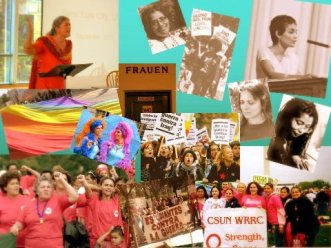
- Welcome to the Winter 2017 GWS 351 course
- This is an online course. This means that our online work will be asynchronous, meaning you can do your work at your own pace. However, you must meet the deadlines that are set in the schedule (see moodle) for the course.
- Each week's readings and assignments will be posted in moodle, which is your online home for the course. All assignments will also be turned in through moodle (via Turnitin) as well.
- Please direct technical questions to the CSUN IT help desk.
Course Description
“Intersections Of Gender, Race, Class And Sexuality” examines race, class, gender as social constructions that are negotiated within specific historical and material locations.
We will study the connections between images in popular culture, history, and social practices in our daily lives. From this perspective we will explore how the social roles we perform and consume every day produce and sustain uneven social relations between and among differently situated people and groups. Of particular interest is the way in which gender intersects with other social categories such as race, class, sexuality, and national origin in our daily lives and popular images. By studying these intersections from the perspective of women living them, we move marginalized women from their typically marginal position to the center of the curriculum.
The central aim of the course is to understand gender not as a singular category, but to see the ways in which gender intersects with other axes of power within specific historical contexts to interrogate the complexities of the social forces that shape our lives in contradictory ways. For instance, how does class privilege relate to gender oppression? How does gender privilege intersect with racial oppression? Upon which axes of power are you privileged and/or marginalized? How are we empowered and/or marginalized by social systems that go beyond our immediate lives and yet influence them so deeply? These considerations take place within the material and historical contexts that shape the possibilities of experience that social groups may have.
The course is designed to enable students to become critically reflexive about the cultural representations that we consume and daily practices we perform in which gender, race, class, sexuality, and nation are constituted. Readings, class activities, and homework assignments aim to enable students to analyze and write about gendered identity formation and the political significance of social categories. One desired outcome of the course is to increase students’ sensitivity towards societal issues relating to discrimination, exploitation, and domination.
We will have a special focus on the Anti-War movement and Marriage Equality movement… particularly as they relate to intersections of gender, race, class & sexuality.
Course Student Learning Objectives
- Students will recognize how gender intersects with other social categories such as race, class, sexuality, and national origin
- Students will be able to describe the matrix of domination and relate how it applies to their lives
- Students will identify how material realities impact current intersections of gender, race, class and sexuality
- Students will identify historical realities that impact current intersections of gender, race, class and sexuality
- Students will be able to describe and give examples of how privilege functions in our society
- Students will compare and contrast how the different forms of oppression function in their lives and in society
- Students will be able to analyze and write about gendered identity formation and heteronormativity
- Students will differentiate between various forms of discrimination, exploitation and domination relating to issues of gender/race/class/sexuality
- Students will be able to appraise and analyze current social policies that impact gender, race, class and sexuality
- Students will develop a roadmap for working toward more a socially just society with regard to gender, race, class and sexuality
Grading
Assignments |
Points |
Participation & Prep (online) eg. Quick-assignments, (knowledge survey, posting profiles, etc.) |
50 |
Discussion Forums (15 points each) |
30 |
Marriage Equality Forum |
20 |
Reading Comprehension Quizzes |
100 |
Quote Links (10 points each) |
50 |
Auto-Ethnography Paper… focus on race |
50 |
Test |
100 |
Final Paper and Project |
100 |
TOTAL POINTS POSSIBLE |
500 |
Divide your "total points" by 5 to get your percentage points.
| 87-89 B+ | 77-79 C+ | 67-69 D+ | |
| 93-96 A | 83-86 B | 73-76 C | 63-66 D |
| 90-92 A- | 80-82 B- | 70-72 C- | 60-62 D- |
| 00-59 F |
Assignments
Online Discussion Forums
The content of this course is not “merely” theoretical or political, but rather, it involves our personal lives—our relationships, our careers, our families. Readings should be done well in advance to class. You should be prepared to contribute well thought-out and relevant content to the discussion questions posted online. You will be expected to demonstrate your preparation by posting to Forums on particular days (refer to class schedule) and by responding to classmates posts online to have a dialogue about the readings.
For each of the Forums... do 2 "original posts" on 2 of the readings... picking from the questions that I have composed for that day. These original posts should be 2-3 paragraphs in length. Then, do 2 "response posts" to 2 other readings from that day... here you are responding to the original posts your classmates have written... which could be the start of a dialogue between you. Your response posts should be at least a small paragraph in length. (You will not get credit for responses that basically stop with one sentence that says things like, "I agree with you." or "I like your reading of the article.") Your responses should be thoughtful and should somehow build on your classmates posts, or tease out another aspect of the reading for them to consider.
Reading Comprehension Quizzes
There are various short quizzes you will take almost on every day with readings (or every other time at most). These are quizzes that are open book and should be low-stress if you are doing the readings. They are meant to help you "get" whatever is in your reading.
Quote Links (QL's)
There are different online times when I have assigned a “Quote Link” rather than a discussion forum. Post one quote from each, on three different readings for that day, followed by a thoughtful or insightful reading of that quote.
You will not be given any points for quotes that do not have your reflection on that quote. For a quote to be accepted for points, it MUST be turned in on the day that the reading is due.
Auto-Ethnography Paper
This project asks you to think about the ways in which your everyday life is personally affected by race and privilege (you may bring in other aspects like gender, class and sexuality... but the focus of this paper should center on race and privilege). You will write one short paper (4-5 pages double-spaced). There are three components to the paper that I will be evaluating: description, definition, and analysis.
Guidelines are:
- Write one to three paragraphs describing an event in your life that was pivotal in your identity formation with regard to race and privilege. Perhaps it was especially confusing at the time, but now you have a better sense of it through the readings in this class.
- Write one to three paragraphs in which you outline, clarify, and define a concept from the readings that you will later apply to the event. You should draw directly on the readings for this portion of the paper, citing specific texts including the author's name and page number
- Write your analysis of the event for the ways in which race operated in that situation. Use the readings (bring in at least 2 readings we have done in the class) and develop your thesis statement with thoughtfulness and complexity.
Test
The test will be based on all the readings assigned for this class as well as materials presented. The exam will be in varied format: multiple choice, short answer questions and long essays.