 |
MYTH TOOLS |
MODERN MYTHS ( T — t — f )
Our Founding Fathers and Mothers:
• Betsy Ross and the First American Flag
(the demands of real estate and patriotism) [There was no USA until the Constitution in 1787]
• George Washington and the Cherry Tree (a morality tale) ( f, T )
Mason Weems, The Life of George Washington for Young People 6th edition (1800)
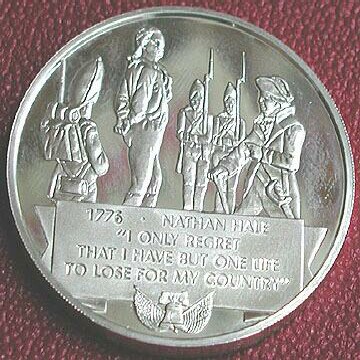
• Nathan Hale (Yale, Class of 1773): America's First Spy [right]
"I only regret that I have but one life to lose for my country." ( f )
(recruiting patriots for the next conflict)
( T )
• George Washington throwing the Silver Dollar across the Potomac
(Image building: superhero)
HISTORICAL CRITICS
• The incompatibility of history and myth ( T versus t )
ETYMOLOGY
Knowing the name gives power over the thing.
Nominalism/Antinomialism. Magical words (abracadabra, hocus pocus)
"And God said, "Let there be light".
"Homer" "the one who does not see", "the prisoner"
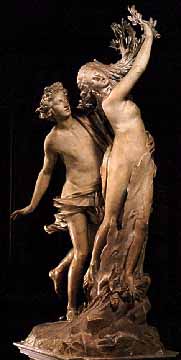
"Daphne" 'laurel' (photo above: Apollo and Daphne, Bernini)
[Barry B. Powell, Classical Myth eighth edition (2014), pp. 64-65 ('Homer'); 171-172 (Apollo and Daphne); 661-663 (etymology); 677-678 (19th century linguistics and solar mythology)]
AETIOLOGY
e.g. Why are there "Vestal Virgins"? (story of Rhea Silvia) Why is 'Daphne' Apollo's girlfriend?
[Barry B. Powell, Classical Myth (2014), p. 637-640 (Aeneas in Italy)]
METEOROLOGY
[Barry B. Powell, Classical Myth (2014), p. 677-678 (solar mythology)]
RITUAL (anthropological theories)
-(Demeter at Eleusis)
-Sir James Frazer, The Golden Bough totem
-Walter Burkert Homo Necans: The Anthropology of Ancient Greek Sacrificial Ritual and Myth : (1972; 1983)
-[Barry B. Powell, Classical Myth (2014), Ch. 10 (Demeter and Eleusis); and pp. 676; 683-684]
ICONOGRAPHY
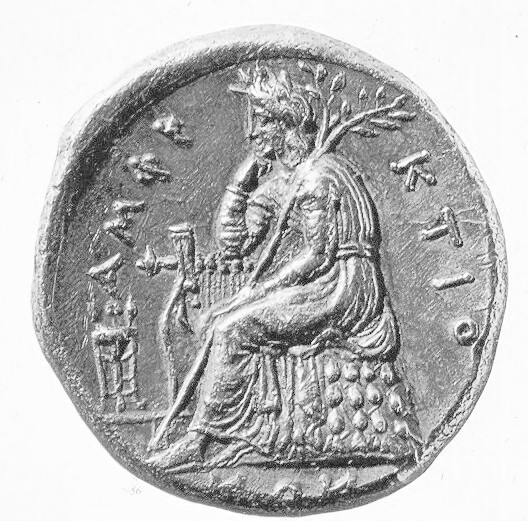 "eikon" pictures: mythological stories conveyed by visual means, e.g. on Greek vases, on wall paintings.
At left: Apollo, at Delphi, seated on the sacred stone (the omphalos), his lyre at his knees. He is holding his sacred laurel tree in his hand (Daphne). The sacred tripod is at the left. The coin was issued by the "Amphictyones", the international Board that ran the sanctuary.
- St. Catherine of Alexandria, and Nemesis
- "Saint Christopher"
- Aeneas fleeing Troy;
- Raphael's version of the flight story
[Barry B. Powell, Classical Myth (2014), p. 621-629] - Isis, Osiris and Horus, Isis Queen of Heaven, [Barry B. Powell, Classical Myth (2014), p. 253-256]. Isis Savior of Ships; Mary, Queen of Heaven, Mary, Star of the Sea.
On the story of "St. Christopher", see: CHRISTOPHER. Another: Analysis.
EUHEMERISM
ANCIENT PHILOSOPHICAL CRITICISM:
[B. Powell, Classical Myth (2014), pp. 659-661]
MANA
[B. Powell, Classical Myth (2014), p. 674-677] Blood and Mana (Torah)
MOTHER GODDESSES
e.g. Robert Graves, The White Goddess;
Marija Gimbutas, The Living Goddesses: indigenous, Neolithic matrifocal or matriarchal societies; ‘Kurganic’ incursions; ‘rape motifs’
Arthur Evans and Minoan Civilization (the people of Knossos, on the Island of Crete)
TRIPARTITE FUNCTION THEORY
[B. Powell, Classical Myth (2014), p. 678; 687]
STRUCTURALISM
[B. Powell, Classical Myth (2014), p. 681-683.]
PSYCHOLOGICAL THEORIES:
-Carl Jung (‘racial unconscious’, now called ‘collective unconscious’; animus/anima, archetypes)
[B. Powell, Classical Myth (2014), p. 678-681.]


