

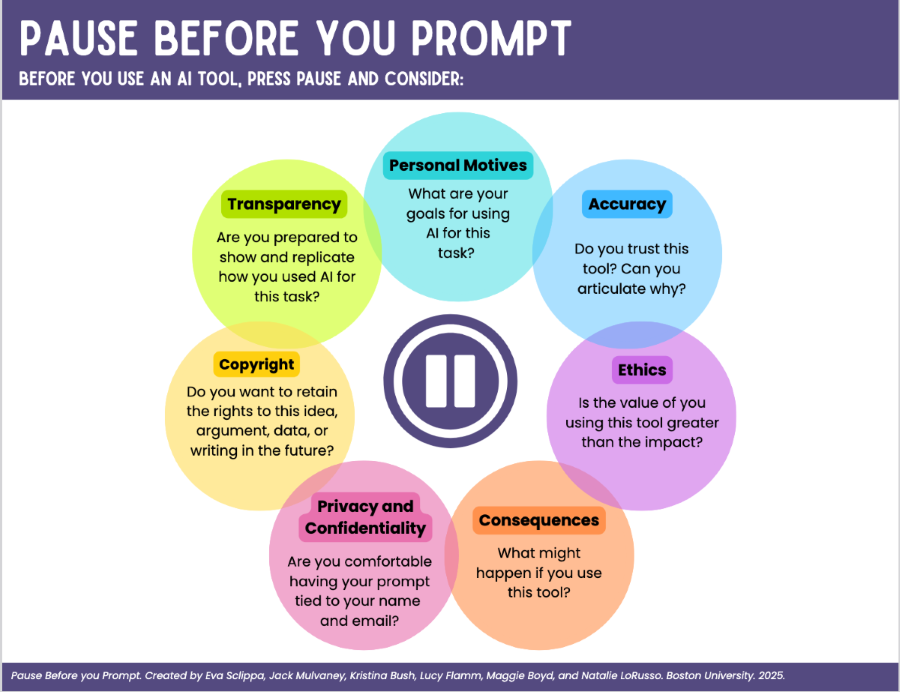
Generative Artificial Intelligence (GAI) tools, such as ChatGPT for text generation and DALL•E for image creation, are widely accessible and evolving. This policy governs the use of all such tools, including any new ones released during our semester.
The emergence of generative AI tools (such as ChatGPT, DALL-E,or any others) has sparked interest among many students in our discipline. The use of these tools for brainstorming ideas, exploring possible responses to questions or problems, and creative engagement with the materials may be useful for you as you craft responses to class assignments. While there is no substitute for working directly with your instructor, the potential for generative AI tools to provide automatic feedback, assistive technology and language assistance is clearly developing. Please feel free to reach out to me well in advance of the due date of assignments for which you may be using generative AI tools and I will be happy to discuss what is acceptable.
Understanding how and when to use generative AI tools (such as ChatGPT, DALL-E, or any others) is quickly emerging as an important skill for future professions. To that end, you are welcome to use generative AI tools in this class as long as it aligns with the learning outcomes or goals associated with assignment and only for tasks instructor permits. You are fully responsible for the information you submit based on a generative AI query (such that it does not violate academic honesty standards, intellectual property laws, or standards of non-public research you are conducting through coursework).
Overall, AI tools should be used wisely and reflectively with an aim to deepen understanding of subject matter.
Students shall not use AI tools during in-class examinations, or any assignment unless explicitly permitted and instructed.
Your use of generative AI tools must be properly documented and cited for any work submitted in this course.
Guidelines for Using GAI in Dr.LOverman's Courses:
In this course, students shall give credit to AI tools whenever used, even if only to generate ideas rather than usable text or illustrations. When using AI tools on assignments, add an appendix showing:
(a) the entire exchange, highlighting the most relevant sections;
(b) a description of precisely which AI tools were used (e.g. ChatGPT private subscription version or DALL-E free version),
(c) an explanation of how the AI tools were used (e.g. to generate ideas, turns of phrase, elements of text, long stretches of text, lines of argument, pieces of evidence, maps of the conceptual territory, illustrations of key concepts, etc.); Screenshots of Prompts and Outputs: Must submit screenshots of both--the prompts you used and the corresponding outputs generated by the AI.
(d) an account of why AI tools were used (e.g. to save time, to surmount writer’s block, to stimulate thinking, to handle mounting stress, to clarify prose, to translate text, to experiment for fun, etc.).
(e) How to cite generative AI output (MLA) click here-when you paraphrase, quote, or incorporate into your own work any content (text, image, data, or anything else) that was created by an AI tool. You will need a brief in-text citation in the body of your paper and a Works Cited entry to match.
It is a violation of university policy to misrepresent work that you submit or exchange with your instructor by characterizing it as your own, such as submitting responses to assignments that do not acknowledge the use of generative AI tools. Please feel free to reach out to me with any questions you may have about the use of generative AI tools before submitting any content that has been substantially informed by these tools
Turnitin and Academic Dishonesty:
Assignments may be submitted through Turnitin, which checks for originality and can detect AI-generated text. Unauthorized use of GAI tools will be treated as academic dishonesty, following the CSUN Faculty Policy. Depending on the circumstances, you may need to:
- A. Meet with me to explain your writing process.
- B. Meet with the department chair to discuss your actions.
- C. Face a formal report to the Student Affairs Office, potentially leading to a letter in your campus file.
Note: Keep in mind that these policies are likely to evolve over time with further advances in AI and its use in the classroom.
CSUN defines plagiarism as “intentionally or knowingly representing the words, ideas, or work of another as one’s own in any academic exercise” (“University Catalogue Policies: Academic Dishonesty.” California State University, Northridge University Catalogue 2014-2015. n. pag.).
In addition to reviewing CSUN Faculty Policy on Academic Dishonesty at link provided above, do review CSUN's Student Conduct Code.
As required by CSUN, I will turn such academic dishonesty and/or plagiarism over to the Student Affairs Office and the English Department. Furthermore, a letter will be placed in your campus file noting such abuse. If any further incidents occur you will have earned yourself an F in the course and/or further discipline will come into play from Student Affairs as spelled out above in CSUN catalogue!
Review all CSUN Policies & Procedures
Academic Dishonesty--Review CSUN Faculty Policy on Academic Dishonesty
Announcements
Class Alerts
- I reserve the right to amend the weekly schedule if the needs of the class require it, however all scheduled due dates are tentative. Any handouts or oral directions supercede the schedule.
- NO unauthorized use (texting or wearing) of ANY electronic devices, in addition, mobiles must be turned off or silenced during class otherwise your grade will be affected. Portable electronic devices used in the class is encouraged and, on occasion, required as a learning device relative to the dictates of the class, however texting of any kind and/or checking email, is NOT and is considered rude and disrespectful to me and other class members. If I have to ask you to cease using your electronic device for other than class related purposes, hear me now, I will not hesitate to ask you to leave and your grade at the end of semester should NOT surprise you.
- No late or emailed homework without my permission --NOT accepted of any kind: review unacceptable email policy above.
- Please come to see me as often as you like, any time during my office hours, if you have general questions, if you need additional help with the class work or expectations (always bring copies of your work so that we can look at it together), or just to shoot the breeze. If my office hours don't work for you, please make an appointment and I will make every effort to accommodate you. Though I prefer speaking to people face to face, I am also available by online chat, email. The point is that this term you have a resource (me, your instructor) who has an intense interest in the improvement and refinement of your writing skills. Research shows that students who spend time with their professors outside of class tend to get higher grades because they are working with the professor and the professor has the opportunity to get to know them as individuals.
Attendance
ABSENCES:
We will work on reading, discussing, and/or writing in every class. If you miss class, you miss important work that cannot be made up. An email in advance of class does not excuse your absence-it simply shows me that you are taking responsibility for choosing to do something else during class time.
Because of this your grade will be lowered after:
- Two X/week classes: four absences.
- One X/week classes: two absences.
-
Grade continues being lowered with each subsequent absence.
You will automatically risk failing after:
- Two X/week classes: six absences.
- One X/week: three absences.
THERE IS NO SUCH THING as an excused or unexcused absence; there are only explained and unexplained absences. For example, let's say you miss class because your car breaks down. Then you missed class for a good reason. But you still missed class and it counts as an absence. Students who miss class have said that they come back completely disoriented because so much has occurred while they were gone.
It is up to you to contact me before an absence or as soon as possible after an absence. Do not, however, ask me to "tell you what you've missed;" it is not my job to take time to update you for classes you have chosen, for whatever reason, to be absent from. It is up to you to get notes and copies of handouts from CANVAS or peers. Do not throw anything away! I would suggest that you make friends with someone before you leave class and trade phone numbers and email addresses so you can keep apprised of what's going on in your absence.
TARDIES
Be on time. NO LATE ENTRY PERMITTED. It is disrespectful both to me and to your fellow students to interrupt the flow of the class by coming in late. Two tardies of more than ten (10) minutes late counts as an absence. Allow plenty of time for traffic jams and to find a parking space. Be on time!
Late entry to ZOOM classes is understandable, AT TIMES, the internet can make it problematic, HOWEVER, arriving extremely late and then leaving early does not constitute as attending class. Any work submitted from this type of partial attendance which is basically partial/non participation in an online task of any kind will be considered an absence and submitted work will not be credited.
Be In Class and On Time.
You will find that the collaborative model helps to create a friendly and encouraging classroom environment and we will benefit tremendously from each other's contributions. But as you can see from the above list of projects, attendance is essential. There is no way you can make up the in-class group work, exercises, discussions, or missed presentations, and any absences may seriously harm your grade.
If something is due a particular class session and you haven't done it, don't compound the problem by skipping class.
Student Responsibilities
1. Unacceptable excuse: "My textbook hasn't arrived yet," or "I don't have my book."
1a. This does not excuse you from the homework demands of the course. Aside from readings usually available on CANVAS, make friends with your classmates to share/borrow/photocopy what you need. Take advantage of your text(s) being ON RESERVE in the library if your professor has taken the trouble to make it so.
2. Professional behavior is expected and includes turning in all projects/assignments on time, coming to class fully prepared even if you were unable to attend a previous class, and initiating timely communication with me about any troubles you are having with any aspect of this course. In short, I expect you will actively participate in and take responsiblity for your own learning. Please feel free to review Responding to Disruptive Student Policies.
3. Also, as in the professional world, attention to detail and knowing how to professionally communicate with your intructor and peers will facilitate your success in this class. These behaviors will be considered as part of the "professionalism" portion of your overall grade, together with the customary expectations about attendance and punctuality.
Class Accommodations
Written documentation of jury duty attendance, court appearances, hospitalization, and genuine medical emergencies will be handled with compassion and flexibility determined in large part by your demonstrated responsibility in the course to date (i.e., work is turned in on time, or early, active participation, etc.).
If you need special course adaptations or accommodations because of a disability, or if you have special medical information to share, or if you need special arrangements in case the building has to be evacuated, please speak to me immediately.
Counseling Services Counseling Services is another wonderful free service the university offers. Transitions can be difficult and college life poses stressful and challenging situations. Ifyou’re ever feeling stuck, it can be a great help just to talk things out, and Counseling Services can do this for you. Check out the weblink below or call (818) 677-2366.
If you have a disability and need accommodations, please register with the Disability Resources and Educational Services (DRES) office (weblink below) or the National Center on Deafness (NCOD) see weblink below. The DRES office is located in Bayramian Hall, room 110 and can be reached at (818) 677-2684. NCOD is located on Bertrand Street in Jeanne Chisholm Hall and can be reached at (818) 677-2611.
Students with disabilities must register with the Center on Disabilities and complete a services agreement each semester. Staff within the Center will verify the existence of a disability based on the documentation provided and approve accommodations. This includes use of any and ALL ELECTRONIC devices.
If you would like to discuss your need for accommodations with me, please contact me to set up an appointment after the first or second class session. DO NOT WAIT until end of semester!
Students who are approved for test taking accommodations must provide a proctor form to their faculty member signed by a counselor in the Center on Disabilities prior to making testing arrangements.
Campus Repeat Policy
“No student may enroll in any course for the purpose of repeating until the first day of classes for the term or semester. SOLAR will block repeat enrollment in a course until the first day of classes. When instruction for a semester or term begins, a permission number is required to enroll in all courses, including repeated courses.”
Click here to review CSUN’s policy on repeating a course
My Repeat Policy:
Generally I do not give permission numbers out on the first day of class. Students must regularly attend the first couple weeks and prove themselves worthy of adding.
Grade Review Policy - TAKE NOTE
If a project is returned to you and you believe that some error has occurred in the grading, you can, within ONE week of the date the assignment is returned to you, request--using a business letter or memo format (easily found online or in one of your prior English class handbooks)--that I re-evaluate it. I am always glad to clarify my commentary on returned assignments ONLY after you have used ALL the tools available to you on our many syllabus grading policy handouts. However if you wish to discuss the grade, you must initiate the discussion with a memo/letter to me. The original assignment should be attached to the memo/letter, and the new memo/letter should carefully explain why you think the assignment should be re-graded. Arguing that "I worked hard and put in a lot of time" or simply saying "I don't understand why I received this grade" are neither full nor careful explanations. Any indication of GAI work will make you inelegible for this appeal. It is important to also realize that the re-evaluation process can result in three types of grade adjustments: positive, none, negative.
Incomplete Policy:
Incompletes are strongly discouraged and will be granted only in cases of emergency for short periods of time. Documentation may be required. Students should note that incompletes are reserved for students who have attended the majority of the class and completed most of the work. They are, in fact, for emergencies that occur late in the semester (see university catalogue).
Privacy Policy
Canvas contains student information that is protected by the Family Educational Right to Privacy Act (FERPA). Disclosure to unauthorized parties violates federal privacy laws. Courses using Canvas will make student information visible to other students in this class. Please remember that this information is protected by these federal privacy laws and must not be shared with anyone outside the class.
Sexual Misconduct Disclosures/Maintaining Respectful Learning Environment
Students and faculty each have responsibility for maintaining a safe and respectful space to express their reasoned opinions.Professional courtesy and consideration for our classroom community are especially important with respect to topics dealing with differences such as race, color, gender and gender identity/expression, sexual orientation, national origin, religion, disability, age, and veteran status. Meaningful and constructive dialogue is encouraged in this class and requires mutual respect, a willingness to listen, and tolerance of opposing points of view. Respect for individual differences and alternative viewpoints will be maintained at all times in this class. One’s choice of words and use of language is a critical component of respectful discourse as we work together to achieve the full benefits of creating a classroom in which all people can feel comfortable expressing themselves.
In this class you will select your own writing topics. Please keep the following in mind as you develop new topics throughout the course of the semester: consider all of your writing for this class as public. You are encouraged to write on topics that matter to you, and while this can elicit writing and reflection that may be deeply personal, you must always be prepared that you may be asked to share your work with others.
As your instructor, one of my responsibilities is to help maintain a safe learning environment on our campus. In the event that you choose to write, speak or otherwise disclose about having experienced sexual misconduct/sexual violence, including rape, sexual assault, sexual battery, dating violence, domestic violence, or stalking and specify that this violence occurred while you or the perpetrator were a CSUN student, federal and state laws require that I, as a “responsible employee,” notify our campus Title IX Coordinator. The Title IX Coordinator will contact you to inform you of your rights and options as a survivor and connect you with support resources, including possibilities for holding accountable the person who harmed you. Know that you will not be forced to share information and your level of involvement will be your choice.
CSUN’s Title IX Coordinator & CSUN’s Campus Care Advocate --CSUN Equity and Diversity
Students and faculty each have responsibility for maintaining a respectful space to express their opinions. Professional courtesy and consideration for our classroom community are especially important with respect to topics dealing with differences in race, color, gender and gender identity/expression, sexual orientation, national origin, religion, disability, and age.
In this course, the topic of sex (including sexual misconduct/sexual violence) may emerge either purposefully or inadvertently in readings, films, class discussions or other class materials. We recognize that such topics may be particularly upsetting for some survivors; we encourage all students to seek the support they need.
While making personal connections with the topics studied in any course can be a meaningful and important endeavor, please be aware of the following policy regarding confidentiality and disclosures of incidents of sexual misconduct/sexual violence.
As your instructor, one of my responsibilities is to help maintain a respectful learning environment on our campus. In the event that you choose to write, speak or otherwise disclose about having experienced sexual misconduct/sexual violence, including rape, sexual assault, sexual battery, dating violence, domestic violence, or stalking and specify that this violence occurred while you or the perpetrator were a CSUN student, federal and state laws require that I, as a “responsible employee,” notify our campus Title IX Coordinator. The Title IX Coordinator will contact you to inform you of your rights and options as a survivor and connect you with support resources, including possibilities for holding accountable the person who harmed you. Know that you will not be forced to share information and your level of involvement will be your choice.
CSUN’s Title IX Coordinator is:
Jessica Galanos
Office of Equity and Compliance
Valera Hall 285
Phone: (818) 677-2077 or http://www.csun.edu/eqd/
Hours: Monday – Friday, 8:00 a.m. to 5:00 p.m.
Hours: 8:00 a.m. to 5:00 p.m., Mon - Fri
If you do not want the Title IX Coordinator notified, instead of disclosing the experience to me, you can speak confidentially with CSUN’s Care Advocate.*
The care advocates can be reached virtually on a confidential line 818-677-7492, and by email Careadvocates@csun.edu.
Please see the Office of Equity and Diversity’s website at www.csun.edu/eqd for information on confidential on- and off-campus support services, sexual misconduct response and prevention, reporting resources, and more information regarding CSU Executive Orders 1096 and 1097 – the CSU’s policy prohibiting discrimination, harassment and retaliation against students and employees on the basis of sex, gender identity, gender expression, sexual orientation, age, disability, genetic information, marital status, medical condition, nationality, race or ethnicity (including color or ancestry), religion, and veteran or military status in university programs and activities.