|
|
 |
Department of Biology California State University, Northridge 18111 Nordhoff Street Northridge, California 91330-8303, USA Office: (818) 677-5737 FAX: (818) 677-2034 Office Location: Live Oak 1328 Email: christine.bruno.59@csun.edu |
|
|
|
Department of Biology California State University, Northridge 18111 Nordhoff Street Northridge, California 91330-8303, USA Office: (818) 677-5737 FAX: (818) 677-2034 Office Location: Live Oak 1328 Email: christine.bruno.59@csun.edu |
Thesis Research
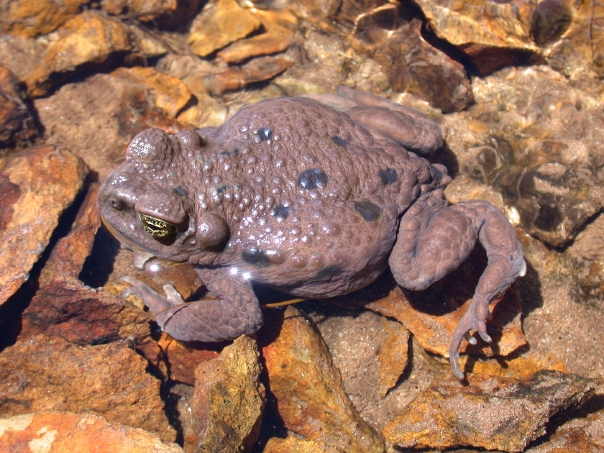
My study examines intraspecific variation in physiological tolerances to address an important issue in conservation biology. Amphibian populations are declining on a global scale. One suspected cause is higher exposure to damaging ultraviolet (UV) radiation resulting from recent ozone depletion. Many amphibian species are particularly vulnerable to UV-B exposure, which causes both lethal and sublethal damage. Although not immediately deadly, sublethal damage can reduce the fitness of an animal by lowering its probability to survive or reproduce. The enzyme photolyase is an important defense against DNA damage caused by UV-B radiation. My study will examine the relationships among UV-B exposure, photolyase activity, and the sublethal effects of UV-B exposure in the wide-ranging Andean toad (Bufo spinulosus). This species occurs over a latitudinal range of more than 40 degrees and from sea level to 5100 m, making one of the world's most widely distributed amphibian species, and the one with the highest elevational distribution record. I hypothesize that the photoreactivity of photolyase will be higher in eggs and tadpoles of Andean toads living at higher latitudes and elevations, which are exposed to more UV-B radiation. Yet, because the dramatic rise in UV-B radiation experienced by amphibians (particularly at higher latitudes and elevations) has occurred recently by evolutionary standards (within the last 100 years), I expect photolyase activity will not fully compensate for higher UV-B exposure in these environments. Consequently, the sublethal effects of UV-B exposure should be more pronounced at higher latitudes and elevations. I will measure the intensity of UV-B radiation along both latitudinal and elevational gradients in Argentina. I will take these measurements at egg or tadpole depth at approximately 20 sites (10 each across latitudes and elevations) during midday under clear skies. Next, I will use standard enzymatic techniques to determine photolyase concentrations of eggs and tadpoles collected at each locality. Finally, I plan to use field experiments to determine the sublethal effects of UV-B radiation by exposing eggs and tadpoles to ambient and filtered UV-B radiation and, at the time of metamorphosis, compare mortality, body mass, and reaction time to prey and a simulated predator. Identifying the mechanisms underlying the decline of amphibian populations is critical to protecting potentially imperiled species. My study will be the first to address the sublethal consequences of UV-B radiation on a species that--given its notably wide latitudinal and elevational distribution--is likely to have considerable variation in radiation exposure and tolerance. Determining the intraspecific variance in these responses is vital to predicting the fates of other wide-ranging amphibian species.
 |
Professional Affiliations Awards and Honors
Geographic variation in photolyase activity and the sublethal effects of UV-B exposure in the Andean toad Bufo spinulosus
Geographic trends in photolyase activity and the sublethal effects of UV-B exposure in the Andean toad