Performance: fr. French parfounir -- to complete or carry out thoroughly. execution of an action, fulfillment of a promise, exhibition.
Language: system of meanings, means of communication.
Culture: process of cultivation and growth.
Language is traditionally understood as a system of signs and meanings that exists as a structure outside of actual practice -- embodied in the dictionary -- language as a set of names for things. Such an understanding of language, however, is inevitably self-referential & tautological: words always refer us not to things but to other words.
Words, however, are not purely descriptive -- they are also proscriptive, or, as we say, performative. When the leader of a wedding ceremony announces, "I now pronounce you husband and wife," those words in themselves perform the ceremony.
Communication and the Need for Cultural Studies
(1) Kenneth Burke: identity and difference represent two contradictory impulses in the human character. These impulses motivate the need to communicate and to develop meaningful constructs that are shared socially.
(2) (Edward T.) Hall's Identity: "Culture is Communication and Communication is Culture" -- Hall and James Carey see culture as an ongoing process of intersubjective agreement to produce social reality. James Carey writes: "Communication is an ensemble of social practices into which ingress conceptions, forms of expression, and social relations. These practices constitute reality (or alternatively deny, transform, or merely celebrate it). Communication naturalizes the artificial forms that human relations take by merging technique and conception in them. Each moment in the practice coactualizes conceptions of the real, forms of expression, and the social relations anticipated and realized in both.... A building, its precise architecture, anticipates and imagines the social relations that it permits and desires. So does a television signal. Social relations of class, status, and power demand both a conceptual structure of persons and a technology to effectuate them. Conceptual structures, in turn, never float free of the expressive forms that realize them or the social relations that make them active agents." (Communication as Culture, 86).
(3) Reality as power struggle: "Reality is, above all, a scarce resource....The fundamental form of power is the power to define, allocate, and display this resource." (Carey) In other words, power struggles determine who has the right and the capability to define the terms of the intersubjective agreements which constitute social reality.
(4) Culture as a process of naturalization: Social relations that have been established by historical accident come to seem natural and unchangeable over time. One example of this process of naturalization is the way in which Western culture has been globalized and universalized so that all other cultures appear as "backwards" or "primitive." Ruth Benedict argues: "Western civilization, because of fortuitous historical circumstances, has spread itself more widely than any other local group that has so far been known. It has standardized itself over most of the globe, and we have been led, therefore, to accept a belief in the uniformity of human behavior that under other circumstances would not have arisen.... The psychological consequences of the spread of white culture has been all out of proportion to the materialistic. This worldwide cultural diffusion has protected us as man has never been protected from having to take seriously the civilizations of other peoples; it has given to our culture a massive universality that we have long ceased to account for historically, and which we read off rather as necessary and inevitable." ("The Science of Custom," 1934).
(5) Communication and social change: The hypothesis that reality is a social construction leads to the implication that reality can be changed through communication. A critical theory of communication is committed to imagining a world more desirable through the construction of social reality.
Roots of Performance Studies
(1) Drama (ancient & modern; comedy & tragedy)
(2) Anthropology
a) Malinowski's "study of primitive man" -- The Sexual Life of Savages -- (criticized as Eurocentric)(3) Speech Acts Theoryb) Claude Lévi-Strauss: "a conversation of man with man"
(begins to emphasize performative aspects of culture & argues that by studying "primitive" cultures we expand our knowledge of our own culture).
c) Trinh T. Minh-ha: "what man? which man?"
(criticizes all anthropological practice as Eurocentric and as a refinement of our ignorance, rather than our knowledge, of other cultures. Anthropology characterized as "gossip about gossip").
Modern Performance Studies: Some Definitions
| performance - derived from French parfounir, "to complete" or to "carry out thoroughly." A performance completes, or thoroughly carries out, social processes. |
| Carole Stern & Bill Henderson: "a performance act is interactional in nature, it involves symbolic forms and live bodies. It's a way to constitute individual and collective meaning." |
| Richard Schechner: performance is restored behavior, or "twice-behaved" behavior. (emphasis here is on repetition and iterability: a performance is always repeatable (iterable - it has the capacity to be repeated), but it will never be repeated in exactly the same way.) |
|
Kenneth Burke: sees performance, and literature, as equipment for
living. Burke's view of culture and communication is dramatistic. He argued that the relationship between life and theater is literal, not figurative. "dramatistic pentad": act, scene, agent, agency, purpose. |
|
Erving Goffman: performance: "all the activity of a given participant on a
given occasion which serves to influence in any way any of the other
participants." (broadest definition). Emphasis on the everyday nature of performance -- Goffman argued that every "strip of behavior" is laden with the performance of cultural meaning. According to Goffman, everyday behavior is mostly an act; there is a fundamental element of insincerity to everything human beings do. (Goffman quotes Robert Ezra Park, who points out that the first meaning of the word person derives from the Latin persona, meaning an actor's mask. The crucial assumption here is that as human beings we actively create our social selves through artistic activity. |
| Robert Ezra Park: points out that the first meaning of the word person -- from the Latin persona -- meant the mask that an actor wears. This implies that our social selves are constructs that we create through artistic activity. |
|
Henri Lefebvre: saw everyday life as the primary terrain of cultural
performance. Society, Lefebvre argued, is better understood through everyday
performances than through the dominant institutions and structures.
|
Elements of Performance:
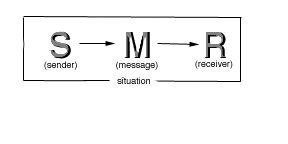
Traditional communication model:
{Note the static nature of the traditional model: communication is portrayed as a mechanical process of transmission. The "receiver" is passive, and the "message" is seen as the most important part of the model. In a sense the "sender" and "receiver" are dehumanized; in the pure transmission model, "sender" and "receiver" need not be human beings -- e.g. a TV remote control could "send" a "message" to the TV set to change the channel}
Performance Model of Communication:
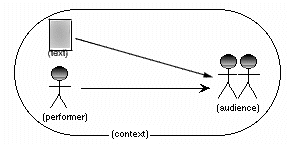
{Note the organic nature of the performance model. All components are active, and there is no necessary prioritization of "text" or "message" in this model. Even "context" is an active component of the model. The focus here is on ritual rather than transmission, and the roots of this model are in spiritual and religious studies. Also, the performer and audience are humanized; this model is structured around real human actors and contexts. Also, there is an emphasis on the ethico-political dimensions of the model, since all actors are engaged in the construction of a social reality.}
Conquergood: Culture as Performance
homo performans: humankind as a culture-inventing and self-making species.
poetics: emphasis on the creative work involved in the construction of culture. Also, emphasis on ethnography itself as a creative performance.
play: improvisation & experimentation. The notion of the "trickster" who violates taboos, crosses boundaries, intensifying our awareness of the vulnerability (and thus mutability) of the institutions we create -- here is the space for performance as an act of social change: "The metacommunicative signal 'this is play' temporarily releases, but does not disconnect, us from workaday realities and responsibilities and opens up a privileged space for sheer deconstruction and reconstruction." One can say the same for the claim often made about television and movies -- "it's just entertainment." This claim is a temporary release from social reality but not a complete disconnection from it.
process: emphasis on culture as a verb; shift from mimesis (mirror representation) to kinesis (movement).
power: the performative text is the site of struggle over cultural meaning. Issues of power and authority are always at work -- how does the performance reproduce or resist relations of power?
Ethical Pitfalls of Ethnographic Performance
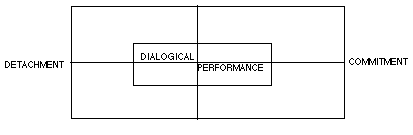
identity and difference: According to Burke this is the origin of communication -- a doubled impulse in the human being to both identify with and differentiate from others. Communication is only possible when both impulses are present.
detachment and commitment: The ethnographer represents an other culture, and must live both within and outside of the culture s/he studies. Somewhere between the "neutral observer" and the "true believer."
1) The Custodian's Rip-Off (both identity and detachment)
Here the ethnographer identifies with the object of study but is not committed -- essentially stealing the culture (Brandon & Dylan at a Native American Sweat Lodge in "Beverly Hills 90210")
2) Enthusiast's Infatuation (both identity and commitment)
The ethnographer here trivializes the other culture by pretending "we're all just the same underneath." This leads to superficial performances, and it means that we never question our selves and our own culture in our investigation of others.
3) Curator's Exhibitionism (both commitment and difference)
The ethnographer here emphasizes difference without attempting to understand ("look -- here are some strange customs of strange people") -- the myth of the "Noble Savage." This dehumanizes the other culture, turning it into a carnival freak show.
4) Skeptic's Cop-Out (both detachment and difference)
This is a paralyzing skepticism on the part of the ethnographer -- "there's nothing we can know about another culture because they are so different from us." This leads either to cowardice (a refusal to allow new information to challenge our own cultural conceptions) or, at worst, to imperialism (domination of the other culture economically and militarily). Conquergood argues that the presence of code-switching on the part of minority cultures demonstrates that one can - and often must - negotiate two cultures simultaneously. ("code-switching" here refers to switching between various codes of cultural meaning, a practice essential to survival for minority cultures -- speaking "black English" at home, for example, while speaking "white English" among the majority culture).
Dialogical Performance speaks in two or more voices at the same time -- "polyvocity," as opposed to a monologue. The goal is conversation: "The sensuous immediacy and empathic leap demanded by performance is an occasion for orchestrating two voices, for bringing together two sensibilities." Additionally, the ethnographer's home culture should be as open to interpretation, questioning, and weighing of alternatives as the host culture. Such performance requires energy, imagination, and courage.
The Organization of Space
Peter Gibian's piece on "The Art of Being Off-Center" suggests that the organization of space in the architecture of the shopping mall is a communicative practice. An entire social reality is created, maintained, and administered through the way in which the shopping mall is structured. The architecture is a "frame" through which the "experience" of shopping is perceived.
The Body
Ewen and Acker both suggest that we read the art of bodybuilding as a performance which turns the body into a work of art. In other words, bodybuilding is one example of the way in which we as individuals create our social selves through performance.
Race, Culture, and Performance
(1) The Social Fact of Race: "Race" is a socially constructed category rather than a biological fact. Biologically and genetically "race" has no precise meaning. When we speak of the "black race" or the "Jewish race" we are speaking in metaphors rather than biological realities. We give "race" meaning through communication within a given social structure and power relationship. However, its visibility and its historical existence means that it cannot simply be changed or ignored (as in the notion of a "color-blind" society); it exists as a social fact. While the colors that we use to designate racial categories -- "black," "white," etc. -- are notoriously inaccurate, these categories have meaning within a social relationship of power.
(2) Naturalization: Race "works" by biologizing and naturalizing cultural and political conditions of existence. Cultural differences are turned into biological differences in order to make racial inequalities seem like natural inequalities.
(3) Chromatism -- or skin color -- is an artificial measure of racial group identity. E.g. -- the category "white" has no explicit cultural reference. There is no such thing as "white culture" yet there can be Irish, German, American, etc. cultural formations. However, someone with black skin whose ancestry is Irish, for example, would have a difficult time identifying as "Irish" rather than as "black." Skin color, then, is used to mark a power relationship rather than ethnic group-belongingness.
Animal Symbolicum: Centering Self and Society
Throughout the ages in the Western world, philosophers have offered various characteristics of the essential, defining aspects of the human being. The collective residue of these various definitions is that abstract philosophical construct which we have called "man." "Man" in philosophical discourse is more than simply a useful (though outdated) category for the human species; it is a collection of philosophical concepts whose history greatly influences its usage.
Some definitions of "man":
Animal rationalis: "reasoning animal" -- Aristotle argued that it is the human being's capacity for inferential reasoning that distinguishes him from the animal world.
Vir bonus: "the good man" -- Some Romans argued that what distinguishes humans from animals is our capacity to act for the social good.
Homo faber: "man the maker" -- Following the Renaissance and into the Industrial Revolution, the human being was distinguished by the capacity to make and use tools.
Animal symbolicum: "the symbol-using animal" -- From Ernst Cassirer, Suzanne Langer, and Kenneth Burke, the twentieth century definition of "man" has become "the symbol-using animal." Burke will go on, defining man as "the symbol-using, symbol-making, and symbol-misusing animal, inventor of the negative, separated from his material condition by instruments of his own making, moved by the sense of order, and rotten with perfection."
Homo performans: "man the performer" -- While performance studies theorists have accepted Burke's definition, they have added the performance of individual and social identity to the list of characteristics that make up the human being.
Communication and Meaning
There are two general schools of thought answering the question "where do meanings come from?" While apparently contradictory, these ideas actually work together to form a notion of communication as a process of intersubjective social struggle:
(1) Idiosyncratic Experience (I. A. Richards' Triangle of Meaning) -- argues that semantic content is largely an individual matter of experience. (e.g. while there is a social definition of "cat," an individual who has been scratched by one may have an individual interpretation that differs from the social meaning).
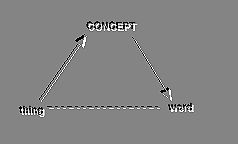
The "thing" existing in the real world is always mediated through a concept in its relationship to the word.
(2) Sociocultural Systems (G. H. Mead's triangle of social understanding) -- argues that semantic content is socially determined primarily.
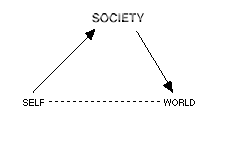
The relationship between the self and the world is always mediated through society.
(3) The struggle to control meaning: Contemporary cultural studies suggests that an individual sign or symbol marks a site of struggle, the outcome of which will determine the meaning of the sign or symbol.
Brief History of Subcultural Studies
(1) Urban Ethnography of 19th Century -- primarily in novels and brief essays. Gave credibility to studies of subcultural groups, especially those that deviated from traditional social practices. Not systematic.
(2) Participant-observer studies of the Chicago School (c. 1920s) -- ethnographer both participated and observed the subcultures they studied. These studies focused primarily on Chicago street gangs and "delinquent" subcultures. These studies were problematic because (a) absence of an explanatory or analytic framework (they made "sense" of deviance only in its particularity, not in reference to the larger social world), and (b) neglected the significance of class and power relations.
(3) 1950s - Cohen and Miller looked at dominant and subordinate value systems in gangs. Cohen argued that gangs took the value systems of their parents and inverted them; Miller argued that the gang cultures ultimately had more in common with their parent cultures than differences.
(4) Matza & Sikes (1961) -- recognized the "subterranean" values implicit in subcultures, but tried to see how Miller & Cohen's positions could coexist. They argued that what seemed like deviance was actually another way of conforming to the dominant value systems.
(5) Peter Wilmott -- pointed out that subcultural studies were hampered by a lack of a class analysis. Too much focus on generational conflict without historical or economic specificity. Willmott showed how generational conflict appears differently at different historical moments and within different class formations.
(6) Phil Cohen -- Explored Wilmott's arguments with reference to specific leisure styles in London's East End. He defined subculture as follows: "a compromise solution between two contradictory needs: the need to create and express autonomy and difference from parents and the need to maintain parental affiliations within a social structure." -- the purpose of the subculture was to express and resolve the contradictions that remained hidden and unresolved in the parent culture.
Sexuality and Performance
(1) Like race, gender and sexuality have no scientific validity as absolute and eternal biological categories. "Male/female" dualism is problematized by the existence of the hermaphrodite (as well as the transgendered person).
(2) Conquergood's notion of the "trickster" is at work in the study of transgendered persons. By moving within and against traditional gender dualism, the transexual calls attention to the artificiality of the categories "male" and "female."
(3) gender performativity (Judith Butler) -- argues that gender identity is something we perform rather than something that we are. Simone de Beauvoir -- "one is not born a woman; one becomes one." A woman becomes a woman in certain concrete social relationships.
(4) Amanda Udis-Kessler notes that bisexuality disrupts a similar binary opposition between "heterosexual" and "homosexual." While sexuality is often perceived as something that can only be one or the other, the existence of bisexuals suggests that the opposition itself needs to be reexamined.
(5) biphobia: fear of bisexuality. Stems from the myths of sexual essentialism (the belief that sexuality makes up the essence of a person's personality) and sex-negativity (the belief that sexuality is "dirty" and must be contained by religious and legal restrictions).
Culture and Power
Definitions of power and the kind of cultural studies they authorize:
(1) possession of control, authority, or influence over others: suggests
studies of power that are related to inequality.
(2) ability to act or produce an effect -- suggests studies of power rooted in
legitimate authority or empowerment.
(3) physical or mental might -- suggests studies of power rooted in
violence.
Ultimately all three areas are intimately related -- e.g. the law represents legitimate authority but it must be backed up by the violence of the police and the courts and the prison system. Mao Tse Tung: "Power, in the final analysis, always comes out of the business end of a rifle."
Walter Benjamin: "Every document of culture is a document of barbarism." Suggests that the texts of a culture or a civilization can be read to understand the power struggles from which that text arose. Hebdige's analysis of subcultural style proceeds from this assumption.
Semiotics
Signifier: sound-image which represents something else. Can be a word, a symbol, a picture, or a real object (such as a stop sign).
Signified: the concept or idea that the signifier suggests.
Referent: the real thing in the world which the signifier and signified attempt to discuss.
SIGN: The combination of Signifier and Signified. Hebdige reads the signs of subcultural style in order to track the ways in which different signifiers can come to change their meaning within specific cultural and social contexts.
langue: the general structure of language. the virtual.
parole: the performance of linguistic structure through an individual utterance. the actual.
Subculture and Style: Some Definitions
culture: "that level at which social groups develop distinct patterns of life and give expressive form to their social and material existence."
subculture: a social grouping defined by its resistance to dominant cultural norms. Experienced contradictions and objections to the ruling ideology are expressed through style.
counterculture: a subculture whose resistance takes on a more explicitly political and ideological form.
class: a social group defined primarily in terms of its access to economic and social power.
Hebdige reads subcultural signs as indicative of class struggles. These struggles, he argues, must be represented in their specificity rather than in general. He focuses on the way in which a group handles the "raw material of social existence" -- in other words, the way in which the group uses the means available to it to articulate and perform its group identity.
ideology: the representation of our imaginary relations to our real conditions of existence.
hegemony: "a situation in which a provisional alliance of certain social groups can exert 'total social authority' over other subordinate groups, not simply by coercion or by the direct imposition of ruling ideas, but by 'winning and shaping consent so that the power of the dominant classes appears both legitimate and natural'."