Copyright 2004, The Los Angeles Times. All rights reserved. This article is posted for the sole use of students in COMS 301.
By Scott Timberg, Times Staff Writer
Aug 15 2004
How do you catch someone's eye in three to 12 seconds? That's the issue
for artists preparing political work for display on billboards — roadside and otherwise — and
hoping to arrest the attention of viewers hurrying past with other things
on their minds.
Although billboards have long served as venues for art — from the Guerrilla Girls' feminist broadsides to Youth Art Month celebrations by Midwestern schoolchildren — the
election year and polarized political climate have sparked new activity.
This season sees two political art projects that are studies in contrast:
The first is a series of works on Wilshire Boulevard that does not look
radically different from what you might see a few stories below at the
Acme Gallery.
The second is a more plain-spoken billboard in New York's Times Square,
sponsored by a Berkeley group. And unlike a lot of art projects aimed at
the public — and often sponsored by arts councils in the name of "beautification" — these
are funded largely by private, even corporate, money. The efforts show
the field's possibilities and challenges.
"I'm not into shock value," says Susan Silton, whose work was selected for Public Speaking, a new series of political-art pieces looming, on alternating months, above Wilshire. "I'm
interested in choosing images that have many meanings."
Silton doesn't want to confound cruising viewers, but she isn't after a
didactic, one-sided slogan, either. "It's a complex image," she says of
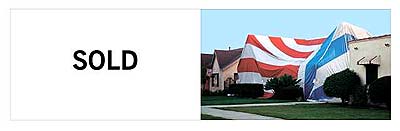
her photograph of a fumigated house draped in a red, white and blue sheet, with the word "Sold" printed
next to it. "But if you think about it a little bit, it's readable."
Similarly, series organizer Julia Meltzer says she's interested in "images that open up the space for thinking, not shut it down." The
other pieces, which will go up in October and December, strive for the
same depth and ambiguity that animate much contemporary art.
It's not the only way to go, though. Deborah Rappaport, a board member
of Berkeley's new Project Billboard, is less interested in layered meaning
or
aesthetic
contemplation. She wants art that's effective, even if it resembles an
ad. The art on her billboards,
which she hopes to post across the country "as fast as we can raise the money," must
serve the billboard's left-of-center message. "Just like a shoe company couldn't
sell shoes if it didn't have good graphics," she says. "People wouldn't
pay attention."
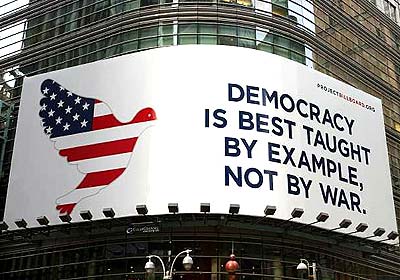
Project Billboard's inaugural effort, which was to go up in Times Square in time for the Republican National Convention, attracted so much attention, in fact, that it almost didn't happen. The billboard was to show a ticking bomb in red, white and blue, accompanied by the phrase "Democracy
is best taught by example, not by war."
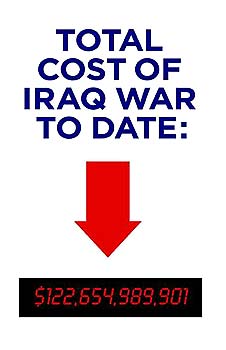
Clear Channel Communications, the owner of the billboard, objected and blocked the image. Project Billboard filed a breach-of-contract suit and, in a settlement, the bomb was replaced with a similarly attired dove. The new image went up, and an electronic
ticker marking the monetary cost of the Iraq war is to be added in time for the convention.
A home for political art
Why the billboard? Artists and organizers say it has become one of the last feasible spaces for political art.
Commercial galleries aren't much interested in political work, says Meltzer, who runs the billboard series through a new nonprofit called Clockshop, which seeks corporate funding for art in public spaces. (In this case, the patron is Viacom, which owns the billboard structure at 6150 Wilshire.)
And alternative, nonprofit venues that traditionally offered political
work — spaces like Los Angeles Contemporary Exhibitions — now have less presence than they did a decade or more ago, she says. "So there's a type of art that's disappearing as well — art
that's not commercial or gallery driven."
Things are especially grim in California, Meltzer says, where state arts funding ranks, per capita, last in the nation.
But the problem exists across the country, says Anne Pasternak, president and artistic director of Creative Time, a New York group that puts temporary works of art, including billboards, in public spaces, largely with private funds. The need for private funding from corporations and individuals has made it harder for edgy, political efforts to find a viewing in more traditional spaces, she says.
Even museums can be a hard sell. Boards of directors, Pasternak says, are often somewhat conservative and have more power than in the past, creating new limitations on what can be shown. Artists, she says, in an effort to fit into a more market-driven world, are producing less overtly political work than they did in the '80s, when debates over racism and AIDS energized the New York art world.
"These are important times as well," she says, "as we see our civil liberties
eroded and stay involved in a war with a dubious motivation. But
it's amazing to me that I don't see artists making political proposals.
I see
artists donating
works and contributing money for progressive candidates, but I still don't
see much art being made about the world we live in."
Neither has the movement for art in public spaces brought more political work into the public eye.
"I see a lot of art watered down by corporate concerns before it can reach a
public space," says Silton. "It's like artists are exploited for 'percent for art,' " requirements
in many cities, including Los Angeles, that mandate that a percentage of
certain new-construction budgets go to arts projects.
Although a billboard can reach an audience that dwarfs that of museums — the Wilshire billboard gets about 32,600 potential viewers a day — it
takes a certain kind of image to stand out in a cluttered, commercial background.
"It's a pretty strange space to work in," says Meltzer, who first secured the Wilshire space, then asked for proposals from two dozen artists and finally reviewed the proposals with her board before selecting four. "It's
a strange shape. And you have to be able to see it and make sense of it in
a matter of seconds."
"The most successful pieces of public art have the ability to communicate across
class lines," says Tom Finkelpearl, author of the book "Dialogues in Public Art" and executive director of the Queens Museum of Art. "The
words 'public' and 'art' have different class connotations."
The phrases "public restrooms, public transportation, public school" suggest working-class or lower-middle-class settings, he says. "And
every survey about who consumes art shows that it's a very upper-middle-class
pursuit."
Effective billboard art, then, needs to reach across that gap — like the San Diego bus signs posted during the 1988 Super Bowl that welcomed visitors to "America's Finest Tourist Plantation." (The
signs, which generated enormous controversy when they appeared, included
images of handcuffed Latino workers, in case anyone missed the point.)
Each city offers its own challenges. Unlike those in Southern California, New York billboards typically are seen by people walking past rather than whipping by on the freeway. But the city has become much more visually cluttered in the last decade, says Creative Time's Pasternak.
"Artists love to work with billboards, but it's hard to make them work," she says, adding that she has implemented only two billboard projects in a decade despite numerous proposals. "Our
buildings have been wrapped in signs that speak to us as consumers and not
as citizens. We've learned to tune out a lot of visual information; it's very
hard
for an artist to break through that."
Sometimes boldness, as with the simple electronic signs of Jenny Holzer
(who employed cryptic phrases like "Protect me from what I want"), is most
effective. But one-liners can grow stale on repeated viewings.
Other works turn on existing images. Last year, a billboard at Hollywood
and Sunset boulevards attracted interest for its reproduction of Picasso's "Guernica," refashioned
by the collective Making Art Work in reference to the Iraq war. Further
out, the Billboard Liberation Front defaces Bay Area signs to undo or invert
their
commercial message.
But more serene work can be at least as effective. Many artists who work
with billboards revere Felix Gonzalez-Torres, the late New York artist
who created
lyrical billboards of images inspired by the death of his lover from AIDS — a
photograph of an empty double bed, another of a tiny bird flying against
a gray, cloudy sky.
It's not cheap
It's hard to say whether Clockshop will spark a rash of corporation-funded — left-leaning or otherwise — billboard
art all over the city.
The Wilshire billboard came out of a specific arrangement in which the landlord, who happens to be Meltzer's uncle, persuaded Viacom to make an unusual concession.
Project Billboard's Rappaport calls the medium "a reasonably cost-effective way to reach people with a simple message," explaining
that the cost is far less than advertising in a newspaper, magazine or
on television.
But billboards are not cheap. A "bulletin"-sized billboard, like the one on Wilshire, rents for $4,000 to $5,000 a month in the L.A. area. Given that fee, the rent paid to the landlord — billboard companies typically own their structure but rent their slice of ground — and
the cost of printing and installing the art, each Public Speaking billboard
costs nearly $10,000. (Viacom is assuming all of these costs.)
But whether it's the wave of the future or a throwback, billboard art is part of a long tradition.
Finkelpearl points out that it's art in museums and galleries that marks
the historical aberration. "In the great stretch of the last thousands of years, since the pyramids," he says, "it's
mostly been commissions and it's mostly been public art. What did Michelangelo
do if not public art?"
*
'Sold'
Where: Public Speaking billboard series, above 6150 Wilshire Blvd.
When: Closing reception 6 to 8 p.m. Sept. 10 in the 6150 Wilshire courtyard
Ends: Sept. 13, 2004
Contact: clockshop.org
Copyright 2004 Los Angeles Times