CD 485 Computer Applications in Communication Disorders and Sciences
The Modality Connection
AAC--A STORY OF
COMMUNICATION RESTORATION THROUGH THE USE OF MODALITIES
:
I. Communication
and Modalities: It was Daniel Webster who said, "...if all my possessions were taken from me with one exception, I
would choose to keep the power of communication, for by it I would soon regain
all the rest." This succinct and yet profound statement
encapsulates the purpose and the story of AAC (Augmentative and Alternative
Communication) ? giving back the power of communication to one who has lost it.
and...ALSO PLEASE SEE. SCHUYLER'S
MONSTER below..
Please click here to see a video introduction to AAC.
Communication is
defined in the dictionary as a conveyance of information. We can add that it is accomplished by
the transmission via some modality of an organized and recognizable pattern of energy.
A Modality
is a path or method, and among the domain of the living there are two
major modalities used for communication: signs and symbols. Semiology is the study of these modalities,
both individually and combined into systems. Hence, Semiology is the study of
the “life blood” of the communication process. This becomes critically
important when one major segment or Sub Modality such as Speech is lost to the
communication process. Then modifications and or manipulations of other Sub
Modalities must be considered to recover as fully as possible the ability to
communicate. This is why a study of the Modalities of communication, their
links and junctions is important to the development a plan of habilitation or
rehabilitation for an individual with a severe speech disability.
Symbols and Signs are transmitted by humans via a number of sub modalities,
some of which are Linguistic and some which are not. Examples of Linguistic
modalities would be speech, Sign Language, and Morse Code. These are symbolically based
communication pathways that typically convey very precise information. Non linguistic
symbols would include Art, Music and Rituals. Signs, all of which are Non Linguistic
in nature, would include facial grimaces, intensity of movement, proximity and many
others variables. Signs typically provide a more general background for meaning.
Frequently, communicators take advantage of more than one modality at a time.
Multi modalities not only provide a richness to the communication process, but also
an element of redundancy
so that if one modality fails, there are others available to fill in the gap.
These will be discussed in more detail in the next Section. But for now, the
question might be, “How do Signs as a modality differ from Symbols?”
II. Signs
Typically Transmit Information Necessary for Survival: What is the
difference between a symbol and a sign? If we were driving along the road and
saw the following image, what would we do?


Hopefully we would stop. This is a stimulus called a Sign and it is a call to action -- to stop! Hence, it is
typically a communication that is necessary for our
survival. Disregard it and the
results can sometimes be fatal! Signs can be events, motions or marks that have
meaning. They may be generated voluntarily or involuntarily in the realm of the
living. But even inanimate objects produce signs, although in this case they
are not always calls to action. Rocks, for example, omit signs that indicate
their age. Stars transmit signs which reveal how hot they are, how fast they
are rotating, how fast they are moving and in what direction, and what gases
are present in their atmosphere to mention a few. For animate objects, however,
there are three important
features of Signs:
1. They are typically calls to action.
2. They are important for
our immediate survival; and
3. They are typically connected to their (referent) meaning through an iconic relationship
or a cause-effect
relationship that can easily be recognized and learned.
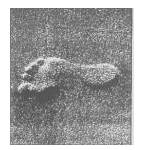
A foot print in the sand, for example, has both iconic and cause & effect significance. It both
looks like a foot, and was caused by some one stepping there. What is the call
to action here? If you were Robinson Crusoe ostensibly alone on an Island in a
part of the world where there were cannibals, and that was not your footprint,
you would probably take great heed!
(A Sign that Someone was here)

It must be noted that the Signs we are
referring to here are not the same as the Signs used as the basis for Sign
Language, but more the signs used in the Pavlovian sense (i.e., a bell can be
learned to be a sign for the imminent arrival of food; or black clouds are a
sign of the possible arrival of rain). In the first case, the call to action is
to salivate; and in the second, to grab a rain jacket. The so calla Signs of
Sign Language on the other hand are not signs at all but in reality they are
visual symbols.
Many communicatively disabled persons with no speech are still capable of using
some natural and learned Signs. In a familiar environment, these signs may be
the most efficient form of communication being easy to produce and being
associated mostly with the communication of important needs. Hence, an AAC user
should not be discouraged from using these signs, even when they have a very
sophisticated and expensive speech communication device at their disposal. In
other situations, however, the speech modality is preferable because the
symbols covey messages with considerably greater preciseness. Einstein, for
example, would have had trouble explaining his Theory of Relativity by jumping
up and down, waiving his arms and yelling “aarrgh. In fact I have seen the same
dialogue applied by some of my students who were commenting on the some
un-relevant facet of class final exam.
III. Symbols
Typically Transmit Information Necessary for Thought: If we see this,
what do we do?


Probably we would do nothing. That is because it was NOT a call-to-action. And
it is certainly was NOT necessary to our survival. It was a call for a bit of
organized information, however, to be brought into consciousness from our
memory banks. For example, it may have brought to mind an idea -- about a man who
is faster than a speeding bullet; more powerful than a locomotive; and who
loves to leap tall buildings in a single bound. He often wears a blue leotard
with a pink cape and boots; and has a quirky habit of frequently changing his
clothes in the nearest telephone booth. He is employed by a newspaper company,
and he has a girl friend of questionable intelligence (she never recognizes him
in his leotard without his glasses). All these threads of interrelated
information, which we will call a concept, were brought to mind by the stimulus (in this case the
word) "Superman." That is what symbols in communication do. They
bring into our minds information (concepts) that we can then modify, enjoy,
discard or use to plan our day. But typically, they are not calls to action.
There are three important
features of symbols:
1. They are calls for information to be brought into consciousness;
2. They can have a relatively arbitrary
relationship to their referent (that which they signify); and
3. They can act as surrogates
in the thought process for the very concepts they signify. For example we can
and do think in words rather than images. Symbols, then, not only transmit
information but they also become a major part of the thought processes.
One might easily think that the arbitrary connection of symbols to their
referents would create a major disadvantage, in comparison to signs, as a
currency for communication, especially for children. Signs with their iconicity
or apparent cause and effect relationship should be much easier to learn. But
this is where nature has provided humans with an awesome edge--the prodigious
ability to create and recall great numbers of arbitrary Concept--Symbol (Word) associations. This
is the "backbone" of language. And just as it is no problem for a
giraffe to reach nutritious leaves high up in a tree, or birds to fly because
of their special structures which are a product of inheritance, it is no
problem for humans to make these wordÑconcept associations. In fact many
persons by the time they finish college have often acquired over 100,000
concept-word associations in their lexicon! This capacity is our genetic
inheritance.
Indeed, for human communication, the arbitrary nature of the concept--symbol
association, has one major advantage: boundless POWER for communication! Because
there is no limit to the concepts that can be associated with symbols, there is nothing
in the Universe that cannot be communicated symbolically! Many concepts
moreover, cannot be seen, heard or touched, and can only be accessed mentally
through their symbols. The words “electron or democracy” would be two examples.
Thus symbols open up to the mind phenomenon and ideas in the Universe hitherto
out of reach of the human senses. In addition, these symbols with their
surrogate function carry the power of communication to the very mind itself.
The potential and advantage for self communication (which we call verbal
thought or language) is awesome. Hence, for severely sensory and/or motor
impaired children, a goal for Assistive Technology in general (AT) and
Alternative and Augmentative Communication (AAC) in particular is to open up
the modalitis of communication so that they can have access to this powerful
instrument of thought and communication.
IV. Words,
Art, Dance, Music, Ritual are all Symbolic Modalities: Humans display
many kinds of symbolic behaviors. Probably, the earliest in history were Rituals, Music
and Dance and
Pictures. They are still as important today as they were in primitive
times, nevertheless, because they have the capacity to communicate visceral
human thoughts and feelings that cannot always be fully expressed in words.
Although limited, AAC and AT (Assistive Technology) devices can provide
“virtual” opportunities to communicate through rituals, music and dance.
Words as symbols, on the other hand, have five features in particular which set them apart from the other symbol
forms, and make them particularly suitable for precise communication.
These include:
1. There is a one-to-one
relationship between a symbol (word) and its referent (a thing or event in
the world). For example, the word "table" can be identified with
a specific object. The body of words which individuals store in their brain is
referred to as a lexicon (vocabulary). This provides the capacity for precision
in communication.
2. The Symbol
(word)--Referent relationship is arbitrary, and provides the capacity
to communicate almost anything.
3. Many symbols can exist for the same object. This, of course, provides the
bases for many languages. For example, “table” (in English), “mesa” (in
Spanish), “stol” (in Russian {pardon my script}) all mean the same thing.
4. Symbols can serve as surrogates
for concepts in the thought process! This gives humans the ability to
think in words about the past, the present and the future, or to visit a world
and a time that never was, through verbal make believe, to mention a just few
advantages. In fact, most adults typically think in this modality, that is,
verbally. It is this feature, moreover, that makes this Modality so valuable.
It is literally a passageway between the mind and the universe of things beyond
our immediate sight, sound and touch!!!
5. The symbols of language can be used to discuss language. This is referred to
as meta-language.
V. There
are Two Kinds of Symbol Sub Modalities: Presentational and Discursive:
1. Presentational
Symbols are perceived as complete units. This typically involves the
right side of the brain. Pictures and maps are some excellent examples. Many of
the AAC devices or systems, particularly for non literate and/or low cognitive
users rely on some form of pictures for encoding messages. These may be
photographs, sketches or two dimensional drawings. One non computer
communication system called the Picture Exchange Communication System (PECS) relies totally on
picture symbols. This system can stand alone for communication, or serve as a
pre training process for picture based AAC devices.
2. Discursive
Symbols occur over a period of time. This typically involves the left
side of the brain. Hence, it is not possible to perceive the whole unit except
through the cognitive process of short term memory. Many of the AAC devices
provide discursive stimuli, not only in the form of words but also in
combinations of words and/or pictures to form phrases and sentences. A major
problem, as we shall see, is the amount of time it takes to produce these
strings of symbols on an AAC device when the user is severely motor impaired.
This, of course, taxes the patience, if not the short term memory capacity of
the communication partner (the listener). Hence, the “Holy Grail” of the AAC
world is always to find techniques and strategies to speed up the communication
process. To experience a discursive communication, please checkout the
following websiteÉ
VI. Signs and Symbols can be
Communicated via Two Modalities.
These are Graded
and Combinative
signals.
1. Graded
signals are stimuli that vary along a continuum, for example, from more to
less. If you change the degree of the stimulus, you change the message. Imagine
yelling at the top of your voice versus mumbling softly as I often do in class.
Students react differently to each. To the latter they smile complacently as
they finger their Ipods. They know the lecture will continue benignly for
hours. To the former they frown complacently as they finger their Ipods. They
know the lecture is about to end in a furor of declarations. Pitch, tension,
timing, space and color are other examples of signals that can convey meaning
when they are changed from more to less along a graded continuum. These can be
important modalities for communication for a motor impaired individual. For example,
an increase in vocalization or body movement (albeit uncoordinated) may signify
distress, anticipation, frustration or happiness etc. Because of the lack of
precision of signs, the context of the situation may be necessary to decode the
message.
2. Combinative
signals are stimuli that occur in a sequence. If you change the order of
the sequence, you change the meaning of the message. Certainly, speech is a
prime example of a combinative stimulus.
VII. Three
Basic Types of Messages: Nominal, Expressive and Predicative, provide a total
of SIX
Modalities for Communication:
Using the two types of signals (Graded and Combinative)
humans can transmit three types of messages for a total of SIX possible modalities. These messages
types are: 1.
Nominal, 2. Expressive (sometimes called Emotional) and 3. Predicative, (sometimes called Propositional).
1. Nominal Graded Modality:
This includes Messages
that are transmitted by Signs.
If a change in the degree
of the signal creates a change in the meaning it is a graded signal as we
mentioned above. They are Nominal
if they are relatively instinctive
and typically generated by internal body processes. Nevertheless, they can
provide an important modality of communication for severely cognitively and/or
motor impaired individuals. Two examples of Nominal Graded Communication are my
rumbling stomach, and the early crying of an infant.
a. My
rumbling stomach, for example, is one form of communication that generates
a sign that may signify to a listener that I am hungry, even if I say I’m not.
A stomach rumble is a Nominal
sign because it is an instinctive
response arising from internal body processes. I have no control over
it, despite what my wife says! If you are not familiar with stomach rumblings,
check out the old classic movie, “The African Queen” with Humphrey Bogart. He
(via special sound effects, of course) gives an excellent demonstration early
in the movie.
b. The
Crying of an infant is perhaps a more relevant example of Nominal Graded communication.
No one teaches a baby how to communicate so effectively. It is an instinctive
reflex generated automatically by internal body processes. This vocalization is
a form that generates a Sign, which is certainly a compelling call for action.
The degree of intensity (e.g., cooing versus screaming) determines the meaning
of the vocalization. Interestingly, humans appear to be neurologically wired to
respond to an infants cry. Hence, the baby's cry is more compelling and is more
difficult to ignore than one might expect, even for other babies. Put one
crying baby in a nursery of ten, and soon you will have eleven crying babies.
Besides crying, there are other body signs that are significant of personal
needs. These can include an increase
in vocalization, or body
movements (agitation). These may be important signs and perhaps the
only modality of communication for a disabled individual, young or old.
Here is a POP Quiz for you...WHICH OF THE FOLLOWING BABIES IS TELLING US
THROUGH NOMINAL
GRADED COMMUNICATION THAT HE/SHE IS HAPPY WITH WHAT IS GOING ON? (Some verbal cues
will be provided for those students who are studying late at night and may be
experiencing mental myopia)
Please click HERE but PLEASE
REMEMBER TO USE THE BACK ARROW ON YOUR BROWSER TO RETURN TO THE LESSON
and...
Please click HERE but PLEASE
REMEMBER TO USE THE BACK ARROW ON YOUR BROWSER TO RETURN TO THE LESSON
and...
YOU
CHOSE BABY NUMBER_____________. Good for you.
As an interesting aside to the last
Baby Picture, the Dad had just received a rejection letter for a job and had
ripped the letter up which totally caught the attention of the Baby who
relished in the continuation of the process, and was great therapy for the Dad.
Now to continue.
Nominal Combinative Modality: These messages are also transmitted by Signs but
their structure is sequential.
Change the sequence
and the meaning changes. Two examples of Nominal Communication are the “Talk”
of Parrots, and the Babbling of a baby.
a. Parrots,
like some Professors, talk but they don’t say anything. Their speech calls are
clearly Combinative,
but unlike the baby's cry, they are not instinctive but are learned from other
birds. The propensity to learn the calls, however, is instinctive and hence, they are still Nominal Signs.
Because they are learned, baby parrots exposed to human speech instead of other parrots’ calls,
will pick up sequences of speech sounds that they frequently hear. These
sequences can get meaning in a Pavlovian sense in that if every time I come
home, I say to the Parrot, “Ed is Home,” the parrot may learn to say this
sequence when Ed comes into the room. It could be a call to action to be fed.
This is not language, however, because the phrase “Ed is Home” is in essence a
“bird song” uttered in its totality with no individual words or grammatical
rules distinguished or intended by the Parrot. The parrot will not say, “Ed is
lazy,” unless of course Ed’s wife has been frequently nearby. The peculiar
aspect of Parrot talk is that meaning is inferred on the sounds by humans that
is not necessarily shared by the bird. Patrick Parrot may look adoringly at
another cute Polly Parrot and sing, "Patrick wants a cracker." But
food is probably not what is on his mind. But these phrases can be useful. For
the pre linguistic and/or low cognitive adult AAC user, canned phrases that can
be made by one stroke of a key are very valuable. Like, “My stomach hurts” or
“How are you today,” or “Please call my doctor!” As with the Parrot, it is not
necessary to know the individual words or the grammatical rules involved. To
experience a swearing parrot incidence, please check out the following websiteÉ
c. Babies
from 3 to 9 months do not have language or speech, of course, but still
communicate vocally using a form of Nominal
Combinative messages called Babbling. It is Nominal because it is instinctive. All humans, regardless
of race, culture or location begin to babble at around the same age of
development. (Even deaf children begin to babble but quickly give it up and
attend to a more rewarding, though analogous, activity using the hands).
Initially, Babbling may be an indication that the child is content. In time, it
becomes social and meaningful depending on the sequence. If dad comes in the
room, the baby may say dadada. If the child sees water, he may say wawawa.
3. Expressive
(or emotional) Graded Modality: Communications through the Expressive
Modality are more complex than Nominal, being mediated by higher centers of the
brain dealing with emotion. Hence, there is more room for decision making on
the part of the communicator. A very common example of an expressive graded
signal is the whimpering versus the snarling behaviors of animals, notably a
dog. A snarl from a dog is a warning to stay away. A less intense vocalization,
such as a whimper, is a sign of submission. The dog may choose his message
based upon past experiences and learning rather than instinct.
Here is a another POP Quiz for you...WHICH OF THE FOLLOWING PUPPIES IS TELLING
US THROUGH EXPRESSIVE
GRADED COMMUNICATION THAT HE/SHE WOULD LIKE TO BE PETTED? (As before, some
verbal cues will be provided for those students who are studying late at night
and may be experiencing mental myopia)
Please click HERE but PLEASE REMEMBER TO USE THE BACK ARROW ON YOUR BROWSER TO RETURN TO THE LESSON
and...
2. PUPPY TWO "CALLED "SNOOKY":
Please click HERE but PLEASE REMEMBER TO USE THE BACK ARROW ON YOUR BROWSER TO RETURN TO THE LESSON
and...
YOU CHOSE PUPPY NUMBER_____________. Good for you.
Now you may survive to continue.
Humans too, engage in a lot of
expressive graded communication. I whimper and my wife snarls. But the best
examples are provided in a popular book by Edward T. Hall on Body Language. I, of course, am Edward P. Hall and
missed the “boat of fame” perhaps by just one letter! However, I would argue
with Edward T’s use of the word “Language.” Body Language, as important as it
is, is a communication system based on Expressive Graded Signs and consequently is NOT language.
It is Graded in the sense that messages are conveyed by changes in the degree
of some variable, like a change of voice pitch, intensity or modulation, the
speed of movement, the degree of body distance, or tension, etc. This is not to
imply that body “language” is not important! To the contrary it is usually very
important. If on my tenth wedding anniversary, for example, when I took my wife
out to see the Mike Tyson heavy weight slugging match (instead of the Bolshoi
Ballet as I had promised), I should have deduced from a number of the
communication modalities she employed (viz., her clenched jaw, her monotone voice, and
the length of time (30 minutes) it took her to walk the 20 feet from the front
door to the car) that she was not happy about my choice of activities.
These Signs are typically a prelude to my being locked out of the house in
favor of the chicken coup for the night. Where does the decision part come in?
If I resembled and had the demeanor of Robert Redford or Tom Cruise, I suspect
she might have decided to alter her body language in spite of these same
circumstances and react more like Marilyn Monroe than Koko the Gorilla!
Now, here is an interesting example of Body Language used to communicate with a Horse. While
this appears to be effective, we do not advise using this in the home to
communicate with ones spouse!
:
For the
communicatively handicapped individual, body language can be a rich modality to
communicate many needs and feelings. These forms should be attended to and
encouraged even after the acquisition of an AAC device. The rubric below
summarizes were we are at this point in our discussion of Communication. ( In
the interest of brevity, and suspecting some of our female students hate bugs,
I deleted the discussion of the insects here.)

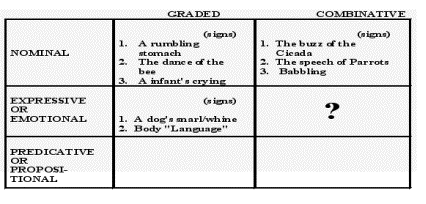
4. Expressive
(or emotional) Combinative Communications don’t exist according to
many credible psycholinguists. But I believe I can point to one example. You
can judge for yourselves the voracity of this idea. The example I would give is
swearing.
Although it is a speech
form it is NOT language. It is an Expressive communication. For example, if you show me someone
who is swearing, I will show you someone (excluding anyone with Tourettes
Syndrome) who is typically mad, surprised, scared, happy, in love, or in pain,
-- all emotional states. Hence, Swearing is a Sign of an emotional state of mind. It is also a Combinative
communication. For example, if I hit my thumb with a hammer, it doesn't feel
like I have communicated my feelings if I say, "Oh green peas!" Hence,
changing the combination of phonemes from what I typically might say (viz.,
“G@%$*^it!!!”) does change the meaning.
Incidentally, it is typically the Right Cerebral Hemisphere that swears. This
is because this hemisphere is for most folks a gestalt processor, which
organizes information in whole units. This includes such things as memories of
pictures, maps and even songs as well as swearing. There is also in the right
hemisphere lots of words and phases as they appear in over-learned clich?s and
expressive epithets. Speech Formulas, which are over used familiar phrases
(like, “How are you today”), Idioms (like, “The Fat is in the Fire”), and
Proverbs (like, “Two’s company and Three’s a crowd”) are all stored in and
emanate from the right cerebral hemisphere. More like songs than language,
these expressions are pretty much units, fairly rigid in their order and tone.
They come as a whole or
they don’t come at all. This is the property that places them in the Right Cerebral
Hemisphere,
which is, as I have said, a Gestalt
processor.
The Left Cerebral
Hemisphere on the other hand is a Segmental processor. Hence, it carries the burden of language
acquisition and use. So, for example, if I should receive a severe injury to my left cerebral
hemisphere, like from a hard blow to the left side of the head with a
heavy purse on my way to the Mike Tyson Fight, I may find upon regaining
consciousness that I am unable to use words to describe my headache or anything
else. I may have what is called Expressive Aphasia. But in my attempt to speak, in the absence of
expressive language, clear and fluent swear words may yet stream out.
In other words, when I have lost my language ability, I may still be able to
say many of those phrases that are not language, such as swear words.
Ironically, this body of words that exists in the right hemisphere can be used
beneficially as a springboard to both speech and language rehabilitation. And,
with some reservations, for the teenage AAC user, some swear words or phrases
might often be included in an AAC device so he can fit in with his peer group,
and/or he may have some opportunities to learn the pragmatics of when to use
and not to use such phrases.
5. Predicative
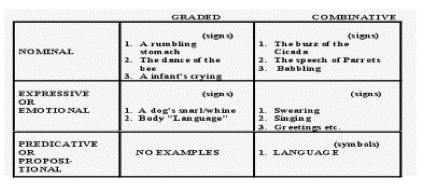
Graded Modality: There are no examples available in the literature that
I could find for this modality. It is conceivable, however, that Sign Language,
one form
of linguistic communication, includes some of these propositional and graded
qualities. For example the Signs (really Visual Symbols) for “Far” and “Very Far” appear to be
distinguishable by the degree of motion of one hand relative to the other.

6. Predicative
Combinative Modality: This Modality includes all sub modalities of Language based communications which use Symbols.
These include speaking, writing, Signing and Morse Code etc. This is in
contrast to all the previous modalities of communication mentioned so far, which are based on
the use of Signs.
Language is Combinative
because it relies on the order of phonemes, morphemes and words to determine
the meaning. It is Predicative
because the symbols bring to consciousness ideas or concepts which can be communicated. It
is this very process of symbolization that in some cases breaks down and causes
the communication disability. This is referred to as Aphasia. Although this is not basically a
motor disorder, there are nevertheless AAC devices (e.g., Lingraphica) which
are helpful in both rehabilitating language and restoring the communication
processes.
The Language modality for communication does exist in a variety of macro
modalities in the brain. It is important to the SLP to recognize these so that
when one modality (or more appropriately, a segment of a modality) becomes
disabled, the Speech Pathologist will know to determine where the break occurs
and to seek other combinations of modalities to reestablish or improve
communication competency. For this reason a full discussion of these macro
Modalities and their accessories will be the focus of the next Section.
Suggestion--if the print in the charts above seem too small to be easily read,
use the Control & Plus keys (Command & Plus keys for MaC) to make them
larger.,