Today's
youth are always the worst
By
Mike Males
NBC News
anchor Tom Brokaw's best-seller, The Greatest Generation, lauds the youth of
the 1930s who toiled through the Great Depression, won World War II, then
supplied three decades of statesmen, can-do spirit, and family stability, as
"the greatest generation any society has ever produced." Conventional
wisdom holds that our goodness has eroded so much since its passing that 1990s
youth might be our "worst generation," asocial, apathetic, even
coldly murderous. As one remedy, California Governor Gray Davis proposes
mandatory community service for college students in order to get back to
"the ethics of the World War II generation" and its "sense of
obligation to the future."
The
ironies challenging this conventional wisdom are startling. For one, surveys
such as the 1999 National Association of Secretaries of State's show
volunteerism by today's allegedly alienated kids, especially for human services
"such as soup kitchens, hospitals, and schools," has risen sharply to
"record high levels," reflecting modern teenagers' desire to
"help others in a personal way."
Another
irony: just as 1990s young people are stereotyped as frighteningly dissolute,
youth of the 1930s were bitterly trashed by the elders of their day. Back then,
they were not called the "greatest generation," but a new and
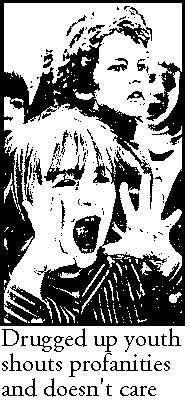
frightening "lost generation." To look at the 1930s press, scholarly
assessments, and official declarations, never had young people been so violent,
mentally disarrayed, drugged, lazy, promiscuous, criminal, and hopeless. Even
given normal wayward-youth apprehensions voiced by grownups back to ancient
"(A)
generation, numbering in the millions, has gone so far in decay that it acts
without thought of social responsibility," historians George Leighton and
Richard Hellman proclaimed in a much-quoted Harper's Monthly article in 1936.
"High school kids are armed, out for what they can get... The Lost
Generation is even now rotting before our eyes."
"Day
by day the newspapers report one grave crime after another, one moral
delinquency after another, and one dereliction of duty after another,"
Columbia University president Nicholas Butler summed up the grave "youth
problem" of 1935. Journalist Maxine Johnson traveled 10,000 miles studying
the new "Lost Generation," the title of her 1936 book. Everywhere she
found teenagers "confused, disillusioned, disenchanted," in a state
"rapidly approaching a psychosis."
 "British tea
and King George's taxes would be unloaded today without protest" by 1930s
youth, she lamented. "... Today's younger generation accepts whatever
happens to it with sheep-like apathy."
"British tea
and King George's taxes would be unloaded today without protest" by 1930s
youth, she lamented. "... Today's younger generation accepts whatever
happens to it with sheep-like apathy."
Yet, six
decades later, Brokaw renders a well-accepted verdict that this same generation's
"sacrifices" and "sense of duty to their country" literally
"saved the world" and built modern
"Youth
gone loco: Villain is marijuana," headlined a major magazine in 1938.
"Organized gangs are distributing drugs to every school in this
city," a 1937 government documentary warned. "...Dope peddlers infest
our high schools... in every community and hamlet in our country. Hundreds of
new drug cases involving our youth come in every day." Sensational press
reports of brutal youthful killers alarmed a nation: "drug-crazed teens
have murdered entire families!"
Famed journalist
I.F. Marcosson authored a classic article for the mass-circulation American
Magazine in 1936 in response to what editors called "literally
thousands" of readers bemoaning the "youth problem." The article
lamented that 75% of the 100,000 young men tested by the American Youth
Commission "were suffering from some health defect induced by mental
anxiety." The FBI reported in 1936 that "the average age of criminals
was nineteen."
Government
estimates of venereal disease and abortion in the 1930s were the highest of any
generation before or since. One result, American Mercury reported in 1936, of
"the drinking bouts in which high school and college students frequently
indulge, resulting in promiscuous relations." Studies by noted social scientists
in the 1941 text, Personality and the Family, found 80% of the young men and
60% of the young women of the 1930s reported having premarital sex. Marriages
contracted in 1935 were four times more likely to end in divorce than those of
1885.
Yet
today, Brokaw lauds that same generation for "duty, honor, country,
personal responsibility, and the marriage vow." The extreme contrast
between the despair with which this "Lost Generation" was greeted by
its elders versus the reverence accorded it by posterity raises a red flag: is
it possible that conventional wisdom about the rottenness of young people today
is also misguided?
More
pointedly, does denigrating youth serve to whitewash the failures of the
grownup generation and its institutions? Monumental fiscal irresponsibility
from
The
surprise: contrary to their bad press, today's young Californians are behaving
spectacularly well. Over the last two decades, teenagers' rates of felony and
misdemeanor arrest are down 40%, suicide and self-destructive deaths have
dropped 60%, and drug abuse deaths have declined 90%. In 1997, no teenagers
died in Los Angeles County from heroin, cocaine, crack, or methamphetamine
(drugs that killed 250 adults) -- one of many phenomenally positive facts about
today's young that are not discussed because they violate the rigid,
official-media narrative that "kids today" are going to hell.
Youths
today seem doggedly determined to survive disinvestment by the elder
generation. Even after 25 years of massive public school defundings and
classroom crowding, students display higher school enrollments, test scores,
college preparatory work, and volunteerism than their carping forebears. Only
California's poorest youth, stressed by the poverty and joblessness of a
selective economic depression whose attrition is every bit as devastating to
the young as the Great Depression was, have shown increases in violence and
alienation, and even these are far less than the dismal conditions imposed on
them would predict.
For all
their grumbling, adults of the 1930s, led by President Franklin Roosevelt,
innovated massive new job and education programs for the young despite a
strapped Depression-era budget. When the New Deal programs, the GI Bill, and
Social Security are added up, Brokaw's "greatest generation" turns
out to have been the most government-subsidized cohort in history. Young people
quickly justified the investment in sweat-labor Civilian Conservation Corps
camps and World War II trenches.
But,
while Roosevelt called on youths of the 1930s to help his administration fight
"the forces of organized greed" that spawned a "a society that
hurts so many of them," Bill Clinton's presidency and the Republican
Congress have abetted the pyramiding of corporate wealth, excused their own
abject moral failings, and loudly demanded a "personal responsibility"
ethic of young people those in power are unwilling to meet. Just possibly, the
better behaviors, personal optimism, and volunteer spirit of today's youth
portend a greatness so far obscured by their elders' ill-considered torrent of negativism.
This
article originally appeared in the