INTRODUCTION
“Life is full of misery, loneliness, and suffering - and it's all over much too soon.”
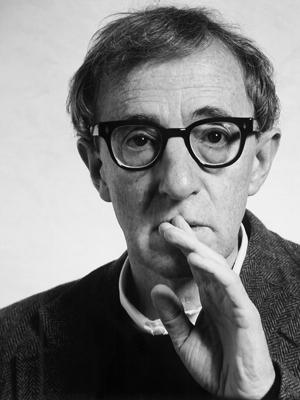
This graduate seminar in literature and film explores Woody Allen's life and work—the films, stand-up, essays, plays, music, and neuroses that launched Allen Stewart Konigsberg from card tricks on Avenue K to auteur status at Cannes. We'll consider Allen's appropriation of Dostoevsky, Freud, Porter, Chaplin, Fitzgerald, Marx, Bechet, Hope, Gershwin, and Bergman as well as his self-conscious engagement with the New York intellectual scene. By the semester's end we'll have a better understanding of Allen's oeuvre and why he was once run over by a car being pushed by two guys.
REQUIREMENTS
“My one regret in life is that I am not someone else.”
You are asked to respond online (WebCT) and on paper to the books and films listed above as well as to supplementary readings distributed throughout the session. Your main projects include leading a discussion on weekly readings, writing a final paper, and presenting an abridged version of that paper to the class.
Here is a summary of our work:
- Journal Forum. Each week post an informal yet thoughtful response to our readings on our WebCT page. This is an important opportunity for you to establish a meaningful dialogue with your classmates since they will post there, too. I don’t count words, but I do look for clear, convincing reflections in a conversational tone. Make connections to texts and things outside the class; go beyond summarizing.
- Analyses. You will be reading a great deal this summer session and often asked to respond more formally than your WebCT posts yet less so than a full term paper. Though these analyses will vary in style and content, they could figure into your seminar discussion and final paper.
- Seminar Discussion. Pair up with a classmate and choose a weekly reading. When it is your turn to lead a discussion (not lecture!), you’ll be responsible for the following:
1. Assigned book chapter(s)
2. Assigned supplemental readings (i.e., journal article) provided by me
3. Any “outside” text for the class to examine critically in light of our weekly readings. Choose any text, e.g., film, novel, poem, magazine or journal article, political speech, YouTube clip, Website, television or radio program, student essay, comedy routine, or song that might help us better understand the larger implications and subtle nuances of our weekly readings
NOTE: Please provide the class with your outside text at least one class prior to your discussion date. Also, if possible, please come by my office before the discussion date to let me know your thoughts and strategies for a good talk. Rather than lecture, try to find interesting and creative ways to get your classmates to situate our texts historically, biographically, politically, pedagogically, and so on. The goal is for everyone to rehearse important approaches to these texts as well as to shed new light on the subject matter, relevance, and implications for the field.
- Seminar Paper. This ten-page paper (excluding Works Cited) is a critical extension of an idea that we’ve examined during the session. You’ll develop and defend your own thesis, based on what we’ve read and discussed. You’ll present a section of the paper to the class and field questions from your classmates, just as you would at an academic conference. These papers could serve as early drafts of journal articles.
ATTENDANCE
“Eighty percent of success is showing up.”
This is a graduate seminar and attendance is absolutely necessary. Please do not come late to class since repeated late arrivals will count as a full absence. You cannot pass this course if you miss more than one class, miss an assignment, or plagiarize.
EVALUATION
“I don't want to achieve immortality through my work. I want to achieve it through not dying.”
I grade holistically, after the semester’s end and after I’ve read all of your work. I'm most interested in your progress throughout the session and your overall commitment to our seminar. Please feel free to come by my office to discuss your work, our assignments, and any other concerns.
SYLLABUS
“Why are our days numbered and not, say, lettered?”
Please note that all course requirements and policies are subject to change. Not all class readings are included below.
7/10 Introduction
"Bananas and You"
Chaplin, George S. Kaufman, S.J. Perelman, Marx Brothers, Bob Hope
7/15 Oedipal Allen
Take the Money and Run
Play it Again, Sam
Roth
Freud JRU: "The Purpose of Jokes" 106-39
Meade
7/17 Oedipal Allen (cont'd)
Annie Hall
Roth (cont'd)
Gilman
Freud JRU: "The Relation of Jokes to Dreams and to the Unconscious" 197-223
Meade (cont'd)
7/22 Intellectual (i.e., reverential) Allen
Manhattan
Benjamin
Adorno
I.D.: “The Whore of Mensa” 141-53
7/24 Intellectual Allen (cont'd)
Benjamin (cont'd)
Adorno (cont'd)
Siedell (Greenberg's "Avant-Garde and Kitsch" vs. Rosenberg's "The American Action Painters")
K. Marx
Music: Bechet, Gershwin, Porter, Reinhardt
Art: Monet, Cezanne, Ben Shahn, Pollock
7/29 Existential Allen
Crimes and Misdemeanors
Dostoevsky
Bergman's The Seventh Seal
7/31 Existential Allen (cont'd)
Love and Death
Dostoevsky (cont'd)
I.D.: “Notes from the Overfed” 57-62
8/5 Egotist Allen
Zelig
Sweet and Lowdown
Fitzgerald
I.D.: “A Twenties Memory” 63-67
8/7 Chekhovian Allen
Hannah and Her Sisters
Midsummer's Night Sex Comedy
Bergman's Smiles of a Summer Night
Fitzgerald (cont'd)
8/12 Dystopian Allen
Sleeper
Fahrenheit 451
Foucault's "Panopticism"
Haraway's "Cyborg Manifesto"
Insanity Defense: "Yes, but Can the Steam Engine do This?" 30-35
8/14 Autobiographical Allen
Stardust Memories
Fellini's 8 1/2
Bergman's Wild Strawberries
8/19 Final Papers and Presentations
|