SYLLABUS: INTERSECTIONS
OF GENDER, RACE, CLASS AND SEXUALITY
Summer 2010
| Instructor |
Sheena Malhotra, Ph.D. |
| Office | Jerome Richfield 340 |
| Phone | 818-677-7217 |
| sheena.malhotra@csun.edu |
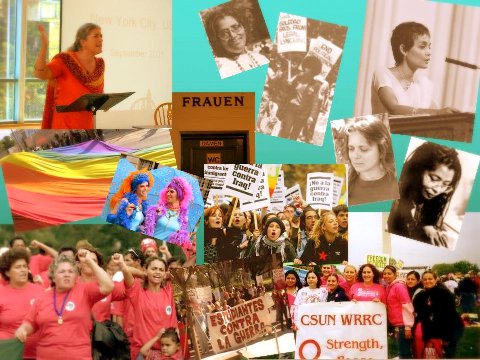
COURSE OBJECTIVES “Intersections Of Gender, Race, Class And Sexuality” examines race, class, gender as social constructions that are negotiated within specific historical and material locations. We will study the connections between images in popular culture, history, and social practices in our daily lives. From this perspective we will explore how the social roles we perform and consume every day produce and sustain uneven social relations between and among differently situated people and groups. Of particular interest is the way in which gender intersects with other social categories such as race, class, sexuality, and national origin in our daily lives and popular images. By studying these intersections from the perspective of women living them, we move marginalized women from their typically marginal position to the center of the curriculum. The central aim of the course is to understand gender not as a singular category, but to see the ways in which gender intersects with other axes of power within specific historical contexts to interrogate the complexities of the social forces that shape our lives in contradictory ways. For instance, how does class privilege relate to gender oppression? How does gender privilege intersect with racial oppression? Upon which axes of power are you privileged and/or marginalized? How are we empowered and/or marginalized by social systems that go beyond our immediate lives and yet influence them so deeply? These considerations take place within the material and historical contexts that shape the possibilities of experience that social groups may have. The course is designed to enable students to become critically reflexive about the cultural representations that we consume and daily practices we perform in which gender, race, class, sexuality, and nation are constituted. Readings, class activities, and homework assignments aim to enable students to analyze and write about gendered identity formation and the political significance of social categories. One desired outcome of the course is to increase students’ sensitivity towards societal issues relating to discrimination, exploitation, and domination. We will have a special focus on the Anti-War movement and Prop 8… particularly as they relate to intersections of gender, race, class & sexuality. |
|---|
REQUIRED TEXTS Alexander, M. J., L. Albrecht, et al., Eds. (2003). Sing, Whisper, Shout, Pray! Feminist Visions for a Just World. New York, Edgework. [The text is out of print -- but can be found online. So please make sure you purchase it as soon as you can] WS 350 Reader. Available at “ASAP Copy & Print.” 9250 Reseda Blvd. On the corner of Reseda and Praire. Ph: 818-700-7999. |
CLASS POLICIES Class Participation/ Readings: Class participation is crucial to “getting” the concepts put forth in this class. The content of this course is not “merely” theoretical or political, but rather, it involves our personal lives—our relationships, our careers, our families. The course is designed to “denaturalize” social categories that are political, which does not mean that they are not extremely personal. Having one’s social privilege/ marginality marked, as this course aims to do, is not always a comfortable process to undergo. Yet it is productive. In order to facilitate a “safe” environment—particularly for those students who are taking risks in exploring the forces that marginalize and/or privilege them—students are expected to contribute in meaningful, sensitive, and self-reflexive ways to online class discussions. Also, because some of the theoretical and critical issues we will deal with in this course are complex, it is important that students stay current on the reading. Reading should be done in advance of class and students should be prepared to contribute well thought-out and relevant questions and content to the discussion. Respect for every student’s experience and opinion will be expected. Please do the readings before logging into the class chats or posting to the Forums as they are essential for meaningful discussions to occur. This is part of your participation grade. Late Work: Turn in papers and projects on the date they are due, unless you have a legitimate university-approved reason (such as a medical emergency). Late work will loose points and may not be accepted if it is submitted more than one week after the due date. Academic honesty and plagiarism: All assignments must be the student’s own original work. Please cite sources in your papers and familiarize yourself with CSUN guidelines on academic honesty. Plagiarism and cheating are grounds for university action and will not be tolerated. It is the responsibility of the instructor to report any cases of plagiarism to the administration and can result in an “F” on the assignment, in the class. |
GRADING
| Attendance (online) and Participation level in class chats | 50 |
| Online Forums (15 pts each) | 60 |
| Prop 8 Discussion Board | 25 |
| Questions on Readings (10 pts each) | 40 |
| Auto-Ethnography Paper ... focus on Race | 50 |
| Response Paper on WAR | 50 |
| 2 Exams (75 points each) | 150 |
| Group Blog or Webpage Project + Final Paper |
75 |
| TOTAL POINTS POSSIBLE | 500 |
Divide your "total points" by 5 to get your percentage points.
GRADING SCALE - By Percentage
97-100
A+ |
87-89
B+ |
77-79
C+ |
67-69
D+ |
93-96
A |
83-86
B |
73-76
C |
63-66
D |
90-92
A- |
80-82
B- |
70-72
C- |
60-62
D- |
ASSIGNMENTS ATTENDANCE AND PARTICIPATION: This portion of your grade will come from your attendance and participation in the online classroom chats we will have on a weekly basis. Please login on time and be prepared to participate having read the material assigned. It is important to make meaningful contributions that demonstrate your engagement with the material, rather than making comments that are not based on the readings. If you have more than one unexplained/unexcused absence online, your grade will be affected adversely. ONLINE Forums:
The content of this course is not “merely” theoretical or political,
but rather, it involves our personal lives—our relationships, our careers,
our families. Readings should be done well in advance to class. You should be
prepared to contribute well thought-out and relevant content to the discussion
questions posted online. You will be expected to demonstrate your preparation
by posting to Forums on particular days (refer to class schedule) and by responding to classmates posts online to have
a dialogue about the readings. QUESTION LINKS [QL's]: There are different class times when we have readings assigned and are meeting online. For these times, there is a "Questions Link" that you have to access in Moodle. Please pick three different readings from that day's assignment. Post one well formulated question each, on three different readings for that day (before we meet for the online chats). BOTH Forums and Question Links (QL's) can be found on Moodle. AUTO-ETHNOGRAPHY PAPER (FOCUS ON RACE): this project asks you to think about the ways
in which your everyday life is personally affected by race and privilege (you
may bring in other aspects like gender, class and sexuality... but the focus
of this paper should center on race). You will write one short paper (4-5 pages
double-spaced). There are three components to the paper that I will be evaluating:
description, definition, and application. Guidelines are: ANTI-WAR SECTION RESPONSE PAPER: You will do one response paper for this class on the Anti-War section of the course. For this paper, choose two of the readings from that section to focus on and write a response paper in which you: 1) identify a key concept that links the authors and 2) analyze the authors' arguments theoretically and in-depth. If you wish, you may discuss your emotional response to the reading, however the main focus of the paper should be building your argument (based on readings). (3-4 pages, double-spaced). TESTS: the tests will be based on all the readings assigned for this class as well as on all in-class discussions and materials presented. The exam will be in varied format: multiple choice, short answer questions and long essays.
|
|---|
Possible Blog pages you could try: livejournal.com, blogger.com, or edublog.com OR any other blog site of your choice. Search the web and find one that works for your group. Group Project Content: 1). Do a “cultural study” of any popular text. Choose a cultural text, such as a music video, a song, a movie trailer, or a commercial. Analyze and critique the ways in which race, gender, class, and sexual orientation get played out within the text in ways that challenge and/or reinscribe dominant social norms. 2). Research the “War on Terror” from a gendered, racial and/or class perspective. What are some of the issues of power in this “war.” How do we understand the historical and political circumstances that have brought us to this juncture, “who counts and who doesn’t?” {Roy}. 3). Do a race/class/nation-based analysis of any current event (such as Hurricane Katrina). 4). Research Prop 8 - and the various issues surrounding it. It has been framed as a civil rights issue by those who support gay marriage, and as a religious issue by those who oppose it. You are free to take your own approach, but make sure to do so in a way that is respectful, as well as one that builds strong arguments based on credible evidence. 5). Research a topic of your choice that focuses on the intersections of at least two power dimensions discussed in this class [gender, race, class, sexuality, ability, etc.]. This last possibility has been kept intentionally very broad to allow you to research and explore further any topic or issue that has engaged you the most.
|