 is
is
 times continuously differentiable at a point
 we can compute its Taylor polynomial of degree
 at
at
 as follows:
If a function
is
times continuously differentiable at a point
we can compute its Taylor polynomial of degree
at
as follows:
 where
where
 is a remainder term which satisfies
 with
with
 the maximum value of
 for all
 such that
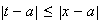 .
.
The Taylor polynomial is an
approximation of the function; the remainder term measures the error in this
approximation. For example, the Taylor polynomial of degree
 at
at
 for the function
 is computed as follows:




Putting these terms together we get

The class software can do the entire computation for us, by using
Compute+Power Series and choosing 5 for the number of terms
and
 for the power.

The term
 represents the remainder, and signifies that the remainder is a fifth order
term.
represents the remainder, and signifies that the remainder is a fifth order
term.
In the figure below both
 and its 4th degree Taylor polynomial about zero are plotted. (When you do this
you should make sure that you do not include the
and its 4th degree Taylor polynomial about zero are plotted. (When you do this
you should make sure that you do not include the
 term in the plot.)

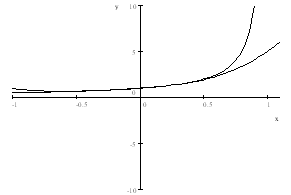
We see that close to 0 the two curves are identical, further away they no longer match. If we want a better measure of the actual error we plot

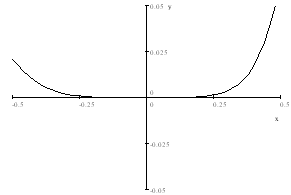
We see that in the interval
 this error is less than 0.05.
The Taylor
series of
 at
at
 is
is
 .
The special case of
.
The special case of
 is called the Maclaurin series of
 .
.
Problems
Use the class software to find the Taylor polynomials up to degree 6 for
 centered at
 .
Graph
.
Graph
 and these polynomials on a common screen.
Evaluate
 and these polynomials at

 and
and
 .
.
Comment on how the Taylor polynomials converge to
 .
.
Use the class software to find the Taylor polynomials up to degree 3 for
 centered at
 .
Graph
.
Graph
 and these polynomials on a common screen.
Evaluate
 and these polynomials at
 and
and
 .
.
Comment on how the Taylor polynomials converge to
 .
.
More Problems
Use the class software to find the Taylor polynomial of degree 7 for the given
functions around the indicated points. Plot the function together with the
Taylor polynomial in a single graph. Then plot the actual error:
 .
Choose your units carefully and estimate the size of the error.
.
Choose your units carefully and estimate the size of the error.
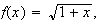


Would the Taylor polynomials of degree 5 be better or worse approximations to the functions? Explain. What about the degree 9 Taylor polynomials? Explain.
Find the Maclaurin series for
 .
Then use it to find a series which is equal to
.
Then use it to find a series which is equal to
 .
.