
 be a sequence such that
 An infinite series is the sum of infinitely many
terms:
An infinite series is the sum of infinitely many
terms:
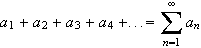
Let
be a sequence such that
An infinite series is the sum of infinitely many
terms:
If the sum is a finite number, we say the series
converges. If the sum is infinite, we say the series
diverges. The two simplest examples are the
geometric series and the harmonic
series. The geometric series has the form:
 , if
, if
 and thus the series converges. On the other hand the harmonic series has the
form
and thus the series converges. On the other hand the harmonic series has the
form
 and using the class software to evaluate it, we see that
 Thus, the harmonic series diverges.
The Cantor set, named after the German mathematician
Georg Cantor (1845-1918), is constructed as
follows. We start with the
closed interval
![$[0,1]$](f3b7__8.png) and remove the open interval
and remove the open interval
 .
That leaves the two closed intervals
.
That leaves the two closed intervals
![$[0,\frac{1}{3}]$](f3b7__10.png) and
and
![$[\frac{2}{3},1]$](f3b7__11.png) and we remove the open middle third of each. Four closed intervals remain and
again we remove the open middle third of each of them. We continue this
procedure indefinitely, at each step removing the open middle third of every
interval that remains from the preceding step. The Cantor set consists of the
numbers that remain in
and we remove the open middle third of each. Four closed intervals remain and
again we remove the open middle third of each of them. We continue this
procedure indefinitely, at each step removing the open middle third of every
interval that remains from the preceding step. The Cantor set consists of the
numbers that remain in
![$[0,1]$](f3b7__12.png) after all those intervals have been removed. Click here
to see the first few steps of the construction.
after all those intervals have been removed. Click here
to see the first few steps of the construction.
Sketch the first few steps of the construction described above (you may do this by hand).
Show that the total length of all the intervals that are removed is 1 and thus the Cantor set has length 0. (Hint: Determine the length of the interval that is removed at the first step, and then find the length of the intervals removed at the second step, and so on until you see a pattern. Write the total length as the sum of these values. You will have a series that the class software can evaluate (or you can evaluate it using the formula given above for a geometric series.))
Although the Cantor set has length 0, it contains infinitely many numbers. Give three examples of numbers in the Cantor set.
The Sierpinski carpet is a two-dimensional analogue of the Cantor set. It is constructed by removing the center one-ninth of a square of side 1, then removing the centers of the eight smaller remaining squares, and so on. Click here to see the construction.
Sketch the first few steps of the construction described above (you may do this by hand).
Show that the total area of all the squares that are removed is 1 and thus the Sierpinski carpet has area 0. (Hint: Determine the area of the square that is removed at the first step, and then find the area of the squares removed at the second step, and so on until you see a pattern. Write the total area as the sum of these values. You will have a series that you should be able to evaluate.)
To construct the snowflake curve, start with an equilateral triangle with sides of length 1. Step 1 in the construction is to divide each side into three equal parts, construct an equilateral triangle on the middle part, and then delete the middle part. Step 2 is to repeat Step 1 for each side of the resulting polygon. This process is repeated at each succeeding step. The snowflake curve is the curve that results from repeating this process indefinitely. Click here for a picture.
Sketch the first few steps of the construction described above (you may do this by hand).
Let
 ,
,
 ,
and
,
and
 represent the number of sides, the length of a side, and the total length of
the
represent the number of sides, the length of a side, and the total length of
the
 approximating curve (the curve obtained after Step
 of the construction), respectively. Find formulas for
 ,
,
 ,
and
,
and
 .
.
Show that
 .
.
Find the area enclosed by the snowflake curve. (Hint: Start with the area of the original triangle and add the areas of the triangles added at each step. This will yield a series you should be able to evaluate.)
Observe that parts (c) and (d) show that the snowflake curve is infinitely long but encloses only a finite area.