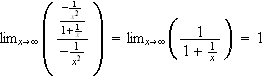
Mathematics 150AL, Spring 2004
Assignment 11 -- Indeterminate Forms and L'Hopital's Rule
Introduction
Certain limits result in the
forms

 or
or
 ,
which are called indeterminate because they do not
guarantee that a limit exists, nor do they indicate what the limit is, if one
exists. One strategy for dealing with such forms is to rewrite the expression
using an algebraic technique.
,
which are called indeterminate because they do not
guarantee that a limit exists, nor do they indicate what the limit is, if one
exists. One strategy for dealing with such forms is to rewrite the expression
using an algebraic technique.
Examples
Sometimes algebraic techniques are of little use. L'Hopital's
Rule can be used when various indeterminate forms arise.
L'Hopital's Rule
Let
 and
and
 be functions that are differentiable on an open interval
 containing
 ,
except possibly at
,
except possibly at
 itself. Assume that
 for all
 in
in
 ,
except possibly at
,
except possibly at
 itself. If the limit of
 as
as
 approaches
 produces the indeterminate form
 ,
then
,
then
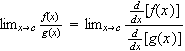 provided the limit on the right exists (or is infinite). This result also
applies if the limit of
provided the limit on the right exists (or is infinite). This result also
applies if the limit of
 as
as
 approaches
 produces any one of the indeterminate forms
 ,
,
 ,
,
 ,
or
,
or
 .
.
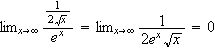
Examples
Other indeterminate forms are
 and
and
 .
In such cases, you should try to rewrite the limit to fit the form
.
In such cases, you should try to rewrite the limit to fit the form
 or
or
 .
.
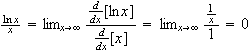
Example
Indeterminate forms such as

 and
and
 arise from limits of functions that have variable bases and exponents. In
these cases, it is usually helpful to find the natural logarithm of the limit
and use it to find the limit. Let us illustrate such an example.
arise from limits of functions that have variable bases and exponents. In
these cases, it is usually helpful to find the natural logarithm of the limit
and use it to find the limit. Let us illustrate such an example.
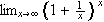
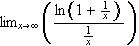
Example
Problems
-
Compute the following table and use your result to estimate the limit. Graph
the function to support your result.


-
Compute the following table and use your result to estimate the limit.



-
For each of the following, (a) describe the type of indeterminate form (if
any) that is obtained by direct substitution. (b) Evaluate the limit using
L'Hopital's Rule if necessary. (c) Graph the function and verify the result in
part (b).
-


-


-


-


-
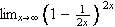
-
Graph the function
 for
for
 ,
,
 ,
and
,
and
 ,
,
 .
Then evaluate:
.
Then evaluate:

 .
(Hint: You may have to use the graphs to determine the limit: what function do
they appear to be approaching?)
.
(Hint: You may have to use the graphs to determine the limit: what function do
they appear to be approaching?)
This document created by Scientific Notebook 4.0.