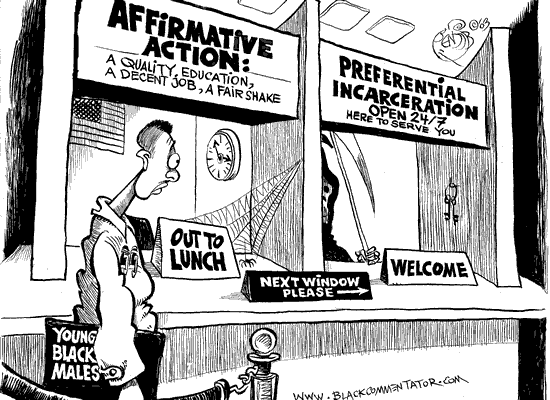
Pan African Studies 300OL
“Contemporary Issues in the African American Community”
Pan African Studies
Department
2004-2005AY
Ticket
No. 13248 Johnie
H. Scott, M.A., M.F.A.
Time:
Arranged
Associate Professor
Online
Course
FOB Room 210
Fall Semester, 2004/2005 (818) 677-2289
3
Units, General Education Office Hours:
By Arrangement
Comparative
Cultural Studies;
Email
Section B/Multicultural Requirement
Professor Scott's "Safe Haven" Homepage
Description:
Prerequisite – Completion of the Lower-Division writing requirement. An in-depth exploration of the social, political, cultural and economic issues in the African American community accomplished through the Distance Learning methodology. Provides insight on the extent to which these issues affect the Black individual and family in their interaction with the majority American society. This particular Pan African Studies section offering of “Contemporary Issues in the African American Community” makes extensive use of the latest cutting edge information technology (i.e., the Internet, email, WebCT, and various software applications) and is student-centered with a Computer Information systems-driven format..
Textbooks:
Required:
1)
Correspondents of the New York Times, Joseph Lelyveld, ed., How Race Is Lived in
2)
Cose, Ellis, The
Envy of the World: On Being A Black Man in
3) Mosley, Walter, et al, Black Genius: African American Solutions to African American Problems , W.W. Norton, New York, NY/1999;
4)
Smitherman,
5)
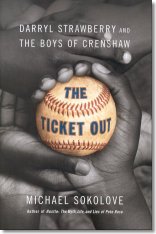
Sokolove, Michael, The Ticket Out: Daryl Strawberry and the Boys of Crenshaw, Simon and Schuster Publishers,
Strongly Recommended:
6)
Gibaldi, Joseph, The MLA Handbook for Writers of
Research Papers/Sixth Edition, published by the Modern Language Assn.
Of
7) Hallinan, Joseph, Going Up the River: Travels in a Prison Nation, Random House, New York/NY:2001.
Important Note:
Books for this course can be ordered for express delivery from the CSUN Matador Bookstore – (818) 677-2913 -- located on the Northridge campus. Those supplemental readings listed for either the Los Angeles Times or LA Weekly can be obtained by visiting the WWW websites of the publications, going to the “Archives” for each newspapers and entering the title(s) of the articles, then retrieving the same (Note that for the Los Angeles Times, articles older than 14 days may be obtained for a nominal sum payable to the newspaper – Professor Scott)
Requirements:
First of all is that every
student enrolling in this course must have direct access to a PC at all times.
This includes making provision for access to backup PCs in the event that the
one a student may own is not functioning. In this class (and similar Distance
Learning classes where the primary instrument is the information technology),
there is a ZERO TOLERANCE policy for “late” submissions;
Each week begins with “Word Up!” – an in-depth observation by the course professor on an issue of importance to Black America drawn from the syndicated column “Not On My Watch” written by the professor and published in The WAVE Newspapers with this being the oldest and largest African-American owned-and-operated newspaper in the western United States. All students are required to read these columns which set the tone and theme each week for the course. Those statements are found as links for each week of the course and are directly accessible to the students as they go to the course syllabus. These are to be treated with the same seriousness and reference as the required textbooks for the course as they are, in effect, the “course lectures” by the professor.
Lastly, students are given ample time to complete the assignments provided they practice good time and study area management. Distance learning courses require the type of student who is highly independent and self-motivated. That observation is certainly true for this course. The student will make note that the course grows out of a special program designed by California State University, Northridge which has enabled this professor to be part of a core faculty group at the campus in being the first to provide online courses to the general student body with this representing the first such course offered by the Pan African Studies Department. In that respect, it also constitutes the first online course offered in the nation by a Pan African Studies Department.
a) Examinations: there are the Midterm and Final Course Examinations. Both are essay-format. For the Midterm, students respond to a series of questions posted on-line by the instructor that are based upon the essays in the Pulitzer Prize-winning New York Times collection How Race Is Lived In America: Pulling Together, Pulling Apart, Walter Mosley’s Black Genius and Geneva Smitherman’s seminal work talking that talk:Laguage, Culture and Education In African America along with the feature films and documentaries viewed as part of class instruction, supplemental readings and the Word Up! Weekly lectures by the course instructor. Students will have two weeks in which to complete the Midterm Examination while answering the questions. The Midterm Examination is to be written using large Blue Books and then either (a) brought to the PAS Department Main Office at CSUN in the Faculty Office Building, Room 221, by the prescribed deadline or (b) sent via the US Post Office Overnight Express Mail or through a carrier (e.g., Federal Express, UPS) with the student making certain that, in any case, the examination has the deadline postmarked as no “late” examinations will be accepted – No exceptions! The Final Examination is an Exit Essay comprised of one question posted to the class on email. Students, in responding, must use Microsoft Word and send the Exit Essay back as an attachment. The Exit is posted for 12 hours in which time the student is to respond, submitting by the stated deadline. No “late” exit essay exams will be accepted for grading. The two examinations are averaged together in establishing the first primary grade component;
b) Film
Evaluations: Each student must have an email address and computer
access. This access is crucial in that a key component of this Pan African
Studies “Contemporary Issues” class are a combination of feature films
and documentaries that students view and then post formal evaluations on. The
film evaluations are sent via email to the instructor at the time noted in the
syllabus or directed by the instructor. These evaluations are based
upon videotapes of feature films and documentaries available at major video
rental outlets (i.e., Blockbuster, Tower, etcetera) viewed by the student at
the instructor’s direction. Those videos available in the Oviatt Library’s
c) Chat ‘N Chew: Each student is assigned to one of the four “Discussion Rooms” in the Chat ‘N Chew Forum. For the semester, the student participates in this virtual classroom meeting with the course instructor (for the record, each student will be assigned to a specific Chat Room and Topic by the instructor in assuring opportunity for dialogic interchange with other class members ). Each Chat ‘n Chew Forum runs for 90 minutes and participation is mandatory. All students enrolled are expected to participate in these Forums in responding to the issues being put forth. It is expected that students will have completed any necessary reading and/or viewing of films prior to the actual discussions. The student receives up to 4.0 points for participating in these discussion, for a total possible 4.0 points maximum (Read: 4.0 points is equivalent to an “A” for with Chat ‘N Chew representing the third primary grade component. The instructor’s assessment of points will be based on the seriousness, reflection and quality of the student participation;
d) Rap Time (Bulletin Board): For each week of the course up through “Review Week,” students will have the opportunity to “rap” with one another in this setting which is much like a Chat Room. The exception is that the instructor will post one topic each week taken from today’s headlines where Black American is concerned for dialogue that the students in the course can respond directly to. “Rap Time” provides the student with an opportunity to post a first response to a discussion prompt provided by the course instructor with several of these drawn from the class having read Black Genius, How Race Is Lived In America or talking that talk. This first posting in direct response to the course instructor’s question is valued at up to 2.0 points. The student then receives up to 1.0 points per reply to the postings made on the same prompt by two other students for a total of 4.0 points per “Rap Time.” There are four (4) of these “Rap Times” sessions during the term. Student have three full weeks per Rap Time in which to give their own best thinking on a given issue. Rap Time constitutes the fourth primary grade component in the course; and lastly
e) Contemporary Issues Case Study: This is the one formal writing assignment. The student develops a topic based on reading and research related to Ellis Cose’s The Envy of the World: On Being A Black Man in America and Michael Sokolove’s The Ticket Out: Daryl Strawberry and the Boys of Crenshaw in comparison/contrast to the issues raised in Joseph Hallinan’s Going Up The River: Travels in a Prison Nation. The Case Study is to be at least 2,000 typewritten words, double-spaced and written according to Modern Language Association guidelines. It is to contain no less than 15 citations done according to MLA guidelines and have a “Works Cited” section with no less than five references including the aforementioned three texts. It is required that one of those references be that of the work done by the Washington, D.C.-based nonprofit The Sentencing Project. Make special note that any references (i.e., critical reviews, feature articles, etcetera) taken from the Internet must be of “Peer Review” caliber. The Case Study represents the fifth and final grade factor for the course.
Grading Scale:
Grading for the course is on a “Plus-Minus” basis as described in the 2002-2004 CSUN Undergraduate and Graduate Catalogue. The final grade is based upon the cumulative grade point averaged derived from the four (4) aforementioned primary grade factors. Final grading shall be as follows:
“A” = 3.7-4.0;
“A-“ = 3.5-3.69;
“B+” = 3.3-3.49;
“B” = 3.0-3.29;
“B-“ = 2.7-2.99;
“C+” = 2.3-2.69;
“C” = 2.0-2.29;
“C-“ = 1.7-1.99;
“D+” = 1.3-1.69;
“D” = 1.0-1.29;
“D-“ = .7-.99;
and
“Fail” = 0.0-.69.
The grade of “Incomplete” shall only be issued to those students doing passing work (i.e., “C” or better) who are forced due to circumstances beyond their control – and subject to full documentation – miss submitting the Final Examination and/or Case Study.
Course Schedule
“The problem of the 20th
century will be the problem of the color line.”
--
W.E.B. DuBois
From The Souls of Black
Folks
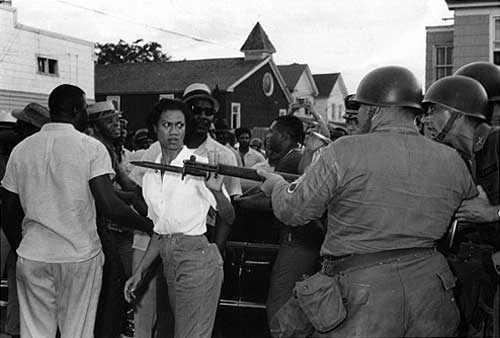
Week One Praxis: “Don’t Talk About It, Be
About It!”
·
Theme: “Praxis: From Talkin’
the Talk to Walkin’ the Walk”
·
Word Up! – “A Message to
Generations Yet Unborn: Black
·
Week
Two Black AIDS
·
Theme: “AIDS – the Undeclared War on People
of Color”
·
Word Up! – “AIDS – The
Undeclared War on the Poor” (WAVE Newspapers,
·
Documentary: Black Is, Black Ain’t (1994,
A Marlon Riggs Film – Title available for viewing at Oviatt Library’s IML)
·
Reading: : “Black AIDS: ‘Our People, Our
Problem, Our Solution’ by Sara Catania, from LA Weekly, June 1-7, 2001;
“Losing Dorothy: If You’re Black and Poor in L.A., Silence Still Equals Death”
by Sara Catania, LA Weekly, June 1-7, 2001; “The New Face of AIDS:
Residents of Carl Bean House, Los Angeles, Winter 2001,” photographs by Anne
Fishbein, LA Weekly, June 1-7, 2001 and “Sunday Report: Life Is Forever
Altered as an Epidemic Turns 20” by Mary McNamara, LA Times, June 3,
2001; “AIDS After 20 Years: Hope for Vaccine Rises, but So Do Fears of More
Infections” by Rosie Mestel, LA Times, June 4, 2001; “An Appreciation:
The Heavy Hand of AIDS” by Mary McNamara, LA Times, June 5, 2001
(Supplements: Students to obtain articles by visiting the websites for these
respective newspapers – Professor Scott); “Introduction,” pgs. ix-xix, from How Race Is Lived In America;
Chapter 2, “Go West, Then Keep On Going,” from The Ticket Out.
·
Rap Time #1: “My First
Week
Three Sankofa: “Return to the
Source”
·
Theme: “’I Ain’t African!’: Searching for
Identity”
·
Word Up! – “I Am a War Baby”
(WAVE Newspapers,
·
File Evaluation #1 Due – Black Is, Black
Ain’t (By or before Friday,
·
Reading: Chapter 1, “Shared Prayers,
Mixed Blessing,” from How Race Is Lived In America;
Chapter 3, “Crenshaw,” from The Ticket Out; and “Educating on
Behalf of Black Public Health” by Jocelyn Elders, M.D.,
pgs. 173-192 from Black Genius.
·
Film: Sankofa (Mypheduh
Films, Produced and directed by Haile Gerima – Title available for viewing at Oviatt
Library’s IML; Sankofa email)
Week
Four Some Call It “The Criminal (In)Justice System”
·
Theme:
“Racial Profiling!: Driving While Black aka DWB’”
·
Word Up! – “Why Racial
Profiling Must Be Brought to an End” (WAVE Newspapers,
·
Film Evaluation #2 Due - Sankofa (By or before Friday,
·
·
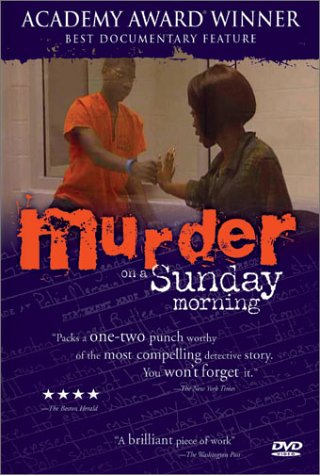
Film: Murder On A Sunday Morning (2002)
·
Chat 'N Chew #1: "New Millennium
Holocaust: Black AIDS"(Every student to have completed reading from Week 2 in joining this first "live" online
class forum on Saturday, September 18th)
Week
Five The
Traditional Black Family: Pre-1970s
·
Theme: “Movin’ Up in the World, or Not?”
·
Word Up! – “Do the Math!:
The Playing Field Is Not Level” (WAVE Newspapers,
·
Film Evaluation #3 Due – Murder On
A Sunday Morning (By or before Friday,
·
·
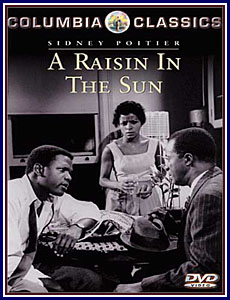
Feature: A Raisin in the Sun
(1961, starring Sidney Poitier – Title available for viewing at Oviatt
Library’s IML)
·
Rap Time No. 2: “The Vanishing Black Family”
“That is our dilemma. After
the dreaming is done, there has to
be an awakening, and the
reality of our imperfections must be
addressed. Sooner or later the dreams
that enrapture us and
the tales that regale us must
make way for the truth which alone
can set us free. All of us.”
-- C. Eric Lincoln
From “The American Dilemma
in Perspective,”
Race, Religion and the
Continuing American Dilemma
Week
Six Broken Promises, Broken Vessels:
Of the Public Schools and Black Children

·
Theme: “A Mind is a Terrible Thing to Waste!”
·
Word Up! – “We Won’t Abandon
Our Neighborhoods or Schools!” (WAVE Newspapers,
·
Film Evaluation #4 Due – A Raisin
in the Sun (By or before Friday,
·
·
Documentary: I Am A Promise: The Children
of
Week
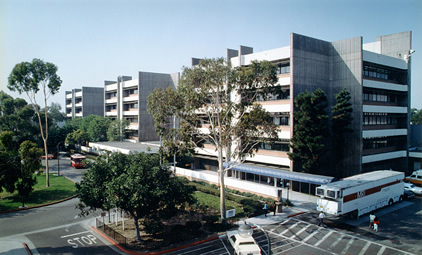
Seven A Fight to the Bitter End: The King/Drew Medical Center Controversy
·
Theme: “The
·
Word Up! – “When Is It Ever
the
·
Film Evaluation #5 Due – I Am a Promise:
The Children of
·
·
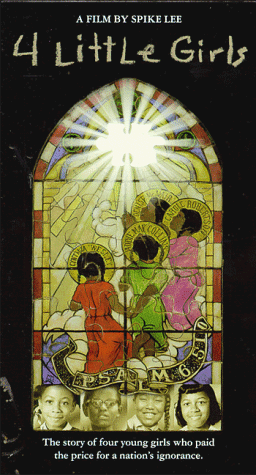
Feature Film: Four Little Girls
(1998 Academy Award-Nominee for Best Feature Documentary, A Spike Lee
Joint)
·
Chat 'N Chew #2: "In the Line of Fire!: The
Martin Luther King Jr./Charles R. Drew Medical Center in South Los Angeles is Under Heavy Siege" (Note: As the
prerequisite for this "Real Time" Discussion scheduled for Saturday from
3:00pm-4:30pm, students beforehand are to visit, read the Los Angeles Times' article on thratened closure of the Trauma Center at King/Drew that was first published on September 14, 2004 in also noting the April 27, 2000, article by LA Times staff writers Nicolas Raccardi and Terence Monmaney on suspension of King/Drew Medical Center research activities and LA Weekly writer Erin Aubry Kaplan's article titled "What Is Lillian Mobley Fighting For?" )
Week
Eight “Who’s That Knocking at
the Door?: The
·
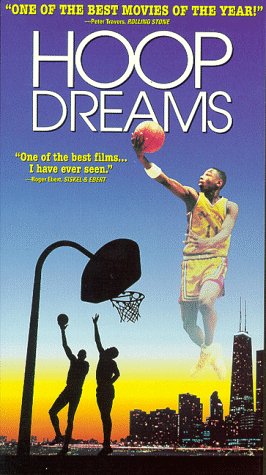
Theme: “The Ultimate 'Hoop Dream': What Happens When A Black Boy Places All His Dreams Into Becoming a Professional Athlete?"
·
Word Up! – “A Knocking at
·
Film Evaluation #6 Due – Four
Little Girls
(By or before Friday,
·
Midterm Examination (To be posted on Monday
as of
·
Screening: Hoop Dreams
(1994, A film by Steve James,
Frederick Marx and Peter Gilbert. To be obtained at your local video store)
·
Rap Time #2 Closes (Thursday, October 14th
as of
·
Week
Nine Of America’s
Most Enduring Controversy: Black Men, White Women
·
Theme: “Black Men, White Women”
·
Word Up! – “There Is a
Lesson in ‘Children of
·
Film Evaluation #7 Due (Hoop Dreams ,
by or before Saturday,
·
Reading: Chapter 9, “Family,” from The
Ticket Out; Chapter 11, “Minority Quarterback” by Ira Berkow and
Chapter 12, “Guarding the Borders of the Hip-Hop Nation” by N.R. Kleinfield,
pgs.180-228 from How Race Is Lived in
America and “Holding the Media Accountable”
by Farai Chideya ,
pgs. 215-244 from Black Genius.
·
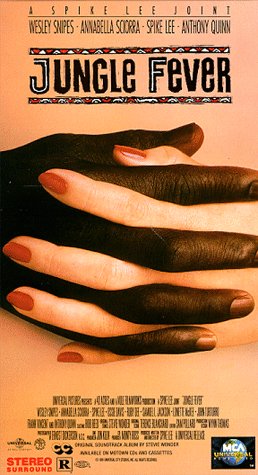
Feature Film: Jungle Fever
(1991, A Spike Lee Joint)
·
Rap Time #3: “No Longer a Safe
Haven: The Endangered Schoolyard” (The prerequisite for participating
in this “Rap Time” will be all students having downloaded and read report Crime
and Violence in the Schools: Final Report by the National Center for
Education Statistics)
Week
Ten Homophobia and Black
·
Theme: “God made Adam and Eve, not Adam and
Steve! The Untold Strictures Concerning Black Homosexuality”

·
Word Up! – “Flashback: Reflections on Bullworth and Presidential Politics 2000” (WAVE
Newspapers,
·
Midterm Examination Due (As of
·
Film Evaluation #8 Due – Jungle
Fever (By or before Friday,
·
Feature Film: Blind Faith
(1998, A
Showtime Third Row Center Film produced by Nick Grillo
and directed by Ernest Dickerson. Obtain this at your local video outlet)
·
Week
Eleven The
Fire This Time
·
Theme: “Can't we just all get along?” – Rodney King, quoted during the
1992 Los Angeles Riots
·
Word Up! – “Of
·
Film Evaluation #9 Due – Blind
Faith
(By or before Friday,
·
Reading: “My Dungeon Shook: Letter to My
Nephew on the One-Hundredth Anniversary of the Emancipation”
by James Baldwin first published in The Progressive, December 1962 and
published by the Dial Press, 1963 in The Fire Next Time;
Chapter 5, “A New Way of Talkin’”: Language, Social
Change and Political Theory” from talking that talk; Chapter 16,
“Removing the Filter: Unmediated Conversations About Race,” pgs. 285-301 from How
Race Is Lived in
·
Feature Film: Do The Right Thing
(1989, A Spike Lee Joint)
Week Twelve “No Justice, No Peace!”
·
Theme: “Black
·
Word Up! – “Reflections on
the LAPD’s Rampart Scandal” (WAVE
Newspapers,
·
Film Evaluation #10 Due – Do the
Right Thing (By or before
·
Film: Training Day
(2001, Produced and Directed by Antoine Fuqua with Denzell
Washington, Warner Brothers Pictures. Obtain this at your local video store
outlet)
·
·
Final Rap Time #4: “Repaying the
Debt: The Case for Reparations in Regards to Black
Week
Thirteen When A Million Black Men
Marched
·
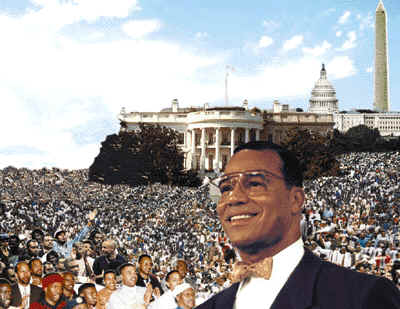
Theme: “In the Matter of the Million Man
March”
·
Word Up! – “Body Counts,
‘Walk-Ups’ and the NRA” (WAVE Newspapers ,
·
Film Evaluation #11 Due – Training
Day (By or before Friday,
·
Film: Get On The Bus
(1996, Columbia Pictures, Produced
and directed by Spike Lee)
·
·
Chat 'N Chew #3: "Ebonics
Revisited: Or the Inside Story on America's Failure in the Education of African
American Kids in Inner-City Schools" (Note: Prerequisites for this
Discussion Forum will be students having read essay "My Dungeon Shook" and/or Chapter
4, "Discriminatory Discourse On African American Speech" from talkin that talk with this Discussion for Saturday,
3:00pm-4:30pm)
Week
Fourteen Reparations and Black
·
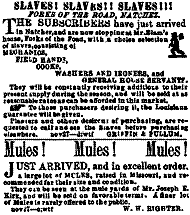
Theme: “I want my 40 acres and my mule! ”
·
Word Up! – “The Things We
Have in Common” (WAVE Newspapers,
·
Film Evaluation #12 Due – Get On
The Bus (By or before Friday,
·
Screening: Higher Learning (1995 with the note that you may want to give your local video outlet a
two week advance notice to order the movie for you)
·
Week
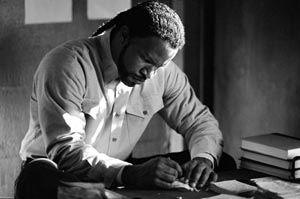
15 Urban Black Men: Street Soldiers or
POWs?
·
Theme: “Black America Today”
·
Word Up! – “The Fire This Time”
(reprinted from The Stanford Magazine, 1994 CASE Silver Medal Award
for “Best Feature Story”)
·
Final
Film Evaluation #13 Due – Higher Learning (As of
·
Screening: Redemption (2004, starring Jamie Foxx as Stanley “Tookie” Williams,
co-founder of the Crips streetgang/Death Row inmate
and Nobel Peace Prize nominee)
·
·
Final Chat ‘N Chew #4: “The Urban
Black Male: Street Soldier, Prisoner of War, or Tomorrow’s Hope?”
(Note: Having completed viewing of Redemption starring Jamie Foxx as
Week
Sixteen The Last Word
“We should
heed (George) Orwell’s words in the discussions
of
Black English. The grim naysayers of black potential
are
the
ones whose language is most opprobrious. Those folk who
denigrate
Black English without trying to understand it speak
in
bad faith. Those political critics who obfuscate their role
in
the economic suffering of the black ghetto with political
chicanery
are the real trouble. And those financially secure
black
folk who demean the users of Black English without
working
to get them better jobs, or to make sure that the
future
of the country’s poorest black children is as bright
as
their own children’s, speak a language of moral hypocrisy.
If all of
this is standard, then perhaps we should give
Non-standard
a try.”
-- Michael Eric
Dyson
-- From Race
Rules: Navigating the Color Line, 1997
·
Theme: “And We Still Rise: The Many Faces of
Today’s Black Woman”
·
Contemporary Issues Exit Essay Examination (Posted Wednesday morning at
·
Contemporary Issues Case Study Due
(Hard copy due in Pan African Studies Main Office, Faculty Office Building Room
221, postmarked by or before Friday,