Wednesday, July 06, 2005
Searching for Lessons in Jefferson High
Melee

Race was one factor, but roots of the tension run deeper than skin and wider than one school.
By Sandy Banks and Nicholas
Shields
Times Staff Writers
July 6, 2005
They had been milling around for an hour in the sun, 2,000 restless, agitated
teens packed onto Jefferson High's football field, waiting for the earthquake
drill to end and lunch to begin. When the bell rang they rushed the gates,
shoving, elbowing, knocking classmates aside.
In the crush, two black girls began tussling over a cellphone
or a boy, or maybe a boy's cellphone.
As school police officers dug them out of the center of a heckling crowd, a
Latino boy launched a milk carton across the quad. It landed in a group of
black football players.
"Who threw the milk carton?" one demanded, confronting the Latino
boys.
"Go back to
The entire quad erupted in fights.
In that brief moment, a food fight became a race riot. And in the days and
weeks that followed, racial skirmishes on this and other
The
"I'm scared even to go to class," said 16-year-old Keiana Scott, as she stood on the lawn outside school a few
days after the second lunchtime brawl. One of only about 300 blacks among the
school's more than 3,800 students, Keiana warily eyed
a passing group of Latino schoolmates. "I've got to look over my shoulder
every five minutes to see if somebody's about to whup
me," she said.
No Single Cause
The unrest comes at a time when
But the confrontations between blacks and Latinos, which have struck campuses
from the
"This is not just at one school, and it's not just kid stuff," said Khalid Shah, whose Stop the
Violence Increase the Peace foundation has been working for years to broker
truces between warring black and Latino gangs in the
"There's a rise in community violence as it relates to blacks and Latinos,
and that is seeping into our schools. When you start seeing large groups of one
race fighting against a group of the other race, we can't, as a city, afford to
ignore it."
"You can't blame [the fights] on any one thing," said Ron Rubine, a counselor at
"Is it really that different with adults? If there was a fight among the
staff, we'd align ourselves with the people we hang around with…. We have our
public face, but look at what we do in private — the way we gossip, the things
we say about other people, other groups. We look at these kids and say, 'What
savages!' but we all have onus in this thing."
Rapid Escalation
A close look at the first Jefferson fight shows how racial tensions can
quickly balkanize a campus — even one where peacemakers outnumber
troublemakers.
Steve Bachrach teaches in the school's Film and
A student ran past the room yelling, "Food fight!" Bachrach shrugged it off. But a few minutes later another
kid shouted, "Race riot — brown on black!" and several of his
students bolted. Outside, Bachrach saw half a dozen
kids scaling the school's chain-link fence, desperately trying to escape from
campus.
Bachrach headed for the quad to retrieve his students
and found one, a black girl, in a standoff with three Latino boys. She had been
beaten and was in obvious pain. He ushered her back to class, where a group of
her
But across the room, a group of younger Latinas bristled. They strode over, and
one angrily challenged the black girl: "Why are you disrespecting
me?"
The older girls quickly intervened, ordering the others to back off. The younger girls retreated, but not before belittling their
In the months since that first lunchtime fight, many others faced the same
brutal choice: "race pride" came to trump friendships, common
interests and personal history.
"Basically, I guess you can say that you had to pick sides. It was just a
must," said Yessinia Rivas, 18, a senior who has
since graduated.
Her worried parents gave her advice she didn't expect: For your own protection,
they said, stay away from other people. Her Latino friends demanded she declare
allegiance. "Either you were with them or against them," she said.
Pressure From Peers
In an essay for the independent teen publication "LA Youth," an
anonymous Latino student described being drawn into the initial fight by
friends' demands that he "stand up for my family, my Mexican ancestors,
and the people who worked hard so I could be here — my heritage that I'm really
proud of."
"I felt good defending my race," he wrote. "I was hitting
anybody I could get my hands on…. Many of my friends who knew I was involved in
the fight asked me, 'Aren't you proud that our people are at war with the
blacks?' … Because of that fight, I lost many friends who are African American.
The whole tension between Latinos and blacks is changing the way we all think
about each other."
The lunchtime crowd at
That kind of separation, long chronicled in post-segregation schools, doesn't
necessarily signal trouble. For adolescents, membership in a "tribe"
can provide a sense of belonging.
"It only becomes destructive when the groups are seen as rigid and
self-enforcing," said Allan Kakassy, a teacher
at
Before the fights, "everybody was having a great time," said Eric
Johnson, 17, president of
After the fights, students were so wary that some blacks were afraid to turn
their backs on Latinos, and some Latinos avoided the student store, because
getting there meant walking past blacks.
"Everything that has been said about the school is not the way it
seems," said Cindy Jaramillo, a 17-year-old senior bound for UC Berkeley.
She was on a visit to the college when she saw news of the disturbances on a
dorm television. She had never thought of her campus as racially divided.
"There was no problem," she said. "There was fighting and
everything, but I think that happens at every single school. The riots turned
things the other way."
Gangs Sow Fear
Race became a factor in even the simplest endeavors. When
school administrators banned white T-shirts because of the style's popularity
with gangs, scores of Latino students showed up wearing brown T-shirts instead.
"It was saying that we're here and that we have pride in each other and
we're not going to let nobody talk stuff about us," said Daniel Rios, 14,
wearing a brown T-shirt that hung to his knees. Black students struck back by
wearing black.
Bachrach considered the "brown pride"
display an act of intimidation, whether deliberate or not. "It was a
direct threat to another population on campus. And that's not tolerable,"
he told his students. He followed up with a letter to their parents, explaining
the racial dynamics of clothing selection.
At
One of the area's largest gangs,
Police have not tied the gang directly to the campus unrest, but fear of gang
retaliation is so strong among students and parents that most interviewed by
reporters refused to let their names be used.
Two years ago, according to parents and an injunction by the Los Angeles city
attorney, the 38th Street gang so dominated Ross Snyder Park, a few blocks from
Jefferson, that a Pop Warner football league run by black parents moved its
practices to the high school's football field.
Racial tension heightened noticeably this spring, when word spread across the
city that Latino gang members were plotting a Cinco
de Mayo massacre of blacks in retaliation for a drug rip-off by a local black
gang. According to the rumor, a Crips gang had stolen a huge cache of cocaine
from Florencia 13, a large
Parents Can Have Effect
The rumor contained a grain of truth.
But Zager said investigators found the Cinco de Mayo threat baseless.
"We're in the Internet age, where every teenager is online, even the thug
teenagers," he said. "We didn't find anything credible to any of that
stuff — and believe me, we tried to substantiate anything we could."
Still, students and parents from
"I feel like my son has a target on his back," said the mother of a
black
"I told my son, don't start nothing, but if they pick with you, don't back
down. It sounds simple to walk away, but it's not that simple. If you do, you
will continue to [have to] run. So you have to fight." She shrugged.
"It sounds terrible, but that's the way society is."
Many teachers and school officials say parental attitudes often prime students
for friction. Tensions are particularly high between blacks and newly arrived
immigrants in the neighborhoods surrounding
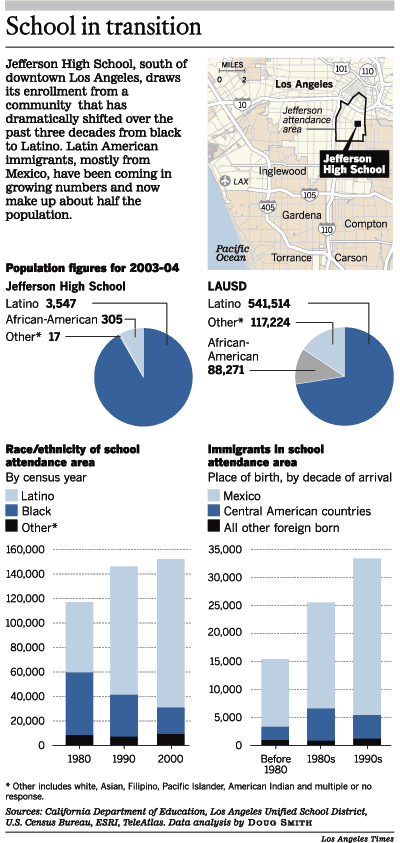
The school reflects the changing demographics of inner-city
Cultural Differences
In the United States, rural Mexican immigrants often come face-to-face with
black people for the first time.
In their home country, racial stereotyping is more open and less challenged.
Mexican President Vicente Fox ignited a furor here in May with a comment that
Mexicans who emigrate to
In the neighborhoods around
Mexicans living in largely black areas tell of being robbed, beaten and
intimidated by blacks. Their black neighbors complain about chickens in the yard,
old cars on blocks and harassment by belligerent street toughs allied with
Latino gangs.
Among parents — often exhausted and embittered by economic stress — race has
become the prism through which every gesture is viewed.
A Latino mother says it doesn't matter that blacks on the campus are vastly
outnumbered: "They're bigger, stronger … they're hurting our boys."
A black mother complains that after one fight, when the combatants sweltered in
a hot room waiting for police, "a teacher came in and gave the Latino kids
water, wiping their faces with towels. Not one time did she reach over and give
any of the African American kids anything."
Listening to their stories, "it's hard to tell who is
the prey and who is the predator," said Phil Saldivar,
the district administrator investigating the fights, who was sent to
Those perceptions give race counselors plenty to combat.
A Latino girl staying after school for a human relations meeting complained to
a black mediator that "the blacks are always whining about slavery. They
don't want to do nothing to better themselves."
Her friends murmured their assent.
A few days later, a black girl waiting for a ride home from school with her
mother blamed the racial problems on "too many Mexicans who can't even
speak English." They gossip in Spanish and poke fun at blacks, she said.
Among Los Angeles Unified's 49 high schools,
Jefferson had the second highest number of major crimes in its attendance area
— 94 homicides, more than 2,700 robberies, and about the same number of
aggravated assaults from 2002 through mid-2004, according to a Times analysis
of LAPD data for that period.
Education Suffers
Accustomed to apathy among students, teachers say
they have been shocked by the physical and emotional ferocity of this spring's
fights. One recounted seeing a Latino boy dragged from his car by blacks and
beaten in front of his mother. Another told of a black special education
student chased from his classroom by a group of Latinos, who pummeled and
kicked him when he fell.
One teacher stepped in to help a boy beaten unconscious in a fight on a
sidewalk near campus. Students watching the beating seemed unmoved, she said.
"It changed me. For days after that, I had to duck into the bathroom or a
classroom to cry. I realized some of our kids see things like this on a regular
basis. No wonder our test scores are in the toilet."
Jefferson Principal Norm Morrow — who was reassigned as the fights raged on —
said he had no idea emotions on campus were so volatile. "This thing
happened so quickly, it caught us off guard," he said. "Had we seen
signs of intolerance … damn right I would have done some things
differently."
Morrow wanted to shut down the school after the first brawl, "just for a
brief period of time … to settle things down," he said. But Supt. Roy Romer refused, concerned that canceling classes would set a
terrible precedent and amount to a public admission that school officials had
lost control.
Changes Underway
The school has tried to stop the cycle of fights with a flurry of community
meetings, increased police presence and student dialogue. The lunch hour is now
divided so only 1,000 kids are on the quad at a time. New security cameras will
be installed and students will be required to wear uniforms. A new principal
was brought in from
The Los Angeles School Board is considering restoring its office of intergroup relations, which provided guidance to schools
struggling with racial issues. It was eliminated five years ago in a round of
budget cutting.
For now,
Many of those arrested or disciplined for fighting have been transferred.
Others were pulled out by parents or simply disappeared.
"It's a handful of knuckleheads causing the problem," one school
police officer said. "Most of these kids don't hate each other. It's just,
'You jump off; I'll jump off.' We're getting rid of the hotheads."
But some say school officials are simply shifting the problems.
"So they're not going to be killing each other at school, just on the
streets," said Chico Brown, an ex-gang member who helps run A Place Called
Home, a community center a few blocks from Jefferson.
"They need to be taught to value each other," he said. "They
have to live together."
*
(BEGIN TEXT OF INFOBOX)
School in transition
Jefferson High School, south of downtown Los Angeles, draws its enrollment from
a community that has dramatically shifted over the past three decades from
black to Latino. Latin American immigrants, mostly from
Population figures for 2003-04
--
Latino: 3,547
African-American: 305
Other*: 17
--
LAUSD
Latino: 541,514
African-American: 88,271
Other*: 117,224
--
* Other includes white, Asian, Filipino, Pacific Islander, American Indian and
multiple or no response.
Sources: California Department of Education,
Times staff writers Joel Rubin, Sam Quiñones and Doug Smith contributed to this report