LUCRETIUS: SOME QUESTIONS ON EPICUREANISM
- (1) Who is 'a hero', according to Epicureanism? Who is The Hero, according to Epicureanism? On
what grounds is the hero a hero? (Gochberg, p. 451)
- (2) What exists? (Gochberg, p. 453) What is an atom? What is 'void'? (I. 334 ff.) Are atoms
created? By whom? Does the Universe have a beginning? An end? (453, top) How big is it?
What is movement' like?
- (3) What do the Epicureans mean by 'Chance' and 'Fortune'? What is the importance of Chance
in the Epicurean system?
- (4) Do the Epicureans have a god? Can there be more than one? (Cf. Epicurus' maxims [below],
from the Life by Diogenes Laertius) If so, what are they composed of? Are they 'spirit' (Answer
is, in fact, NO)? How do they become and stay gods? Are they interested in human beings?
- (5) What is the Epicurean view of 'Religion'? What is the usefulness of: (a) temples, shrines, altars;
(b) the Rev. Clergy; (c) prayers ?
- (6) What is the Epicurean explanation of the significance of 'death'? (III. 530 ff).
- (7) What is the Epicurean afterlife like? What is the relationship between a dead Epicurean and his
family? Other living persons?
- (8) Do the Epicureans believe in 'Morality'? (i.e. a system of correct behavior based on some
objective standard, perhaps revealed, perhaps dictated by society or some other person or persons)
- (9) On what principles does an Epicurean base his ethics?
- (10) With regard to his ethical/moral stance,
-Would an Epicurean be willing to be a town magistrate?
-Would an Epicurean be willing to be a municipal priest?
-Would an Epicurean be willing to be a soldier or officer in the army?
-Would an Epicurean be willing to be a Senator of Rome?
-Would an Epicurean be willing to be a member of a cult (Christianity, Mithraism, Isis Worship)?
-Would an Epicurean be willing to be a teacher?
-Would an Epicurean be willing to be a lawyer?
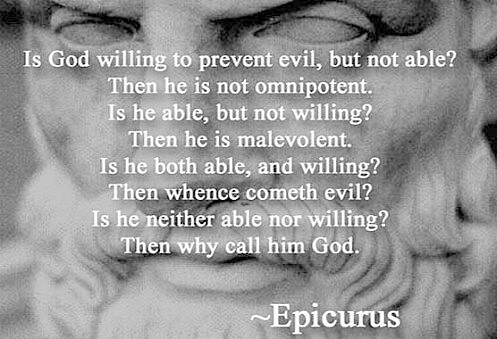
EPICURUS, Sovereign Maxims
- #1 A blessed and eternal being knows no inquietude himself, and brings no disturbance to anyone
else. Thus, he knows movements neither of anger nor of partiality, for all such movements point
to weakness.
- #6 Any means of obtaining security from other men is a good according to nature.
- #9 No pleasure is in itself evil. But the things that produce certain pleasures involve
inconveniences much greater than the pleasure they produce.
- #19 If the bounds of pleasure are measured by reason, then a length of time--short or long--affords
equal satisfaction.
- #27 Friendship is the most important of all the means counselled by wisdom for securing happiness.
- #33 Absolute justice has never existed. There have existed only reciprocal agreements, at different
times and in different places that provide against the infliction of pain or harm.
- #36 JUSTICE, as a general notion, is the same for all. That is, it is that which is necessary in order
to make social change possible. Its meaning in particular cases, under differing circumstances of
time and places, varies
A collection of Epicurean materials: John Gaskin (ed.) The Epicurean Philosophers (London: J. Dent 1995) [Everyman series]
A discussion of Epicureanism: John M. Rist, Epicurus: An Introduction (Cambridge 1972).
Return to the Handouts List.

