
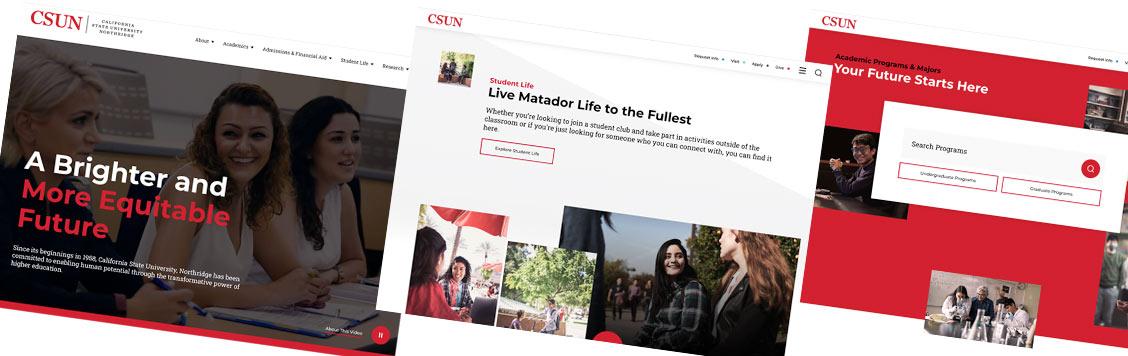
Page Description

The following page is a two column layout with a header that contains a skip navigation and other utilty links as well as the search CSUN function. Page sections are identified with headers. The footer contains update, contact and emergency information.

ALERT NOTIFICATION

Cum sociis natoque penatibus et magnis dis parturient montes, nascetur ridiculus mus. Proin ac tincidunt dui. Etiam dapibus semper velit at molestie. Phasellus quis lorem sed arcu ultricies suscipit. Maecenas tempus facilisis scelerisque.

Pellentesque nibh magna, ornare vitae sodales a, bibendum quis mauris. Cum sociis natoque penatibus et magnis dis parturient montes, nascetur ridiculus mus. Proin ac tincidunt dui. Etiam dapibus semper velit at molestie. Phasellus quis lorem sed arcu ultricies suscipit. Maecenas tempus facilisis scelerisque.

Community Engagement

Faculty

Forms and Downloads

What is Service Learning?

There are many definitions of service learning in the literature, each one with common elements that define how service is conducted in conjunction with course content. Service learning includes three elements: Course content/concepts, service project, and student reflection. The Office of Community Engagement at California State University, Northridge has adopted the below definition in 2012.

Service Learning is a teaching and learning strategy that integrates meaningful community service with instruction and reflection to enrich the learning experience, teach civic responsibility, and strengthen communities. Faculty choose a limited number of meaningful partnerships with the goal of providing students with different, but consistent off-campus learning experiences. Through service learning, students—from kindergartners to college students—use what they learn in the classroom to solve real-life problems. They not only learn the practical applications of their studies, they become actively contributing citizens and community members through the service they perform.

Continuum of Service and Community Engagement

Volunteer—Community Service—Field Work—Internships—Service Learning
Continuum of Service and Community Engagement
Definition Examples
Volunteerism: Emphasis is on the receiver of the service. Person decides to help, usually a one-time service opportunity without pay. Not tied to a course * One day beach clean up
* Read Across America-read books at a school
* Pack food boxes at a shelter
Community Service: Emphasis is on the receiver and how the service can make a difference over time. It is done with non-profits and is organized volunteerism. Not tied to a course. * Tutor a child in math for a semester&
* Help build a house or structure
* Ongoing park clean up
Field Work: This is a capstone experience in the field that applies skills learned in a credential or certificate program. The focus is on student learning. * Student teaching in a school
* Nursing practicum in a hospital
* Field work in a social services office
Internship: An internship is usually a capstone experience (more than 45 hours) where a student applies skills and material covered from a series of classes into the field. This experience normally requires no weekly reflection of the student, yet requires this student to culminate the semester with a project or research paper. * Working in a congressional office
* Working in social services office
* Working in a health organization
Service Learning: The focus is equally on student learning and service to the community. Academic content is blended with community service hours (10-45 hours) and students reflect on the connections between the classroom content and service placement. Tied to course where content and service are equally balanced. *Students use architectural concepts to design and build a new wing to a non-profit *Teachers design and teach arts lessons in an afterschool program and mentor staff *Business students create a marketing plan for a non-profit

Why Service Learning is Important

A national study of Learn and Serve America programs suggests that effective service learning programs improve grades, increase attendance in school, and develop students' personal and social responsibility.

A growing body of research recognizes service learning as an effective strategy to help students by:

  1. Promoting learning through active participation in service experiences;
  2. Providing structured time for students to reflect by thinking, discussing and writing about their service experience;
  3. Providing an opportunity for students to use skills and knowledge in real-life situations;
  4. Extending learning beyond the classroom and into the community; and
  5. Fostering a sense of caring for others.

Service Learning also strengthens both education and local communities by:

  1. Building effective collaborative partnerships between schools or colleges and other institutions and organizations.
  2. Engaging parents and other adults in supporting student learning.
  3. Meeting community needs through the service projects conducted.
  4. Providing engaging and productive opportunities for young people to work with others in their community.

*The above information was provided by the Corporation for National and Community Service, Learn & Serve America