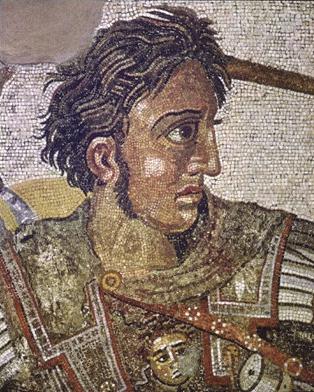
 | PHILIP II AND ALEXANDER THE GREAT |
 |
CHANGES INTRODUCED
- (1) New military technology (brought from Sicily)
New military technology (invented in Macedonia: SARISSA: spear) - (2) Wide use of bribery on friendly parties in Greek poleis
- (3) Corruption of Delphic Council (Philip II makes himself president)
-
(4) The League Against the Persians revived by King Philip (338/7) as a way of 'uniting' the Greeks under himself (as 'hegemon': commander-in-chief) to fight the Persians (at least that's what he said). Forced Greek unity in violation of eleutheria ('liberty').
-
(5) Crusade of Hellenes against Asia (Philip and Alexander): expands the idea of what is Greek and brings Greeks into contact and gives them dominion over many other (older) civilizations
- (6) Colonies of military veterans: urbanization
-
(7) Alexander's policy of intermarrying himself and his chieftains with members of the Iranian aristocracies of the Persian empire (e.g. Alexander himself and Roxane from Bactria/Afghanistan)
-
(8) Alexander's policy of founding new cities (32 ALEXANDRIAS): Greek language, Greek architecture, Greek gymnasium culture, Greek political institutions, but very mixed and mostly non-Greek citizens. The definition of 'Hellene/Greek' is no longer racial, ethnic, national-family, or even cultural in a natural develomental sense. 'Hellene' is a cultural term thereafter, but anybody can be a Hellene by adapting.
-
(9) Appearance in Greek cities of new artifacts, ideas, habits from other civilizations: new interpretations of reality (Aristotle)
-
(10) New religious cults and attitudes change the basic ideas of the Greek polis religion, as well as the meaning of life and death, reward and punishment (dualism of Mesopotamian Zoroastrianism)
-
(11) The breakup of Alexander's empire produces four separate monarchies (Ptolemies of Egypt, Seleucids of Syria-Mesopotamia, Attalids of Pergamum, Antigonids of Macedonia), who interfere in polis politics, to the point of severely damaging their political integrity through intimidation, domination.
See my Alexander the Great Bibliography.
© J. P. Adams Revised: 7/23/1996

