| David A. Gray
Sexual selection and acoustic communication in crickets.
|
![]() |
My research program has two parts, both examining the
evolutionary interplay of natural and sexual selection. The first
part is microevolutionary, and asks questions about adaptation, the second
part is macroevolutionary, and asks questions about speciation.
Microevolution.
| Male crickets use long-range
calling songs to attract females, but those same
songs may also attract predators and conspecific male competitors.
After a female has located a male, the male sings a different type of song, the courtship song. This has been far less studied than the calling song, but is an increased focus of current research. This part of my research involves quantitative genetic, behavioral, and bioacoustic approaches in both the laboratory and the field.
|
Mating in crickets requires female cooperation - she's on top. (photo copyright 2000-2001 by David A. Gray) |
Macroevolution.
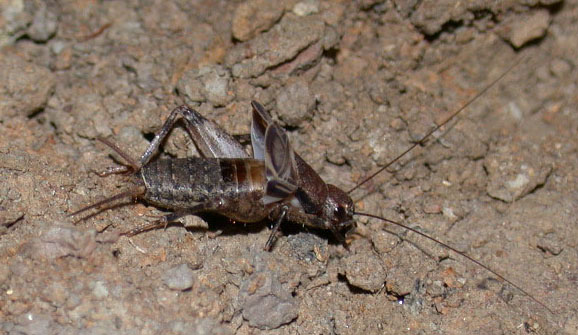
| The field crickets Gryllus texensis and Gryllus
rubens are each others' closest relative, but males can only be distinguished
(by humans that is) by their songs.
Molecular phylogeny of North American field crickets from Huang et al. 2000 Molec. Phylogen. Evol. 17:48-57 |
This portion of my research
examines sexual selection and speciation, specifically the pre-mating isolating
role of male signals and female preferences for those signals.
Work with Gryllus texensis and Gryllus rubens suggests that divergence in male sexual signals and in female responses to those signals played an essential, although perhaps not exclusive, role in the speciation process. Future work, some in progress already, will use primarily molecular techniques to attempt to assess (1) levels of past and/or present hybridization, (2) intraspecific gene flow, and (3) phylogeography as a means of distinguishing allopatric versus sympatric speciation. Other work in progress is examining molecular divergence, courtship song divergence, as well as patterns of sperm precedence in females mated to both conspecific and heterospecific males. |