A Catalogue of Design Influences


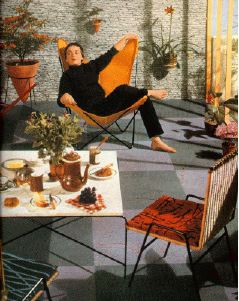
The chair we all grew up with on the patio: the butterfly chair. I have the one from my parent's patio--circa 1955--not one of those cheesy fold up ones you can buy now... No, this is not me, its a pic from a Daily Mail Home Guide from 1954....

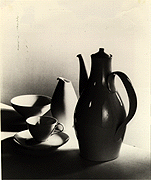
Eva Zeisel's first dinnerware as a refugee in the United States: The MOMA Collection. Pictured is the coffee service.

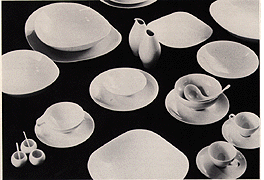
A picture of Zeisel's full service. Who influenced who, Eva Zeisel or Russell Wright?


Some Other Great Spaces


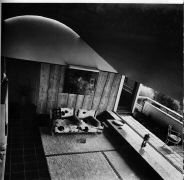
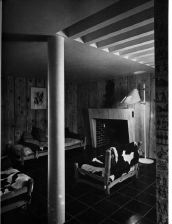
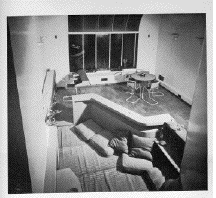
Berthold Lubetkin's Highpoint II Penthouse,London,1938

An emigre member of Britain's most well known prewar architectural firm Tecton, Lubetkin had a hand in the design of the ground breaking Highpoint luxury apartment blocks. Lubetkin created a penthouse apartment for himself on the roof of Highpoint II, finished in 1938. The design of this penthouse remains, today, remarkably fresh, as Lubetkin's interior design foreshadowed the design cliches of the 1950's, with its use of organic form, natural materials, distressed woods and ceramic tiles. Lubetkin's work represented the last days of the elegant, refined urban life of prewar London.


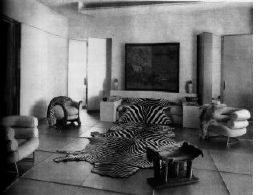
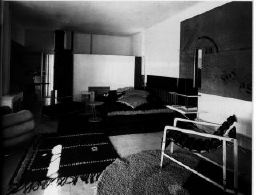
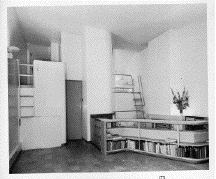
Eileen Grey

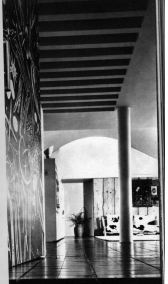
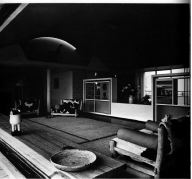
Little known until Peter Adam's comprehensive biography of her life and works, Eileen Grey was a progenitor of the Industrial Chic style of the 1980's. Although not as well know as the work of someone like Pierre Chareau and his Maison de Verre, Eileen Grey's work was every bit as ground breaking. Pictured here, on the left, is the 1933 apartment of Suzanne Talbot, well know Parisian actress and, on the right, the living room space of Eileen Grey's own first house, E 1027, finished in 1929. Although different, the Talbot apartment more obviously luxurious, they both share the innate good taste and sense of refined space which characterised her work. Nearly unknown in her own time, her ideas appropriated by a string of less talented men with whom she shared her artistic vision, Grey lived long enough to see her work exhibited and praised both in her adopted country France and in design circles around the world.


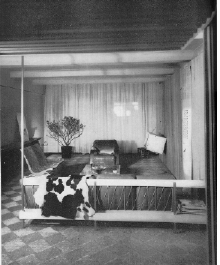
Wells Coates

A relatively unknown British modernist, Coates is best known for his industrial design, most notably the sound studio of the BBC, Great Portland Place. He was a strong advocate of modern design in Britain in the 1930s and took part in the Festival Of Britain of 1951, which shaped post war British design. Pictured here is his flat, designed in 1935. It employed multiple levels and an open plan to accomodate the limited space and zoning requirements of a traditional London row house.


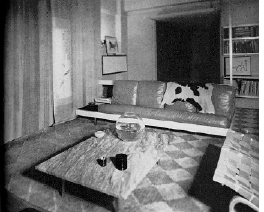
I.M. Pei

I.M. Pei, one of America's foremost modernist architects of the late 20th century, has always been characterized by cool, clear rationalism. This can be seen in one of his earliest architectural projects, his own apartment of the late 1940's. Like some of the other examples above, Pei favored a pristine environment of simple yet refined materials. You can see the influence of both purists like Mies van der Rohe and the traditional elements of Pei's own Chinese culture.


Mies van der Rohe's Barcelona Pavilion, 1929

Thanks to the incredible home page of Matiu Carr, Senior Technician, School of Architecture Property and Planning, Auckland, New Zealand, we have this virtual tour of Mies van der Rohe's greatest architectural achievement.
 
[Main Gallery]


You can send comments to me at csales@csun.edu

Last modified 9/6/00